
Over 33,000 people arrested in Bukele’s crackdown were not listed as gang members
Internal intelligence documents reveal that 36% of those captured during the state of emergency were not profiled as criminals before the measure was implemented
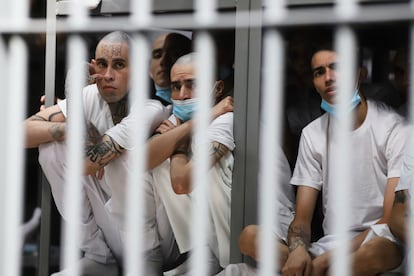
The government of Nayib Bukele has renewed its controversial state of emergency 48 times, promising not to stop until the last gang member is captured in El Salvador. However, official data reveals a significant discrepancy: while intelligence reports identified 58,270 gang members and collaborators at large before the state of emergency was implemented, authorities have arrested 91,628 people as of March 25. This means that more than 33,000 of those arrested (36%) were not previously listed as gang members in police records.
Although various human rights organizations have reported nearly 7,000 arbitrary arrests over the past four years, this is the first time the discrepancy has been documented by comparing official data. The finding stems from a cross-referencing of three internal police intelligence reports with the publicly available number of arrests, practically the only indicator that the Bukele administration keeps publicly accessible.
Reports obtained by this newspaper reveal the true extent of what Bukele and his officials call the “margin of error.” On April 9, 2022, just 12 days after the regime took power, the president admitted that the number of innocent people captured could be as low as 1%, assuring that 85 people would be released shortly, though without specifying the source of this figure. Now, according to police intelligence documents, that margin of error could be as much as 36.4%, or higher.
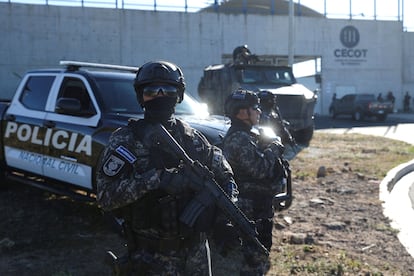
“This new information reinforces a question: what kind of intelligence has been used to detain people during the state of emergency? Our investigations indicate that many people have been arbitrarily detained. We have cases where the police themselves fabricated evidence, used unverified anonymous reports, and even tattoos that had nothing to do with MS-13. In other words, they looked for excuses to arrest people,” says Juan Pappier, deputy director of the Americas Division of Human Rights Watch.
The reports prepared by police intelligence were obtained thanks to a massive leak of National Civil Police (PNC) emails that occurred in late 2022, known as the Guacamaya Leaks and disseminated by the hacktivist group Distributed Denial of Secrets (DDO Secrets). Two former mid-level police officers, speaking on condition of anonymity, confirmed their authenticity.
If the arrest data that the government publishes periodically is accurate, the goal of arresting the last gang member could have been achieved by the end of 2022. Just eight months after the measure began, in November of that year, the Presidential Press Office issued a statement reporting: “In just eight months, the government has managed to capture more than 58,000 gang members and has had 146 days with zero homicides.” However, the arrests continued.
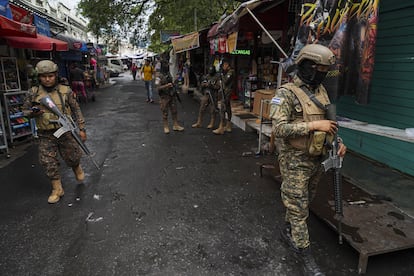
One such case is that of Santos Navarro. In February 2022, a month before the state of emergency began, his name (identification number 02166378-2) was not listed in the MS-13 Gang Database of the National Police. However, on July 6, 2023, police officers raided his vegetable stand in the Santa Tecla market, where he had worked for 11 years. He was arrested and imprisoned in a maximum-security facility on charges of being a front man for MS-13.
The prosecution accused Navarro of being a collaborator with that gang, holding the rank of “paro,” a term used in gang slang to describe those who perform occasional favors without holding any status or power within the organization. His family, however, maintains that his arrest was based not on any investigation, but on a simple anonymous tip. Navarro died in prison a year later. The family claims he died from complications of diabetes and blames the authorities for failing to provide him with medical attention, which resulted in the loss of two toes on his right foot.
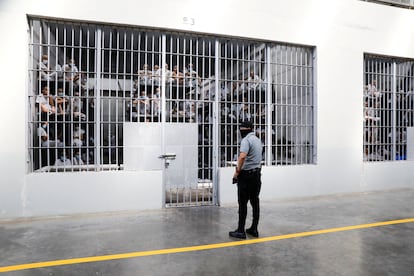
Navarro’s case is not unique. Human rights organizations report that, in four years of the state of emergency, they have documented nearly 7,000 complaints of arbitrary arrests of people not linked to gangs. Of these, nearly 500 have died in state custody before reaching trial, according to the NGO Humanitarian Legal Aid.
Information opacity has become one of the pillars of authoritarianism in Nayib Bukele’s El Salvador, despite transparency and the fight against corruption being his main campaign promises before taking power in June 2019. “All information is classified for seven years. The only place where any data appears is in the legislative decrees extending the state of emergency. But even those figures are questionable: if you compare them month by month, they show inexplicable variations; sometimes they decrease, other times they increase. There doesn’t seem to be any serious handling of information,” says René Valiente, director of research at Cristosal, El Salvador’s leading human rights organization.
The first report obtained by this newspaper, titled “Origin, Current Situation, and Links of Gangs,” dates from March 2021, a year before the state of emergency was declared. The 28-page document was prepared by the PNC’s Investigations Sub-Directorate and the Transnational Anti-Gang Center (CAT), an intelligence unit funded by the FBI and the U.S. Department of Justice since 2007.
On page 15, a table titled “Numerical Situation of Gang Members” breaks down the presence of six gangs: MS-13, MS-503 (a prison splinter group), the two factions of Barrio 18 (Revolucionarios and Sureños), “MS and 18 N/A,” and “Others.” In the section on “Free and Collaborators,” the report counts 34,500 MS-13 members, 22,970 Barrio 18 members, and 800 members of other groups, for a total of 58,270 people linked to gangs outside the prison system.
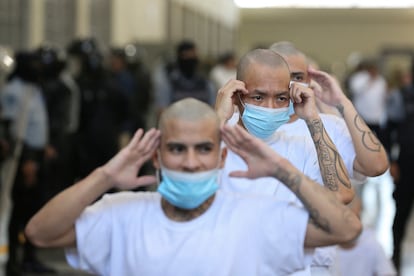
According to this census, the total number of gang members registered with the PNC was 79,556, of whom 21,286 were already in prison. The document clarifies that the number of individuals at large is an estimate, as it does not include minors. In this regard, Human Rights Watch noted in 2024 that, under the state of emergency, the number of detained minors reached 3,319.
Police reports show that by November 2021, the country’s three main gangs were weakened and were reducing homicides in order to request prison benefits from the Bukele administration. One report indicates that by January 2020, the three main gangs had signed a non-aggression pact both inside and outside prisons, and that many gang members were already migrating to Guatemala, Honduras, and Mexico.
Even in the most favorable scenario for the government — that all previously registered gang members have been captured — the data indicates that for every two gang members arrested during the state of emergency, one person with no gang affiliation was detained. In a May 2025 interview with the BBC, Security Minister Gustavo Villatoro stated that at least 4,500 MS-13 gang members alone remained at large. The state of emergency continues to be renewed under the pretext that gang members still need to be apprehended.
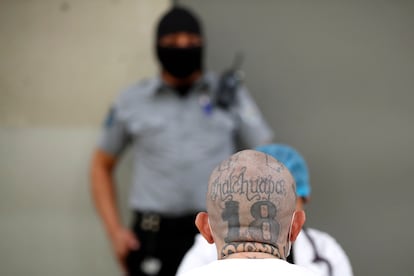
“The dynamics of arbitrary detentions have been denounced by Cristosal since the beginning of the regime. We have a database of 3,808 complaints, of which 3,655 are for arbitrary arrests; that is, in 96% of the cases, the families maintain that those detained do not belong to gangs or have not committed the alleged crimes. We have records of police officers who, upon not finding the person they were looking for, took their father or another relative,” Valiente explains.
“We must not confuse a complaint of arbitrary detention with a request for the discriminatory release of people. Cristosal has never requested a mass release; what we are asking for is a serious review of the cases and, in cases where irregularities have been demonstrated, that the people be compensated,” Valiente added.
Two former mid-level police officers who worked for the force until 2025 confirmed to this newspaper the decline of criminal structures prior to the regime. “The gangs had not only stopped recruiting new members; many were fleeing the country, dying in confrontations, or being arrested. We weren’t facing a strengthened structure, but one in clear decline,” one of the sources explained.
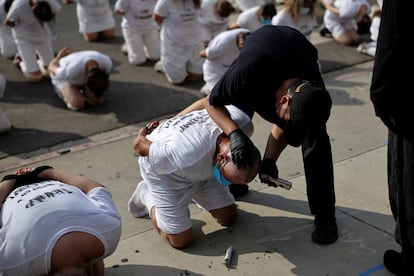
Their testimonies align with the report “Current Situation of Gangs in El Salvador,” from November 2021. The document details how gang leaders reported to the “ranfla” (leadership) about a lack of personnel and the loss of territorial control. However, it warned that the gangs compensated for this weakness by instilling terror through recruits, collaborators, and family members, even without having “homeboys” (full members) in the area.
Despite this diagnosis of structural weakness, the Bukele administration maintains its goal of reaching 100,000 arrests. With more than 91,000 arrests to date — 2% of the adult population, or one in every 50 Salvadorans — the government asserts that it will not lift the crackdown until it captures “the last gang member,” accepting as collateral damage the imprisonment of thousands of innocent people.
Sign up for our weekly newsletter to get more English-language news coverage from EL PAÍS USA Edition









































