
Japan embarks on largest reorganization of intelligence services since World War II
The new model foresees the creation of a National Intelligence Council that centralizes management under the direct command of the prime minister
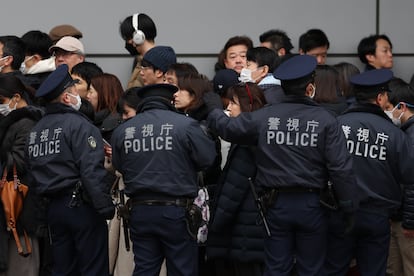

Japan has just taken the first step toward the biggest overhaul of its security services since the end of World War II: this summer it will unify, under a National Intelligence Council chaired by Prime Minister Sanae Takaichi, information scattered across ministries and security forces that until now had no legal obligation to share it. The second step, scheduled for 2027, will create an external intelligence agency — a tool Tokyo has not had since Allied forces dismantled its military apparatus at the end of the war.
The reform, passed by parliament in May, creates a National Intelligence Agency that will collect and analyze information produced by the police, public security services, and the foreign and defense ministries, then forward it to the National Intelligence Council, which will set priorities and make policy decisions. When proposing the measure, Takaichi — an ultraconservative leader who has made Japan’s rearmament the core of her political agenda since taking office in October 2025 — cited the need to “protect national interests in the most severe and complex security environment since the postwar period.” The reform has roots that go far beyond the current geopolitical context.
Japan’s intelligence system is one of the most fragmented in the developed world and has spent decades accumulating the consequences: foreign spies operating freely in the country because of the absence of anti-espionage laws, repeated kidnappings of citizens that went undetected, and diplomats caught in international crises who depend on intelligence provided by other countries.
For Sanshiro Hosaka, a researcher at the International Centre for Defence and Security in Tallinn, Estonia, one of Japan’s weak points against foreign espionage is “the lack of legal authority for administrative interception that prevents detecting or prosecuting them before they leave the country.” In a video call, the expert cites the label “spy paradise,” popularized after the case of Stanislav Levchenko, a former KGB officer who defected in 1979 and told the U.S. Congress about how easy it was to recruit collaborators and extract secrets in Japan, with no agency having the authority or legal duty to coordinate a response.
Espionage inside Japan has gained another nationality, Chinese, Hosaka continues, explaining that Beijing invests heavily in intelligence and that its agents — like the Soviets in the past and more recently the Russians — have for decades used student covers to extract technological secrets from Japanese universities and laboratories. Given the current demographic contraction and limited resources, the researcher says the priority is “optimizing through integration between agencies.”
Although Japan hosts thousands of U.S. troops on its soil and has access to CIA intelligence under the 1960 Security Treaty, North Korea kidnapped Japanese citizens between 1977 and 1983 off its coasts — and even in Europe — to train spies it later infiltrated into Japan. In September 2002, then-prime minister Junichiro Koizumi traveled to North Korea’s capital, Pyongyang — the first Japanese leader to do so — and secured an acknowledgment of the abductions from then-supreme leader Kim Jong-il, as well as the return of five of the victims.
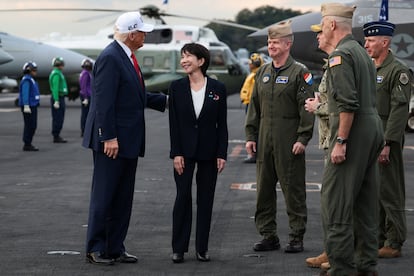
The families of 12 other abductees met with U.S. President Donald Trump during his visit to Tokyo in October 2025 to ask him to intercede with Kim Jong-un, the son of the former North Korean leader, whom the Republican had met three times during his first administration.
If the North Korean abductions revealed Japan’s vulnerability to hostile operations on its territory, the 1996 attack by the guerrilla group Túpac Amaru Revolutionary Movement (MRTA) on a party of 600 guests at the Japanese ambassador’s residence in Lima exposed a deeper shortcoming: a country that managed emergencies abroad without its own intelligence.
“The guerrilla leader Néstor Cerpa Cartolini told me his group was planning to attack the U.S. embassy residence to demand the release of their political prisoners,” says Terusuke Terada, a retired diplomat and Japan’s observer in negotiations to free the hostages. “But U.S. security was perfect and Japan had organized a party with little security and many guests,” adds the then-ambassador to Mexico, who was urgently sent to Lima because of his knowledge of Latin America and his command of Spanish.
Terada’s account of the 126 days of negotiations reveals the Japanese government’s total dependence on Lima, which rationed all information. “One of the guerrillas, El Árabe [the alias of Roly Rojas Fernández], told me they were digging a tunnel,” Terada continues. “He said he heard the noise of underground work.”
Because the Japanese government advocated a peaceful resolution, the Tokyo envoy asked then-president Alberto Fujimori for explanations, but his request was ignored. He could only confirm the tunnel’s excavation thanks to an official from Japan’s National Police Agency who was watching the residence’s exterior and noticed the accumulation of soil. “After the Lima crisis I realized Japan lacked a system, a centralized intelligence service institution,” notes the former diplomat, who does not hide his skepticism about the current reform. He points to the scarcity of trained officials and argues that the key is learning Chinese, Korean, and Russian.
Fear of arbitrary surveillance
Although the current reform was approved by a parliamentary majority on May 27, opposition parties fear it could be used by the government to expand surveillance powers without democratic checks. Makoto Oniki, a lawmaker from the opposition Constitutional Democratic Party (CDP), questioned during a parliamentary session the absence of guarantees that the new intelligence agency will not veer toward arbitrary surveillance practices.
A study by the Japan Institute of International Affairs speaks of a “deep institutional aversion to strong intelligence bodies, inherited from the memory of wartime repression and the suppression of civil liberties.”
Hiroshi Ito, an editorial board member of the liberal Asahi Shimbun newspaper, warns that even if current investigative powers are retained, the agency’s expansion increases the likelihood of rights violations or invasions of privacy. For that reason, he adds, a mechanism of third-party oversight, starting with parliament itself, was firmly demanded. However, that requirement was omitted from the final text.
Terada, the former diplomat who spent four months in Lima as an observer with no more information than Fujimori decided to reveal, closes the conversation with a statement that sums up more than half a century of inaction: “The time has come for Japan to wake up.”
Sign up for our weekly newsletter to get more English-language news coverage from EL PAÍS USA Edition









































