
Former Spanish PM Rajoy clouds Spain-France semifinal with ‘racist’ article
The World Cup match takes on new meaning after a column in which the conservative politician said France is a team ‘without Frenchmen’
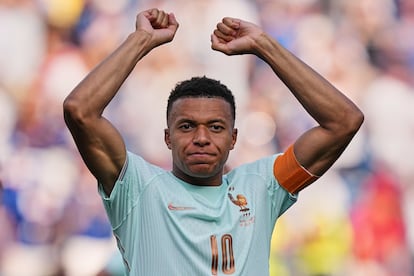

France has grown accustomed in recent weeks to living on the edge. To an endless “all or nothing” scenario that will play out again this Tuesday, July 14, when the country’s National Day is celebrated against the backdrop of a World Cup semifinal against Spain. Two neighbors who view each other with suspicion, with a long list of historical grievances between them, will be playing for more than just a spot in the final. It will be either the culmination of national euphoria — in which Spanish Prime Minister Pedro Sánchez will participate — or the bitterness of defeat, even if it takes place over 3,000 miles away.
As if all this weren’t enough, former Spanish prime minister Mariano Rajoy, in an article published Saturday in El Debate, sparked a diplomatic row with remarks that France considers “racist” and “ignorant,” according to French PM Sébastien Lecornu’s office.
On Tuesday night, France will play a decisive match in an atmosphere strained by extreme heat and the memory of the Nice attacks, in which 86 people died 10 years ago — an event that has dampened celebrations that could be further overshadowed by a defeat. But on the eve of July 14 — the national holiday commemorating the Storming of the Bastille in 1789 and a supposedly egalitarian Republic that champions fraternity among its citizens — it was Rajoy who stirred up the country and the political class. He did so, moreover, by stoking old racist impulses associated with Jean-Marie Le Pen’s National Front when he questioned the legitimacy of certain players on the French national team based on the color of their skin or their religion.
“It would be nice to find good players who were French,” Le Pen said 30 years ago. “They have a top-level squad. That said, they don’t have any French players,” Rajoy wrote on Saturday.
The xenophobic claim also ignores the fact that Spain has similar cases among its squad, such as Lamine Yamal or Nico Williams. Moreover, one could infer that France’s current interior minister, Laurent Nuñez (descended from Spaniards), the former mayor of Paris, Anne Hidalgo (born in San Fernando, Cádiz), or the former prime minister Manuel Valls (born in Barcelona) are not French either. But they are white. That is the only difference.
Valls, of all people — hardly someone suspected of being lax on integration issues — responded as follows: “It’s not a quip; it’s a confession. Because what he thinks he doesn’t see on that team aren’t nationalities. They’re skin colors.”
“Sometimes in Spain, people are surprised that there are players in France who come from, or are the children of, former colonies. I always reply that they’re French — sometimes more so than I am, because they were born here,” he says over the phone. “But it’s surprising that a former prime minister, in a written article, could say that out of ignorance and not realize that it’s pure racism. Jean-Marie Le Pen used to say that many years ago, but he was clever and malicious: he did it to provoke. That’s not the case here.”
Valls also recalls how in the 1980s the French team was made up of the sons of Spaniards, like Luis Fernández, or Italians, like Michel Platini. “There were Poles, Algerians, sons of French workers. Football is often a mirror of the working classes in our countries. The same happens in the U.S., where it can be seen in the NBA or NFL. Sport is chosen as a social elevator.”
Rajoy’s words, which even Marine Le Pen’s National Rally (RN) would not dare utter today, run headlong into republican integration principles on July 14, the last National Day Emmanuel Macron will celebrate as head of state.
France’s political class, including five members of the cabinet led by Lecornu, rushed to denounce Rajoy’s column, which the conservative Popular Party in Spain was quick to describe as “sarcastic.” The overseas territories minister, Naïma Moutchou, denounced: “With each victory of Les Bleus the same obsessions and racist insults resurface. They are not mere slips; it is methodical, normalized hatred toward France and what it represents.” Foreign Minister Jean-Noël Barrot recalled that “France has no skin color.” “Any claim to the contrary is stupidity, racism, or a combination of both,” the head of diplomacy said, bewildered by the lack of moderation from a former prime minister.
The French national team has functioned for decades as a mirror of society and of that social elevator through sport that Valls describes. Also of the colonial past and the traumas that accompanied those countries’ independence. Its victories are not interpreted solely as sporting successes, but as moments of collective affirmation, a portrait of the social and cultural moment that began to change clearly with the team that won the 1998 World Cup, made up largely of children of that colonization: Zinedine Zidane (a Marseille native, son of Algerians), Thierry Henry (born in France, son of a mother from Guadeloupe and a father from Martinique), David Trezeguet (born in France, son of Argentines), Lilian Thuram (from a Guadeloupean family) or Marcel Desailly (born in Ghana, but integrated into France from a very young age).
The coach and former Franco-Spanish player Luis Fernández, himself an example of what Rajoy speaks about, believes “the article is a lack of respect toward the team and French society.” “It would have been better if he had kept quiet,” he tells this newspaper by phone.
The timing was not good. Franco-Spanish relations suffered a new setback in the Spanish Senate last week when the PP and the far-right party Vox blocked in the upper house the Treaty of Friendship and Cooperation between the two countries signed in 2023, against which they have filed a preliminary constitutional challenge. “They are sabotaging, with an absurd constitutional challenge that exists only in their minds, the Treaty of Friendship and Cooperation with France; they make extremely dangerous, hurtful statements toward the French national football team […]; they clearly position themselves as an anti-French party against France,” criticized Spain’s foreign minister, José Manuel Albares.
Every year on July 14, the question arises: What does it mean to be French? And on the soccer field, on the other side of the Atlantic, some answers to Rajoy’s article might be found. At 9:00 p.m., when the ball starts rolling, France will be caught between two conflicting emotions: the promise of that time-honored collective celebration and the awareness of a social divide — but also of how its society has evolved. This year, however, the celebration will be put on hold until, around midnight, the match’s result is known.
Sign up for our weekly newsletter to get more English-language news coverage from EL PAÍS USA Edition









































