
United States and Iran return to open war after a week of confrontations in Hormuz
Attacks on tankers kill one sailor and leave eight wounded as conflict threatens to spread again to the Red Sea and Iraq
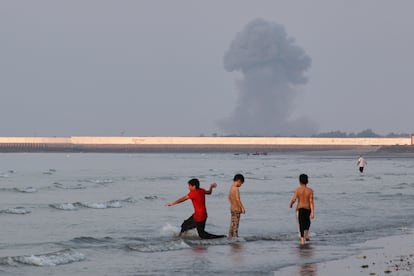

The United States and Iran have returned to open warfare after a week of bombings and mutual accusations of breaches of the ceasefire agreement signed on June 17. Notably, U.S. President Donald Trump has notified Congress that his country is again at war with Tehran. In the early hours of Tuesday, Washington bombed numerous Iranian towns and the Islamic Republic struck U.S. interests in neighboring countries as well as two vessels in the Strait of Hormuz — where a sailor died — but the conflict also threatens to spread again to the Red Sea and to Iraq.
U.S. Central Command said in a statement that it “successfully struck” military targets in Iran, “including Bushehr, Chabahar, Jask, Konarak, Abu Musa and Bandar Abbas,” using “precision munitions against Iranian coastal defense systems, missile and drone sites, and maritime capabilities” to “degrade Iran’s ability to attack commercial shipping.” The locations named are on Iran’s southern coast or are islands in the Persian Gulf where major commercial ports, oil facilities and, in the case of Bushehr, the country’s only civilian nuclear power plant are concentrated.
Iranian media reported that at least four people were injured in Omidiyeh (Khuzestan province). Since U.S. forces resumed strikes on Iran on the night of last Tuesday, at least 20 people — both civilians and military personnel — have been killed and more than 100 wounded, according to the Health Ministry.
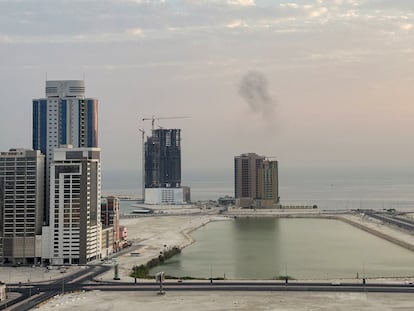
The Islamic Revolutionary Guard Corps said it had attacked U.S. military targets in Jordan and the U.S. Fifth Fleet base in Bahrain. “We struck the U.S. enemy’s facilities with ballistic missiles at a base occupied by an army of child killers and thus punished the American criminals for their actions,” the paramilitary force said in a statement. Jordan said it had intercepted four missiles launched toward its territory.
The UAE Ministry of Defense condemned what it called Iran’s “shameless attack” on two tankers linked to the country. An Indian sailor was killed in those strikes and eight others — two Ukrainians and six Indian nationals — were wounded, four of them seriously. The ministry’s statement said the offensive “constitutes a serious violation and a breach of international law.”
Brig. Gen. Hossein Mohebi, the Revolutionary Guard’s spokesman, justified the strike by saying the vessels had violated the closure of the Strait decreed by Iran over the weekend. “The two offending supertankers were lured by the U.S. into using that route and to turn off their navigation systems. They ignored repeated warnings from the Strait of Hormuz Security Center and chose to pass through the mined route, so they were struck and disabled,” he said. India summoned Iran’s ambassador in New Delhi to officially protest the attack.
But the conflict threatens to spill beyond the Strait of Hormuz. Yemen’s Houthi government, allied with Iran, said it had fired on Abha airport in Saudi Arabia after Sana’a airport was bombed on Monday by the rival Aden government — backed by Riyadh — while a plane arriving from Tehran carrying a Houthi delegation returning from the funeral of Iran’s Supreme Leader Ali Khamenei was landing.
The Houthis have also threatened to resume attacks on vessels in the Bab el-Mandeb Strait, which connects the Red Sea to the Gulf of Aden and the Indian Ocean and is therefore vital to global trade. During the most intense phases of the U.S.-Israeli military offensive against Iran in March, the Houthis began attacking ships in the area, forcing many shipping companies to sail around Africa.
Also overnight, a base in Iraq belonging to the Kurdish-Iranian armed group PAK was attacked, one of its leaders, Rebaz Sharifi, reported. In March and April, many bases of these groups in northern Iraq were attacked by Iran and by pro-Iranian Iraqi militias after the United States, under Israel’s influence, considered them as a potential tool to launch a ground invasion of Iran.
The return of open war has pushed oil prices to this month’s high, rising from around $70 a barrel for Brent crude to nearly $85 on Tuesday.
Sign up for our weekly newsletter to get more English-language news coverage from EL PAÍS USA Edition









































