
Iran’s ‘mosquito fleet’ brings guerrilla warfare to the Strait of Hormuz
The capture of two large ships by Revolutionary Guard speedboats serves as a reminder of their crucial role in blocking the strategic maritime passage


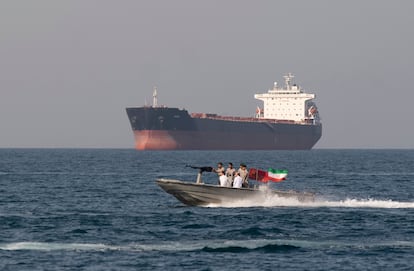
“Iran’s navy is laying at the bottom of the sea, completely obliterated — 158 ships” Donald Trump boasted on his social media account, Truth, on April 13. In the same message, the U.S. president continued: “What we have not hit are their small number of, what they call, ‘fast attack ships,’ because we did not consider them much of a threat.” These small boats belonging to the naval force of Iran’s powerful parallel army, the Revolutionary Guard, attacked three large container ships on Wednesday. Two of them were forced to head to Iranian ports for allegedly trying to pass through the Strait of Hormuz without the Islamic Republic’s permission.
As the capture of those two merchant ships reminds us, these boats, capable of launching missiles and drones, are actually considered a crucial weapon in Iran’s hands to control the strait, the maritime artery through which, in normal times, 20% of the world’s oil flows, in addition to other vital raw materials.
Trump’s assertion is probably true regarding larger vessels. It is estimated that the conventional Iranian Navy has been 90% destroyed. However, Tehran does not need those sunken vessels the Republican alluded to in order to control the Strait of Hormuz, Iranian political scientist Vali Nasr asserted in a recent interview with this newspaper. The fears of tanker owners — and, above all, insurers — are enough to deter many ships from attempting to cross the strait. Tehran also does not need frigates to deter those who venture into those waters. It is sufficient to use “drones, mines, and cheap weaponry,” explained Nasr, a former Iran advisor to the Barack Obama administration. Or, indeed, speedboats.
Iran not only has two armies — the regular military and the Revolutionary Guard — but also two navies. One is the traditional fleet, with frigates and submarines. The other is the naval force of Iran’s parallel armed force, which has some 20,000 personnel, according to an analysis by the Gulf International Forum, and which has traditionally favored small, fast vessels.
“The Islamic Revolutionary Guard Corps (IRGC) uses a ‘mosquito fleet’ instead of large warships,” confirms Saeid Golkar, a professor of political science at the University of Tennessee in Chattanooga, via text message from the United States. This expert on the Revolutionary Guard describes how these vessels operate “in swarms, approaching at high speed from different directions. In a narrow area like the Strait of Hormuz, this puts significant pressure on U.S. naval forces.”
The Revolutionary Guard’s fast patrol boats thus constitute the maritime spearhead of a specialty the country has been cultivating for decades, precisely in anticipation of an attack by the United States and/or Israel: asymmetric warfare, designed to counter a conventionally superior enemy. In the case of the IRGC, the specialist explains, they carry out “a form of maritime guerrilla warfare focused on harassment, disruption, and increasing the cost of U.S. operations, rather than trying to win a traditional battle.”
It is difficult to know how many of these vessels Iran possesses. It is believed that there are between several hundred and 1,500, although, contradicting what Trump stated days later, the Chairman of the Joint Chiefs of Staff, General Dan Caine, had asserted on April 8 that “half” of the total number — which he did not specify — had been destroyed.
These are boats of between 14 and 17 meters in length that move at high speed and are therefore difficult targets to detect by radars and satellites, and even more difficult to hit, especially if they attack in large numbers to saturate the defenses of enemy ships.
In this war, now paused by the fragile ceasefire that Trump extended on Tuesday, the Revolutionary Guard is also combining its maritime and air strategies, designing attacks with speedboats accompanied by Shahed-series drone strikes.
Shallow waters
The Strait of Hormuz is a narrow, shallow waterway, 20 miles wide at its narrowest point, so small that Iranians know it like the back of their hand. It is relatively easy to block, especially since oil tankers and container ships must navigate through the few channels where the water is deeper.
The boats of the “mosquito fleet” are easily concealed along Iran’s more than 1,050 miles of coastline in the Persian Gulf and the Sea of Oman. This is not only due to their size, but also because the Revolutionary Guard has constructed fortified and/or underground bases for them. On March 11, a video broadcast by Iranian state television from January 2025, purportedly showing a secret underwater military base, was circulated on X. It alludes — emulating Tehran’s “missile cities” — to an underground “boat city” on Iran’s southern coast.
The Trap 🚨🇮🇷
— Gandalv (@Microinteracti1) March 11, 2026
The Iranian regime has released footage of underground naval tunnels packed with fast-attack boats, anti-ship missiles, and naval mines.
Something tells me they did not build this last week.
The Islamic Republic has had forty years to prepare for this moment.… pic.twitter.com/QaA1e6DAqY
These boats reach speeds exceeding that of a torpedo in some cases: between 40 and 70 knots (46 and 80 mph), or even 110 knots (around 125 mph) for the Heydar 100 model, unveiled in January 2025. The Heydar 100 is equipped with two anti-ship cruise missiles, likely derived from the Chinese-developed Nasr 1, which have a range of up to 50 kilometers (31 miles), according to the Defence Security Asia website. Without its armament, the Heydar 100 weighs only nine tons. It is designed for hit-and-run operations.
U.S. vessels lack their speed and agility and cannot venture into the shallow waters that those boats can navigate.
The U.S. military, of course, possesses rapid and agile weaponry. For example, Apache attack helicopters, which are being used against these Iranian vessels, as confirmed by General Caine. However, when confronting the Revolutionary Guard boats, the United States faces the problem of what military experts call “cost asymmetry.”
The Iranian boats are armed with heavy machine guns and, in some cases, anti-ship missiles, according to U.S. congressional reports. “Even if they can’t destroy a major warship, they can damage it, slow down operations, and constantly threaten escalation,” Golkar points out.
They can also, theoretically, shoot down an Apache. An Arleigh Burke-class destroyer — like those in the USS Abraham Lincoln carrier strike group, stationed at the entrance to the Strait of Hormuz — costs about $2.7 billion; a state-of-the-art Apache can cost over $100 million, while the Iranian patrol boats are worth only a few tens of thousands of dollars.
“Its objective”, says Golkar, is “to create chaos, inflict pain, and disrupt the flow of energy and goods, putting pressure on the West and the global economy”.
🚨🇮🇷🇺🇸 PERSIAN GULF ALERT
— Defence Journal (@Defence_Journl) February 24, 2026
Iran’s “mosquito fleet” is flexing as U.S. carriers move in. Over 1,500 fast, small boats patrol the shallow Gulf, with 250+ armed with missiles like Nasr, Kowsar, Ghader, Zafar, and the long-range Abu Mahdi.
Mini submarines, hidden coastal bases, and… pic.twitter.com/tOBxX0e4yd
The design of these vessels, as well as the “swarm saturation” strategy, aligns with the military doctrine of the Revolutionary Guard, developed since the war with Iraq (1980-1988) and promoted since the U.S. invasion of that Arab country in 2003. A crucial part of this doctrine is the use of cheap weapons in attacks that, combined, generate high defensive costs for the enemy, such as risking helicopters that cost hundreds of millions of dollars, or expending expensive interceptor missiles to stop Iranian missiles and drones.
Taken together, this “asymmetric strategy” allows the Revolutionary Guard to “seriously challenge a much more powerful navy,” says Golkar, who points out that some of these boats are also “equipped for kamikaze-type attacks.” The professor emphasizes how “the concept of martyrdom plays a crucial role” in this matter, as it “reduces deterrence” and makes Iranian tactics “more unpredictable.”
Even with the largest U.S. military force attempting to open the Strait of Hormuz, that and other strategies deployed by Iran have led to a situation in which “it will take weeks to reach a level that allows for safe operation in the strait, and even then, a significant portion of Iran’s [military] assets will remain intact,” Parzin Namidi, an Iranian defense expert at the Washington Institute for Near East Policy, told The New York Times.
Sign up for our weekly newsletter to get more English-language news coverage from EL PAÍS USA Edition









































