
Trump extends ceasefire until Iran presents a proposal and talks conclude ‘one way or the other’
The US president prolonged the truce with Tehran hours before it expired, although Washington will maintain the naval blockade of Hormuz
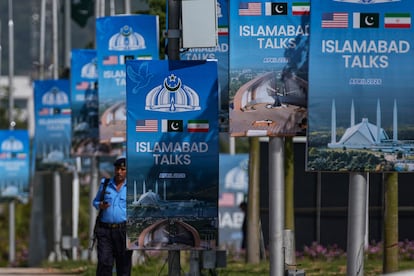
Just as he did 14 days ago when he announced the ceasefire with Iran, U.S. President Donald Trump waited until Tuesday, when tensions were at their peak, to announce its extension. A few hours before the ceasefire was set to expire and with the mediating country, Pakistan, still awaiting the arrival of the U.S. and Iranian negotiating delegations, Trump justified the decision by citing internal divisions within Iran. He extended the ceasefire until Tehran presents Washington with “a unified proposal” and until “discussions are concluded, one way or the other.” He made it clear, however, that he would maintain the naval blockade of the Strait of Hormuz in the meantime.
The announcement comes amid concern and, above all, confusion over the possibility of a last-minute deal or extension that would avert an escalation that had been gaining momentum, following the negotiators’ double snub of Pakistan and the boarding of a massive Iranian oil tanker on the high seas by U.S. forces. Trump had stated on Tuesday that he was “prepared” to resume the war if the deadline passed without an agreement, and Tehran accused him of “piracy.”
The truce was initially scheduled to end in the early hours of Wednesday morning. Late on Tuesday, Iranian Foreign Ministry spokesman Esmaeil Baghaei told state television that they had not yet decided whether or not to attend the talks in Islamabad. Meanwhile, U.S. Vice President J. D. Vance, who was scheduled to lead his country’s delegation, postponed his trip indefinitely.
With central Islamabad under heavy guard and a luxury hotel cleared out to host talks that no one attended, Information Minister Attaullah Tarar was still awaiting “a formal response” regarding the “crucial” participation of the Iranian side. The deputy communications director of Iran’s presidential office added fuel to the fire by accusing the enemies of the Iranian nation of demanding “inaction and surrender.”
Uncertainty
In Washington, the day was marked by uncertainty. The U.S. capital awoke assuming that Vance was about to leave or already en route to Islamabad. Later, he was seen arriving at the White House for some “working meetings,” while it emerged that the plans of the other two U.S. negotiators, Jared Kushner and Steve Witkoff, Trump’s son-in-law and special envoy to the Middle East, respectively, had changed. They would no longer fly from Miami to Europe and then on to Pakistan, but were instead heading to Washington, presumably to meet with Trump.
A couple of hours later, the White House put Vance’s trip on hold, given that Iran, according to administration sources, was not meeting Washington’s demands. Tehran warned that its negotiators would not depart until they were certain they would meet with the vice president in Pakistan.
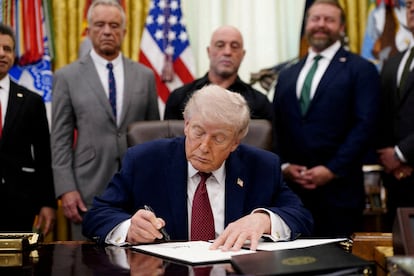
The U.S. president gave an interview early in the morning to CNBC, in which he once again engaged in the kind of confusing speech he has been so diligently cultivating in recent days. On the one hand, he saw a “great deal” as being closer than ever, but he also indicated that, should the talks fail, the United States was ready to return to the language of arms. He maintained that Washington was in a strong negotiating position and rejected extending the two-week ceasefire with Iran, which he himself established on April 7 and subsequently extended. “Well, I don’t want to do that. We don’t have that much time,” Trump stated when asked about the possibility of extending the truce.
Even that part wasn’t entirely clear. The U.S. president issued the original ultimatum at 6:32 p.m. EDT, but it became evident on Tuesday that this wasn’t the deadline that would apply. Iranian state television mentioned midnight, London time (GMT). Adding to the confusion, Pakistan’s information minister offered another option: “4:50 a.m. PST” — the abbreviation for U.S. West Coast time — even though he was referring to Pakistani time (12:50 a.m. Wednesday GMT, 7:50 p.m. in Washington).
Regional escalation
The tense wait kept the Middle East on edge. Abdelmalik al-Houthi, the leader of the Houthis — the Yemeni rebel group that joined the conflict on March 28 in support of Iran, launching targeted missiles at Israel — stated in a televised address on Tuesday that renewed clashes were inevitable. Al-Houthi considered the escalation in the region “possibly high” as the end of the “fragile” ceasefire approached, which he described as a pause “within a continuous conflict with the enemy.” “Our course is escalation if the enemy escalates and returns to aggression,” he warned. Although they did not do so this time before the ceasefire, the Houthis have the capacity to attempt to block Red Sea shipping lanes again, as they did during the Israeli invasion of Gaza, which began in 2023.
Israel initiated the current conflict, along with the U.S., but is not directly participating in the talks and is adhering to the ceasefire. Now, it is also committed to a ceasefire in Lebanon, enforced by the United States, after its initial exclusion from the truce further slowed down progress in the negotiations, already hampered by the stand-off in the Strait of Hormuz.
On Tuesday, Israeli Prime Minister Benjamin Netanyahu (who opposes the truce and wants to resume attacks, targeting civilian infrastructure such as power plants) used a speech in Jerusalem on Memorial Day to reiterate his widely criticized and baseless comparison between the Holocaust and Iran’s intentions. He launched the war against the Tehran regime on February 28, in conjunction with Washington, because it was “planning another Holocaust,” like the one the Nazis and their allies committed — exterminating approximately six million Jews by the end of World War II in 1945.
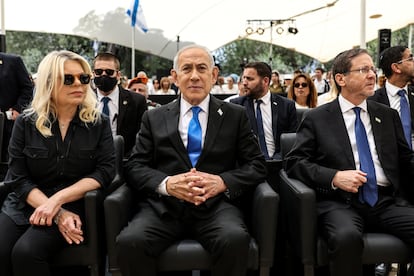
Iran does not possess the nuclear weapons that Israel does (it is the only country in the Middle East not covered by the Nuclear Non-Proliferation Treaty), it wasn’t even enriching uranium in the preceding months, and it hadn’t been threatening to attack Israel. Netanyahu, however, has asserted that Iran was “plotting” to destroy the country “with nuclear bombs and thousands of ballistic missiles.”
“Had we not acted against the existential threat, had we not acted with determination and daring, the names of the death sites Natanz, Fordow, Isfahan might have joined the names of the death camps of the Holocaust: Auschwitz, Majdanek, Treblinka,” Netanyahu said on Tuesday. Both the Israeli prime minister himself and Trump claimed, after airstrikes against Iran in June 2025, to have destroyed or severely damaged those nuclear facilities.
Sign up for our weekly newsletter to get more English-language news coverage from EL PAÍS USA Edition









































