
Sea of plastic: Global study finds thousands of microparticles even in the Mariana Trench
These synthetic materials have now become part of both the life and carbon cycles, from the surface to the deepest parts of the oceans
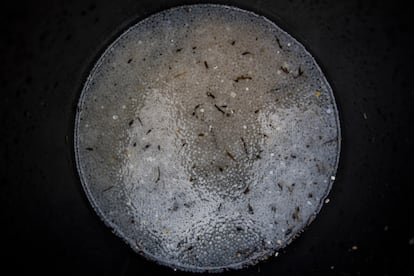

Plastic is like air. Vital to modern societies, it’s everywhere. But once its useful life ends, as sunlight, wind, and erosion break it down, it ends up in the ocean. Its supposed buoyancy, supported by some studies, led to the belief that the biggest problem was on the surface. However, a new study published in Nature, drawing on hundreds of sampling stations placed at various depths, reveals that microplastics are now omnipresent — from beaches to the high seas, from the surface to the ocean’s deepest layers. Researchers have also discovered that the carbon in these polymers is becoming part of the ocean’s natural carbon cycle, with consequences that remain unknown.
Hundreds of studies have been conducted on the presence of microplastics in the oceans. Now, a group of researchers from four continents has compiled data from more than 1,200 of these studies to review their results and supplement their own research. They found great variability in the results, but noted that most studies relied on surface-level trawl nets and few examined plastic presence throughout the entire water column. That’s exactly what this team did — gathering data from the past decade from nearly 2,000 stations at varying depths. This allowed them to validate models to estimate how much plastic is in the ocean and where it accumulates.
“We classified microplastics into two categories, small [1–100 µm] and large [100–5000 µm], with small microplastics predominating numerically,” says Shiye Zhao, a researcher at the Japan Agency for Marine-Earth Science and Technology, in an email.
The values (µm) refer to micrometers or microns, one-thousandth of a millimeter. “Due to their tiny size, small pieces sink very slowly and tend to distribute more evenly in the water column compared to larger macroplastics and microplastics,” he adds.
In fact, the researchers observed that larger pieces build up at the surface or the seafloor, while smaller ones are less affected by physical ocean barriers. “As a result, small microplastics remain suspended in the water column for longer, increasing the likelihood of biological exposure,” Zhao adds.
The researchers also found great variability depending on the region of the sea. Continental shelves showed a median of 500 particles per cubic meter (m³) — 30 times higher than the 16/m³ found in the open sea. The team says that this makes sense due to their proximity to pollution sources.
However, along the coastlines, concentrations drop drastically — by as much as 1,000 times — as depth increases, only to rise again until peaking at the depth of the seabed.
“The marked decrease in microplastics is likely due to the high mineral and biological productivity in coastal waters, which accelerates the sinking of aggregated microplastics,” Zhao says. “Diatoms, abundant in coastal ecosystems, produce siliceous frustules [cell layers] that are often found on the surface of microplastics, which increases their ballast and facilitates their sinking,” he adds. This and other processes, such as calcite precipitation, “favor the vertical transport of microplastics in coastal waters,” he concludes.
In the open ocean, the study confirms massive microplastic accumulation in subtropical gyres — large rotating ocean currents like the North Pacific or South Atlantic Gyres. The median concentration is several hundred particles per m³, but some sites measured over 10,000, although they do not create so-called plastic islands.
“Plastic islands don’t exist. If we travel to the convergence zones of the subtropical gyres, where these famous islands are, you won’t see anything. You might see more bottles, bags, and other more buoyant plastics, but you won’t see accumulated masses of plastics,” says Patricia Villarrubia Gómez, an expert in plastic pollution and the impact of the plastisphere at the Stockholm Resilience Centre in Sweden.
“The situation is bad enough without the need for exaggeration,” she adds. Furthermore, exaggerations distract from the real issue, she warns.
“Plastics are made from fossil fuels and chemicals [also from fossil fuels] that are hazardous to health. And the only real way, from a scientific [systemic] perspective, to address microplastic and plastic pollution of all sizes is to significantly reduce their production,” says Villarrubia, who was not involved in this study.
The distribution of microplastics at different depths does not follow the gradual pattern observed along coastlines. For instance, researchers found 1,100 particles per cubic meter between 100 meters — the maximum depth reached by sunlight — and 270 meters along an imaginary north–south transect in the Atlantic. In the Arctic, concentrations exceeded 2,500 particles per cubic meter, and in the Pacific’s Mariana Trench, at depths of up to 6,800 meters, levels reached as high as 13,500.
This irregular distribution is influenced by pycnoclines — layers of water with higher density caused by temperature, salinity, or both — where larger microplastic particles can become trapped. The median concentration throughout the entire water column was 205 particles per cubic meter.
The study identified polymers with up to 56 different formulations. Although the industry has developed hundreds of ways to combine monomers (molecules), the vast majority of microplastics originate from just seven types of polymers — such as polyethylene and polystyrene — all of which are found in the ocean. These long chemical chains can contain nearly 16,000 different chemical substances, but one element appears consistently: fossil-derived carbon. The deep-sea analysis revealed that up to 5% of the carbon present is now of plastic origin.
Aron Stubbins studies the carbon cycle at Northeastern University in the United States. The circulation of this element is fundamental to life, and plastic may be disrupting it.
“The situation is similar to that of human health: we are rapidly discovering that plastics are present in our blood, brains, and newborns. However, we are not yet fully aware of the health problems caused by our exposure to them,” recalls Stubbins, senior author of the study published in Nature. “In the oceans, we are also discovering the extent of plastics. As we become aware of their prevalence, we are starting to consider its potential impact on marine life and the oceanic carbon cycle.” Aron Stubbins’ work was supported by the U.S. National Science Foundation (NSF) Directorate for Geosciences Division of Ocean Sciences Chemical Oceanography Program and the NSF Directorate for Engineering Division of Chemical, Bioengineering, Environmental and Transport Systems Environmental Engineering program.
In a study published in 2024, Stubbins and other colleagues analyzed the possible impact of plastic on what’s known as marine snow. “The term refers to organic carbon particles produced by life at the ocean’s surface that sink to the deep ocean, transporting carbon to the depths and removing it from the atmosphere,” he explains.
But when mixed with plastic-based snow, it sinks more slowly than unpolluted snow. “Therefore, the incorporation of plastics into marine snow slows the flow of carbon into the deep ocean, reducing the ocean’s ability to capture atmospheric carbon dioxide and offset human-caused climate change,” he concludes.
The authors have also quantified another effect that will complicate matters for scientists. One of the main tools for dating the past — whether in archaeology or natural processes — is carbon-14. But the input of plastic-derived carbon is distorting the ratio of this radioactive isotope, throwing off this natural clock by up to 400 years, for now.
As Andrés Cózar, who studies plastic pollution at the University of Cádiz in Spain, points out, “for years, the narrative about ocean plastic pollution has focused primarily on beaches and the extensive accumulation zones that form on the ocean’s surface.” But this new work “expands our understanding of the problem, definitively confirming that the plastic problem doesn’t end at the ocean’s surface.”
His concerns about the deep ocean’s ecosystems are now backed by data. “Floating microplastics don’t stay afloat, but are infiltrating the ocean’s interior, reaching depths exceeding 2,000 meters,” he says. “Below 1,000 meters, we enter what is known as the bathypelagic stratum of the ocean, a layer of water that is, in principle, quite disconnected from the rest of the planet. There, the water isn’t renewed for hundreds of years, even millennia. Well, our legacy is already there. In the dark and warm conditions of the deep ocean, microplastics will be practically eternal.”
Sign up for our weekly newsletter to get more English-language news coverage from EL PAÍS USA Edition









































