
Of tariffs and Nazi salutes
The White House’s tariff threat against Brazil to keep Bolsonaro out of prison goes beyond a violation of US law. It means that a president is now using economic blackmail to force another country’s justice system to do his bidding
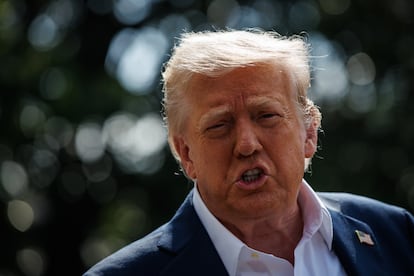

With each new transgression by Donald Trump, with every norm he breaks before the eyes of the world, it becomes increasingly clear that his sense of impunity knows no bounds — perhaps because there are none. In recent days, he has ordered an attack on a country that had not previously attacked the United States, without going through Congress: this had never happened before.
But of course, the president of the United States has never been a convicted criminal, a self-confessed sexual predator, and a bully with a mobster’s temperament whose decisions seem designed to cause harm — especially to the most vulnerable men, women, and children in his country, and the more harm, the better.
A U.S. president has also never openly supported an aggressor nation and blamed the aggression on the country being attacked. On another level, never before have travelers to the United States been routinely advised — even by U.S. institutions — to delete their social media from their phones.
These are just the examples that come to mind today, but there could be others: every day brings a new one.
The most recent attack on everything we mean when we say “democracy” (though it won’t be the most recent by the time this article is published) is far more than a violation of U.S. law, international order, or basic decency. As part of his unhinged economic strategy — one that consists of sowing chaos in global markets through tariffs — Trump has now declared he will impose the highest tariff of all, 50%, on Brazil. And he makes no effort to hide that it’s meant as punishment or retaliation for the trial currently underway against former Brazilian president Jair Bolsonaro.
Gone, suddenly and completely, is the world in which we were scandalized by a president tweeting an opinion about another country’s internal politics. Now, a president is using economic blackmail — pure mafia style — to force the justice system of another country to do his bidding. And what he wants is for that justice system to declare innocent someone accused of a serious crime. To say this is unprecedented would be a gross understatement.
But no one is surprised by the solidarity between the two men: Bolsonaro is the closest thing to Trump that politics in our American continent has produced, and not only because of his playground bully temperament, his fascist leanings, or his somewhat exaggerated and laughable machismo, nor because of his more or less overt racism or his nostalgia for dictators of the past (dictators from other traditions, in Trump’s case, and from his own, in Bolsonaro’s), and not even because of the inexplicable appeal they hold for the religions of their countries. No, it’s not just all of this that makes them alike, but the violent loyalty they inspire in their equally violent followers.
Bolsonaro is accused of leading a conspiracy of generals and other accomplices to reject the election results, carry out a coup d’état, and remain in power. One of the key scenes of this melodrama is the uprising of January 2023: a day whose images — ones we have all seen — bear a striking, almost caricature-like resemblance to what happened at the U.S. Capitol on January 6, 2021.
Trump has devoted considerable energy to whitewashing the catastrophe of that day — an attempted coup incited by him and his movement. He has twisted the truth that we all witnessed, turning those who attacked democracy into heroes and those who defended it into saboteurs, while abusing the powers of the presidency to pardon the violent.
Bolsonaro wanted to do the same, but he has not succeeded. The trial against Bolsonaro has continued, and justice has functioned as it should (and it must be said, without cynicism, that this does not always happen in Latin America), as the evidence is overwhelming: documents proving the proposal for an uprising that he made to his generals, for example, as well as serious indications that he was aware of a plan to assassinate Lula, his successor, and the judge he considers his main enemy in the justice system.
The judge’s name is Alexandre de Moraes; he is the lead investigator in Bolsonaro’s case and has two notorious enemies: one is Donald Trump, who accuses him of leading a witch hunt against Bolsonaro; the other is Elon Musk.
And this is where everything starts to become clear. Alexandre de Moraes, who many consider the second most powerful man in Brazil, has led a resistance from the Supreme Court against the darkest and most dangerous effects of social media. In a country where the influence of social networks is enormous, Bolsonaro’s digital armies organized themselves to lie and spread disinformation without hesitation, accusing opponents of everything from pedophilia to complicity with leftist authoritarianism.
Moraes was able to use the law to suspend accounts that incited violence, promoted hate speech, or slandered or lied about the integrity of the electoral process — and anyone can imagine how Elon Musk reacted to that decision. The eternal adolescent threw a tantrum, childishly claiming that Moraes was a cross between Voldemort and a Sith Lord, and refused to obey the law: clearly believing himself above it.
Moraes fined X; Musk ignored the fines just as he had ignored earlier demands. Moraes suspended X’s operations in Brazil; Musk had no choice but to comply.
It doesn’t matter that since then Trump and Musk have given us the pathetic melodrama of their falling out — they still share a common enemy, and in politics, common enemies have always united people far more than friends ever do. Moraes and the Supreme Court have become the nemesis of what Moraes calls, in a wonderful article Jon Lee Anderson wrote for The New Yorker, “the new extremist digital populism.”
It’s possible that Trump wants to use his mafia-style tariff blackmail to protect Jair Bolsonaro, who is facing a possible sentence of 43 years in prison. But let there be no doubt that he also wants to undermine the resistance of that inconvenient judge who has, at least once, been able to stand up to the machinery of disinformation, mass manipulation, and the chaos orchestrated by Elon Musk’s network. The intersection of Trump and Musk’s interests is, today, the greatest threat facing our democracies.
Moraes says, also in Jon Lee Anderson’s report: “If Goebbels were alive and had access to X, we would be doomed. The Nazis would have conquered the world.”
Insert here the Nazi salute Musk made in January of this year. Then recall the reactions of so many good people who said no, it wasn’t such a big deal, that we were overreacting. And then consider that Trump’s grotesque interventionism in Brazil’s internal affairs is not, after all, just interference in another country’s domestic matters — it’s part of something bigger, related to other issues.
It’s another instance of the shell game. And sadly, our democracies are focusing on the wrong hand.
Sign up for our weekly newsletter to get more English-language news coverage from EL PAÍS USA Edition









































