
Chile’s far right overtakes the traditional right less than a month before the presidential election
Kast and Kaiser, the two extremist candidates, are collectively polling at 35.21%, while the mainstream conservative Matthei is at 15.9%. The leftist government privately harbors little hope of winning


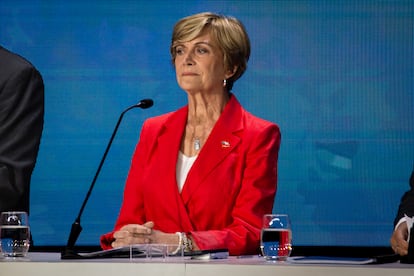
In the final stretch of Chile’s presidential election campaign, with the vote scheduled for Sunday, November 16, one of the phenomena drawing the attention of analysts is the surge of the radical right. Republican candidate José Antonio Kast, who is into his third presidential bid, is polling at an average of 23.26%. Johannes Kaiser, a lawmaker for the National Libertarian Party who has surpassed Kast in the radical nature of his proposals, comes in at 11.95%. Together, their support level reaches 35.16%, more than double that shown for Evelyn Matthei, of the moderate right, who is polling at 15.9% with less than a month to go before the first round of voting.
Matthei has climbed into third place in recent months. Although that’s not enough to advance to the second round, her support of around 10% would still allow her to prop up the parliamentary candidates from Chile Vamos — the party of the historical right — and the centrist Yellow and Democratic parties. However, Kast’s upward trend worries them. Although the leader of the center-right party Evópoli, Juan Manuel Santa Cruz, stated this Monday that Matthei has managed to narrow the gap with Kast and that both candidates are in a “technical tie,” Kaiser is closing in on her according to polls released over the weekend. Although the candidate is appealing to responsible and sensible voting, many voters in Chile’s mandatory voting system will make up their minds at the last minute, and it’s not being ruled out that Matthei could even finish in fourth place.
Even Jeannette Jara, President Gabriel Boric’s ruling party candidate and a Communist Party member, addressed the issue this Monday, when she debuted at her weekly press conference. “Kast tried to move toward Matthei, and Kaiser grew on his side,” asserted the candidate for the left, center-left, and Christian Democrats. Although Boric’s former labor minister is leading the polls — averaging 29.54% support — she has failed to surpass the 30% threshold that the current government has historically enjoyed. Given the strength of the opposition in the runup to the 2025 presidential elections, it will be difficult for Jara to win the runoff on December 14. The ruling party maintains that anything can still happen — a last-minute mistake by Kast, for example — but for a long time now, the left has privately considered this presidential election to be already lost.
The fact that the far-right parties led by Kast and Kaiser are outnumbering Matthei, at least according to the polls, shows that Chilean voters are demanding a change from the current leftist administration. This has been the case in all recent administrations: no president since 2006 has handed the presidential sash to a successor of the same political persuasion. But voters aren’t just looking for change, they’re also looking for radical proposals. In an election marked by three key issues — crime, migration, and the economy — Kaiser, for example, has said regarding the education of migrant children that “if there are foreign children who are in Chile illegally, our obligation is to return them to their country of origin. It’s not to keep them here.”
Kast, meanwhile, is borrowing from the playbook of Argentina’s Javier Milei and wants to take a chainsaw to the state: he seeks to cut $6 billion in government spending in 18 months, and there has been a virtually general consensus that this cannot be done without affecting social rights. “It’s not doable because more than 85% of public spending is set by law. And, within what is set by law, the largest items are associated with social rights, with policies that transcend any administration’s horizon,” Mario Marcel, Boric’s former finance minister, told EL PAÍS. “It’s clear that Kast doesn’t know how to cut the $6 billion.”
The radical nature of Kast’s proposals has been evident in recent days with an opinion column by his chief strategist, Cristián Valenzuela, describing public officials as “parasites.”
Matthei, whose time is running out, is trying to portray herself as the candidate who offers the country the greatest certainty. “In recent years, Chile has gone from one set of stumbles to another and from one extreme to another. We can bring stability,” she asserted this weekend.
Sign up for our weekly newsletter to get more English-language news coverage from EL PAÍS USA Edition









































