
Mark Lilla, political scientist: ‘Trump has lost his magic’
The author of ‘Ignorance and Bliss’ warns of the illness afflicting democracy in the United States: ‘It is its worst moment since the Civil War’

Mark Lilla says that, until the era of George H. W. Bush, White House menus resembled what the average citizen ate: meatloaf, mashed potatoes, green beans… It was under Bill Clinton that U.S. presidents’ diets began to become more sophisticated, just as working-class people cooked less at home and relied more on junk food. And then came Donald Trump, who loves being photographed with McDonald’s burgers. “He knew how to connect with that popular America that has been drifting away from the elites for decades. He is both weirdly a master manipulator and a shape changer.”
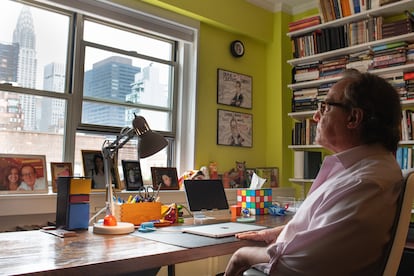
Lilla, 70, speaks in his splendid Manhattan apartment on the 18th floor, from which much of the island can be seen. On the occasion of the Spanish publication of Ignorance and Bliss, the political scientist, who teaches Humanities at Columbia University, paints in his book a picture of a society in which increasing numbers of people are consciously choosing not to know.
A liberal in the American sense of the word, he criticizes the more leftist and woke Democrats, a concept that for some time now has been under attack from all sides and which he challenged in The Once and Future Liberal: After Identity Politics. He is scathing about the Republicans, whom he calls the irresponsible party, but also about the Democrats, among whom he sees no one capable of leading the country after 2028.
Despite repeated attempts to steer the discussion toward other subjects, the conversation inevitably circles back, question after question, to the same name: Donald Trump.
Question. In your book, you talk about what you call happiness based on ignorance. It’s something that has always happened, but you say it’s much more common now. Why?
Answer. There’s a general sense that people are unable to control their own destinies. The problems we face are too complex to understand. In such a situation, people become susceptible to those who say everything is very simple, and they latch onto that idea. That is why the Trump phenomenon is so striking: his supporters remain loyal to him no matter what. They have to twist and turn to justify him. But letting go of him would mean letting go of the one person or authority who says: “It all makes sense; I have the situation under control.” That is what is new about this era.
Q. You argue that our opinions are like extensions of ourselves. That attacking them feels like attacking us as people. And that this helps explain why people resist accepting reality. But doesn’t it also matter that in recent years, at least since the Great Recession of 2008, many people have felt that their lived reality did not match what the so-called experts were telling them?
A. Yes, it’s true that that period increased the sense of instability. Another development after 2008 was the rise of the Tea Party against the super‑rich and the Democrats in power, a movement that gained a certain respectability among the ignorant in this country. One example was Sarah Palin [former Republican governor of Alaska and John McCain’s running mate]: she was Trump before Trump. That should have been a warning sign that something deep had changed. The idea, for those people, that a plumber’s opinion is preferable to an expert’s.
Q. The situation doesn’t look set to improve with the artificial intelligence revolution.
A. AI is not a mere change; it is a machine of perpetual change. When Marx and Engels wrote in the Communist Manifesto that, under capitalism, “all that is solid melts into air,” they were precisely complaining about that. They did not imagine the future as a liquid world; they conceived it as something stable. In a way, they were conservative: they assumed that after the revolution things would stay the same. Since the 1960s we have lived through a constant string of changes, but AI is the most unsettling. It’s striking to me how quickly many voters are organizing against it, opposing the installation of data centers and similar infrastructure.
Q. Politicians have always used truth and lies to their advantage. But are the boundaries between the two now less clear?
A. There is tremendous uncertainty about what is true. No one understands how the world works. No one knows what to do about poverty or how to protect domestic industries. It’s not that someone has a secret plan; those involved in public life have to pretend they do. The reaction to this is people’s desire for sure answers. But there aren’t any.
Q. Is Trump the embodiment of this whole process?
A. He never thinks beyond tomorrow; he lives anchored in the present. That sometimes allows him to have a somewhat clearer view of where things are at the moment, but not of what will happen in a week or a month. For example, after a war with Iran.
Q. The Trump of today is not the Trump who won in 2016. He is more erratic and less controlled.
A. Well, in his first term he had serious people around him. It seems now he cares about his legacy, but not the policies he will leave behind, rather the things he will build, like the Triumphal Arch or a $250 bill with his face. He is older. He has lost his magic. Many of his followers no longer believe in him, but they cannot let go of him. There’s going to be a reckoning in 2028 to see whether, as with any charismatic authority, it’s transferable.
Q. What looks difficult is a return to the pre‑Trump world, to old politics.
A. I’m concerned, first of all, about the bureaucracy. I wonder whether we will again have a professional civil service not aligned with the parties. If the bureaucracy cannot be mobilized to follow orders and democratic structures, we are lost. On the other hand, since Trump appeared 10 years ago, the Republican Party has stopped producing elites. If a Republican wins the next election, who will they rely on? Republicans have become the irresponsible party.
Q. In a world where half the population believes one thing and the other half something entirely different, is it possible to sustain a democracy that requires basic shared consensus?
A. Of course not. At least not a democracy as it is supposed to operate. There will be elections, of course; one side will win and the other won’t. But if we understand democracy as a form of self‑government, then it is necessary to have a shared reality. And that brings us back to AI: if you can’t even know whether what you see on a screen is real, how are you going to agree on what’s happening out there? It is very hard to form a clear picture of the situation because, after all, we remain a largely centrist country. Trump won because he convinced centrists to hate the Democrats.
Q. What do you think of the rise of the Democrats’ socialists associated with New York City Mayor Zohran Mamdani?
A. One reason for their victories is their energy. These are people who truly believe in what they do and devote a lot of time to it. Most of them are crazy. It’s hilarious to read the transcripts of their party debates; it’s completely over the top. The district of the craziest congressperson we are going to have, Darializa Avila Chevalier, voted massively for Trump, but now votes for her. But Mamdani is a political genius. He has a way of sticking to his points: he doesn’t hedge or become obscure; he says yes or no, defends his position without belligerence and with a smile, and states: “I stand here.”
Q. Do the Democrats offer an answer for the future?
A. People feel a huge disconnect. And the Democrats still lack a convincing vision; they do not convey credibility. When Khrushchev visited Nixon, he said: “If people tell you they want an imaginary river, don’t tell them there is no river; tell them you will build an imaginary bridge.” The Democrats have not learned to do that. Just look at the quality of their current leaders: it’s geriatric. There are no young, strong voices in the center of the party.
Q. The United States Declaration of Independence is now 250 years old. What kind of country has emerged from this anniversary?
A. In terms of democratic structure, we are going through our worst moment since the Civil War. Sociologically, things are not so bad: we remain a prosperous country, immigrants still want to come, people have considerable freedom… But if we think about politics, yes, the regime is very sick.
Q. You have written against what is called cancel culture. But given Trump’s persecution of universities, journalists, dissidents… weren’t you targeting the wrong enemy when you criticized the left’s attempts to impose its views?
A. That has happened because Trump was re‑elected and had the energy to wage all those battles. But it’s not a question of who is more to blame. My criticism of identity politics in the Democratic Party was strategic, because you can’t capture centrist voters with identity rhetoric, especially when it comes to sexuality. And it’s not that I don’t believe in gay rights or abortion. But instead of offering a common vision for the country, Democrats offer you a salad with different ingredients and tell you that this is who we are.
Q. Is the woke movement dead and buried?
A. It has been defanged and is on the defensive in the face of universities and companies that are toeing the Trumpian line. I don’t think it will come back in the same way, because it proved toxic. The ad that worked best for Republicans in 2024 said: “Kamala is for them; Trump is for you.” I don’t think the movement will regain the institutional momentum it once had. But it’s been metabolized by many people, so there will be universities and other bodies that will informally push certain identity policies. Frankly, I feel more comfortable with that model than with the bureaucracies that elevated woke to a basic principle.
Sign up for our weekly newsletter to get more English-language news coverage from EL PAÍS USA Edition









































