
How the left lost its mojo (and how it can get it back)
Progressive movements lost support among the working class as well as the digital battle for hearts and minds — and to recover it, they’ll need to turn those defeats around without resorting to polarization

The century dawned with an impressive constellation of traditionally forged progressive leaders in Europe: Blair, Schroeder, D’Alema, Jospin, Guterres and Kok among others. The president of the European Commission was Romano Prodi and the managing director of the IMF was Michel Camdessus, a Frenchman who had ties to his country’s socialists and who, alongside Parisian consensus figures like Delors and Lamy, had a profound influence on the post-1989 world. In the United States, Bill Clinton was in power. The second quarter of the 21st century, however, dawns with a bleak outlook for European progressives, who hold executive power in only two major countries: the United Kingdom and Spain. What happened?
Analyzing this decline is, of course, complex. One of the relevant factors is surely the trend among a large part of those leaders that became known in the world as the Third Way model, which gave free rein to predatory capitalism under a political premise that focused more on the redistribution of created wealth than the regulation of how that wealth was created. Over the years, with the outbreak of economic crises and financial scandals, as well as the erosion of support due to job offshoring and other issues, these parties began to suffer damage from being seen as being partly responsible for building a globalized economic system that inflicted considerable collateral damage. Significant segments of the working classes stopped believing in social democracy as a protective force.
Social democracy neglected its role as a check on capitalism and its focus on the class struggle. Instead, it concentrated on defending groups facing asymmetrical disadvantages, be they women — due to the intolerable inequality they still face — or minorities based on sexual orientation and so on. It attempted to unite the defense of these disparate interests under a single umbrella, but the binding force of the element of class was missing. And so, it went from being a beacon for the working classes to being supported by a narrower base: educated urban social sectors.
In addition, it was not able to formulate an effective response to the challenges posed by massive migration flows. In some cases, it chose to ignore legitimate concerns; in others, it wound up adopting right-wing political narratives. The result is that it failed to prevent a certain socioeconomic discontent from morphing into an even more dangerous, identity-based discontent. The stage was set: large segments of the working class were disappointed, precarious and filled with resentment, especially among men, first the middle-aged and then, the young.
This was likely also fueled by certain problematic fringes of the feminist movement, which is capable of extraordinary achievements but also, naturally carries with it unresolved issues that have facilitated the emergence of reactionary initiatives. Certain extremes have made it difficult for the movement to establish itself as a movement of the majority — the place where progress takes root most firmly — instead, causing mistrust among some, and a desire for revenge among others.
Another fundamental failing was the delay in truly understanding the mechanisms of revolutionary technology and its impact on political discourse. Extremists understood how to very effectively exploit these tools to fuel a simplistic, emotional and mobilizing narrative, while certain progressive circles remained fixated on nuance, rationality and deliberation. Those things are all well and good, but they were a losing strategy.
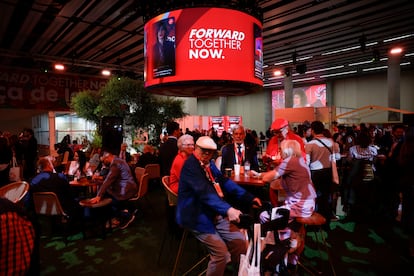
Correcting issues in these and other areas is crucial for progressive forces to once again become attractive. Reflecting on adapting to a new era was the goal of a large conference that took place in Barcelona this weekend, the Global Progressive Mobilization. It was the site of many ideas and, of course, each sensibility had their preferred course of action. But there are many reasons to believe that it is essential for progressive forces to once again be seen as credible defenders of the working class, and as the strict enforcers of regulations on large corporations and the wealthy.
It is crucial that we develop a new political language that, without succumbing to the temptation of polarization, manages to inspire passion and that, without resorting to trivializing language, succeeds in connecting with people — and not just those with college degrees. We must articulate new ideas upholding internationalism, but recognizing that interdependence has become a weapon in the hands of the most powerful, which requires the development of safeguard measures that defend multilateralism while acknowledging that it is now largely unworkable. Mini-lateral approaches must therefore be explored, ones that promote pacifism, but not in its outdated version that consists of leaving a victim at the mercy of the aggressor, or of praying that a predator does not decide to attack. Furthermore, it is imperative that all of this be done while protecting institutions, whose deterioration spells the defeat of any progressive project, by avoiding their wholesale cooptation when in power and offering loyal cooperation to facilitate their functioning when in opposition. Victories achieved by widening chasms within societies may have the sweet taste of relief in the short term and a very bitter aftertaste in the long run.
Sign up forour weekly newsletterto get more English-language news coverage from EL PAÍS USA Edition









































