
How Paul Newman brought Scorsese and Tom Cruise together — and finally won his Oscar
Forty years on, ‘The Color of Money’ remains a 1980s classic and a reminder that unlikely collaborations can produce extraordinary results

In the mid-1980s, Martin Scorsese was beginning to learn a harsh lesson. The industry had changed. The days of New Hollywood and its brash cinematic revolution were over. The major studios were no longer willing to give free rein to the generation of rebellious filmmakers — including Scorsese himself — who had burst onto the scene 15 years earlier to change the rules of the business.
The utopia of a commercially successful auteur cinema — that was bold and fiercely independent — was beginning to fade. Francis Ford Coppola had fallen from favor; William Friedkin, Michael Cimino, John Milius and Peter Bogdanovich were considered little short of box-office poison. In 1983, Scorsese himself had seen one of his most ambitious projects, The Last Temptation of Christ — a rebellious and unorthodox adaptation of the Gospel story — cancelled after two years in development.
In that bleak moment, Scorsese told his good friend Hal Ashby, another once‑brilliant filmmaker in decline, that he could see only one possible survival strategy: they needed to revive the old formula of the aging, resigned Orson Welles and accept making “one for them and one for you.” In other words, for every relatively low-budget, personal, and artistically ambitious film, they would have to make another that was an industrial, studio‑driven, big‑budget picture.
The idea was that one would bankroll the other. Only then could a filmmaker work continuously and build a satisfying career. Scorsese would say years later that the alternative was to go back to New York, make experimental movies and teach film. “The question was: Are you going to survive as a Hollywood filmmaker? Because even though I live in New York, I’m a ‘Hollywood director,’" he said.
Of course, the 30‑year‑old Scorsese who made the amphetamine‑fueled, ground‑breaking Mean Streets (1973) would never have accepted such a compromise. It would have felt like a living death. But 10 years later, after suffering a depression and a collapse attributed both to asthma and to his prodigious drug use, he was willing to concede. After the picassoesque After Hours (1985), a comedy that ended up costing more than expected and grossing far less, it was time to make “one for them.”
That was when Paul Newman entered the equation. The legendary Ohio actor was then 60, widely famous, wealthy and highly respected, but had never won an Oscar. In September 1984, Newman called Scorsese in London with a proposal. Newman wanted to revisit Eddie Felson, the pool hustler he had played in The Hustler, and told Scorsese he was interested in adapting Walter Tevis’s later novel about the character. He made clear that he would only proceed if Scorsese agreed to direct. At that stage, the project was little more than a conversation between the two men.
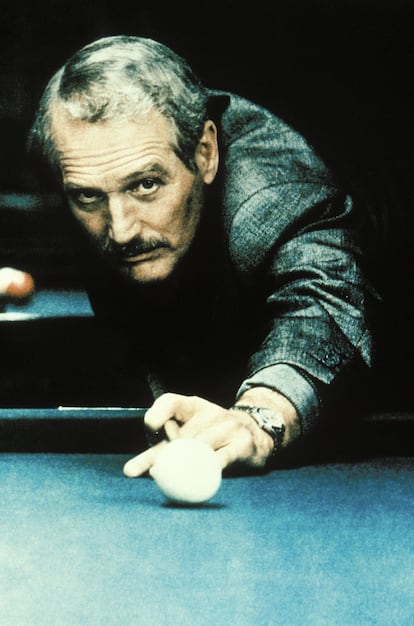
Of course, The Hustler (Robert Rossen, 1961) was a masterpiece whose reputation had only grown with time, and Eddie Felson — the narcissistic, alcoholic pool player portrayed by Paul Newman — was one of the great antiheroes in cinema history. Newman wanted to work with Scorsese. He had been deeply impressed by Raging Bull and by the dramatic leap it had represented in Robert De Niro’s career. Newman did not consider himself a lesser actor than De Niro, but he readily acknowledged that he had spent several years working with directors who were unimaginative and overly conventional. One of his finest performances was approaching its 25th anniversary. The time seemed right to launch a sequel that would create a sensation, and Scorsese struck him as the ideal person to direct it.
Revisiting Eddie Felson
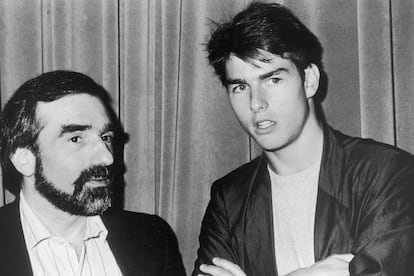
The Color of Money is celebrating its 40th anniversary this year. Despite its flaws — and it certainly has them — it has aged well, buoyed by its undeniable strengths. Scorsese agreed to direct it because he sensed it would be a major commercial success and because he genuinely wanted to work with Newman. As they finalized the details of an initial meeting in Los Angeles, the filmmaker suggested hiring Richard Price as screenwriter, a novelist whose sensibility he felt was very close to his own, despite never having had the opportunity to collaborate closely with him before. Newman agreed.
Price later described that first meeting as an encounter between “two New York clowns” and Hollywood royalty. Although Newman was friendly and approachable, Scorsese’s and Price’s efforts to make a good impression must have seemed somewhat pathetic to him. That first meeting would set the tone for their working relationship over the following months. Newman trusted his collaborators, but he established a collegial working method in which virtually everything was debated at length — usually around a table in a good restaurant — while he reserved the final word on almost every matter of strategic importance. After all, it was his face on the poster, and his access to financing that made the project possible.
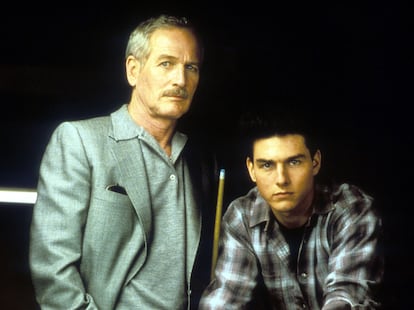
According to Price, it was Newman who made key choices such as casting a young Tom Cruise (22 at the time), who had impressed him in the war drama Taps (1981) and was about to film Top Gun. Scorsese suggested Jean‑Pierre Léaud but ultimately conceded on this, as on almost everything.
It was also Newman who suggested, through successive rewrites, that the antagonist from The Hustler — the legendary Minnesota Fats — be progressively sidelined, as if he did not want any ghost of the past to overshadow his Eddie Felson. The ploy was so obvious that Jackie Gleason, the brilliant actor who had played Fats in Rossen’s film, decided to bow out. Without Gleason, Minnesota Fats vanished from the script entirely.
Finding a studio
When the time came to sell a project that was nearing its ideal form, the three partners received an unpleasant surprise. Their first choice, 20th Century Fox, showed interest, but wanted only Scorsese and Price; Newman and Cruise were considered expendable. Columbia also raised objections that the filmmakers found impossible to accept. Only Touchstone/Disney, under producers Michael Eisner and Jeffrey Katzenberg, was willing to finance the film, but on draconian terms: the budget could not exceed $14.5 million — not by a single cent — and Newman and Scorsese were required to place one third of their salaries in escrow as a guarantee. If the production went over budget, they would forfeit the money.
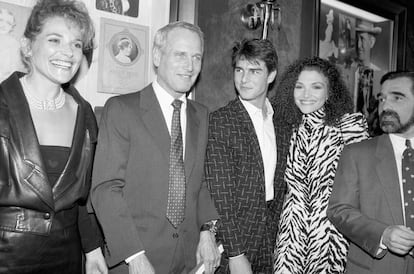
In the end, they wrapped shooting in 49 days — one fewer than scheduled — and spent just $13 million, $1.5 million under budget. Scorsese had learned that on the films he made “for them,” it was essential to shoot efficiently, stay within budget, avoid unnecessary risks, and refrain from antagonizing the people in charge. It was a lesson Coppola would take decades to absorb and one that wayward filmmakers like Cimino or Paul Schrader never did.
But that exercise in prudence and realism came at a price for Scorsese. Chief among those costs was that, despite his worries about delivering a “soulless” movie, he accepted almost all of Paul Newman’s creative interventions with barely any resistance. Newman was a very talented man, but one with rather conventional tastes, and he was an alpha personality unused to being contradicted.
Nor did Scorsese press Tom Cruise to play his character — Vincent, a young pool prodigy cynically mentored by a fading Eddie Felson — with the restraint that might have added greater depth and nuance to the role, but which was entirely alien to the young actor. Cruise was a thoroughbred: intensely committed to his craft, disciplined, and methodical. Yet he had a tendency toward a kind of showy excess that horrified Scorsese. Even so, the director let him have his way, aware that trying to rein him in would have meant tension on set, additional takes, and lost dollars.
Scorsese also suffered during production from an acute case of what the literary critic Harold Bloom called “the anxiety of influence.” He simply admired Rossen’s The Hustler too much, yet felt compelled to distance himself from it as much as possible in order to assert his own artistic identity and avoid accusations of merely appropriating someone else’s achievement. Perhaps for that reason, he avoided engaging directly with the murky tragedy at the heart of The Hustler and with the aura of self-defeating melancholy that had made the original Eddie Felson unforgettable. He tried to offer a different perspective on the story, but in the process sidelined many of its greatest strengths. As a result, The Color of Money would prove far more predictable — and considerably less suggestive and unsettling — than The Hustler.
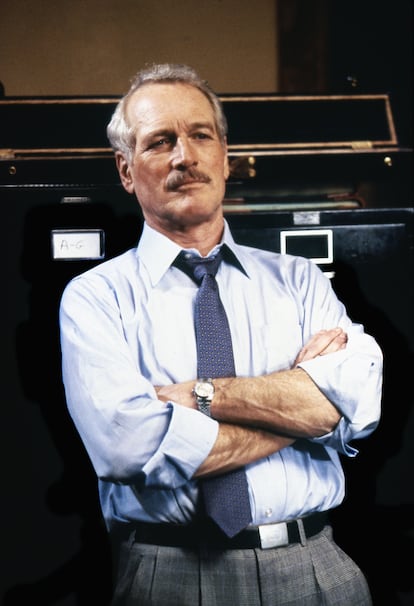
The final concession was purely aesthetic. In the brisk, jittery visual style that had defined Scorsese up to that point, close-ups tended to be brief and often distorted by zoom lenses or abrupt camera movements. Newman respectfully asked for more conventional close-ups. He saw the film as the vehicle that would finally win him an Oscar, and he wanted to look good on screen.
Scorsese agreed. He even took a strange pleasure in fixing the camera on Newman’s handsome, deeply lined face. During an early editing session, alone with his longtime collaborator Thelma Schoonmaker, he reportedly summed up his reaction to those close-ups with a mixture of admiration and amusement: “That man’s gonna go places! He’s got a face!”
The Newman effect
Years later, Scorsese would explain that The Color of Money was the first production on which he truly felt he was working with — and for — a major movie star. De Niro, Harvey Keitel, and Joe Pesci were not stars in that sense. They were close friends he had known forever, and he had watched their rise to fame step by step. Paul Newman was a star: “With Paul, I would go in, and I’d see a thousand different movies in his face, images I had seen on that big screen when I was 12 years old. It makes an impression.”
Even though he dealt with Newman casually, as one professional collaborating with another, Scorsese could never entirely stop seeing him as a mythical figure. He wanted to please him, earn his approval, and above all avoid disappointing him. To Newman’s credit, he never abused the almost mythic admiration he inspired in the director. He had a mission — to deliver the finest performance of his career — and he approached it with rigor, perfectionism, and not an ounce of self-indulgence.
Newman worried about onscreen chemistry with an occasionally overacting Tom Cruise and found an unexpected ally in the third element of the film, Italian‑American actress Mary Elizabeth Mastrantonio. If Vincent was a spoiled child and Eddie a prematurely old, world-weary veteran, Mastrantonio’s Carmen was a perfectly balanced combination of ice and fire, calculation and adventure. She was a femme fatale disguised as arm candy — the richest and arguably best-performed character in the film.
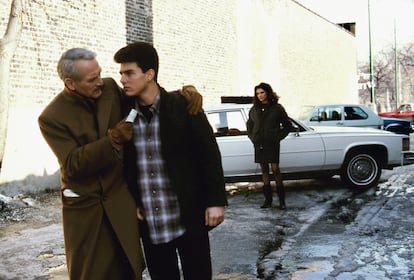
The movie was shot largely on real locations: pool halls, seedy alleyways, run-down hotels and decrepit bars in and around Chicago. Its supporting cast included actors as accomplished as Bill Cobbs, John Turturro and a still-unknown (though already brilliant) Forrest Whitaker. In the end, despite all the concessions, trade-offs and constraints, it did have “soul,” and Scorsese’s authorial stamp was clearly visible.
Happy ending
Released on October 17, 1986, it grossed a satisfactory $52 million, was applauded (albeit with some reservations) by much of the critical establishment and achieved its main goal: Paul Newman finally won the Academy Award for best actor. It also helped Scorsese regain favor in the industry and unblock projects such as The Last Temptation of Christ, which would become a high‑budget auteur film — a product both for the director and “for them.”
Tom Cruise was the only participant left less than fully satisfied. He did not receive the praise he had expected and suffered a painful humiliation: the Academy overlooked him, yet nominated his far less established co-star Mary Elizabeth Mastrantonio for Best Supporting Actress. He would soon make up for it with the success of Top Gun, a breakthrough that propelled his career forward.
Finally, Richard Price was also nominated at the Academy Awards ceremony in March 1987, despite respected critics like Roger Ebert calling the film’s chief flaw a script filled with “preordained teacher-pupil cliches” Price himself was quick to point out that, although he alone received screenwriting credit, the script had really been the product of the combined efforts of three very different men: two New York clowns and Hollywood royalty.
Together they devised the unforgettable scene that finally does justice to the proud antihero Eddie Felson. Vincent has just granted him a “real” rematch after deliberately losing a fixed game during the Atlantic City tournament. Before they begin, the young man needles his former mentor with characteristic arrogance:
“What are you going to do when I kick your ass?” asks Vincent.
“Pick myself up and let you kick me again. [...] Just don’t put the money in the bank. Because if I don’t whip you now, I’m gonna whip you next month in Dallas,” replies Eddie.
When Vincent asks him how he can be so sure he will win, Vincent answers: “Hey, I’m back.”
Sign up for our weekly newsletter to get more English-language news coverage from EL PAÍS USA Edition









































