
Danny Elfman, Hollywood’s macabre musician: ‘I don’t know how young composers coming up now are going to survive’
The author of many of the most memorable film scores of his era including most Tim Burton movies, as well as the TV theme for ‘The Simpsons,’ says his success is due to his being ‘just lucky’
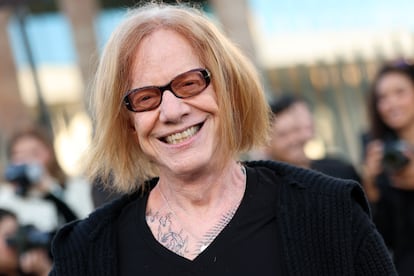

Danny Elfman, 73, is still a bit surprised by his place in film history. “Edward Scissorhands. Such a surprise. I didn’t even know if it was a good score or not. At the time, I couldn’t tell. I thought maybe I’d fucked it up. And it wasn’t until later that I saw people really enjoyed it,” he explains via videoconference. His place in history would likely have been secured simply by his time as the go-to film composer of the late 1980s and early 1990s, when he was recruited by a rookie director named Tim Burton, bringing incredible sounds to a run of films that include Pee-wee’s Big Adventure (1985), Beetlejuice (1988), Batman (1989), Edward Scissorhands (1990), Batman Returns (1992) and The Nightmare Before Christmas (1993), and becoming Hollywood’s most coveted oddball. In 1989 he also wrote the world’s best-known television theme for The Simpsons.
Or perhaps his place in the annals was earned later, when he left behind the sound that had catapulted him to fame (sarcastic circus marches and solemn choral pieces, sometimes both together — again, think The Simpsons) and established himself in Hollywood as one of contemporary cinema’s most versatile, dependable composers, able to handle big action franchises (Mission: Impossible in 1996, Sam Raimi’s Spider-Man, Justice League in 2017, his early work for Marvel), intimate dramas (Gus Van Sant’s filmography) and just about every other genre — in all, more than 110 movies. But to the man with long orange hair speaking with a Cheshire-cat smile from the other end of the Zoom call, all of this sounds a little distant.
“Your music survives long after the film releases. Why is that?”
“I’m just lucky.”
“It’s only luck?”
“What else can I think?”
“There are a lot of film scores.”
“I got lucky many times.”
It’s the oddball’s curse to spend a lifetime second-guessing himself. And the film composer’s curse is to assume his work will always go unnoticed by the public, as indeed often happens. But in Elfman’s case, there is more. While writing what are now some of the most memorable film scores of his era, he never felt he was creating masterpieces. Many of those films didn’t look like hits at first. Some only became so decades later.
Today, for example, The Nightmare Before Christmas, the stop-motion musical produced by Burton, is considered a cult classic. Elfman not only wrote the music and lyrics but also provided the singing voice for the lead, Jack Skellington. “At the premiere everyone thought: God, who is this movie for? It’s so weird...,” he recalls about his signature work. “I usually work two to three months on a film; on this one I spent two and a half years and it broke my heart when it came out that people just didn’t understand it. We presented it in Orlando, Florida; I must have done 200 interviews in two days and in every one they told me the same thing: ‘It’s too scary for kids. And I said, it’s really not.’ But that was the perception... Now, for so many children it’s my best work; I sing it at concerts and I see entire families, several generations, listening and singing ‘What’s this, what’s this, there’s color everywhere.’ I see Jack Skellington on people’s lawns at Halloween. It took me between 10 and 15 years to get this cult following.” Likewise, Edward Scissorhands went on to become a ballet, devised by Matthew Bourne and premiered in 2005. The Big Fish score spent decades as a major reference for the next generation of film musicians. Elfman has been performing the Nightmare score since 2013: four years ago he played it at the Californian festival Coachella.
Perhaps we can answer for Elfman about the secret of his success — why a film composer has over the years acquired the kind of popularity associated with an aging rock star. Elfman had no film experience when Tim Burton saw him perform with Oingo Boingo, his experimental new-wave band, and asked him to score his first movie. In those early years he learned on the go, guided by instinct. At that time Hollywood was dominated by John Williams’s symphonic rigor (Star Wars) and Jerry Goldsmith’s avant-garde savvy (Alien, Planet of the Apes, Poltergeist). Elfman, however, was drawn to other things: 19th-century traveling circus music, for example, because it was the sound of the Looney Tunes and other cartoons of his childhood; the complex percussion he’d learned while traveling in Africa.
Elfman brought those two elements to his films along with some original musical ideas: that a minor key can be used with movie heroes (a minor key is traditionally reserved for villains — in Hollywood, a hero deserves a major key) to underline their dark side; that you don’t have to wager everything on melody — his legendary theme for Batman is essentially five notes and nothing more, the trick being how they are looped across half a dozen keys. The result was retro yet new, macabre yet playful, and above all it conveyed the sense that someone was having a great time behind it all. “Edward Scissorhands, Batman, Big Fish, Alice in Wonderland, Beetlejuice… These are all scores that I really love doing and I wish I could keep writing with those melodies and those motifs.”
When he was asked to write the theme for a strange animated series about a yellow family, he took less than an hour to come up with the Simpsons theme, humming a first draft straight from his car. There’s probably no need to recount the immediate international phenomenon that followed: the show that was never off the air, the endless re-runs; the most-heard TV fictional melody in the world over the past 40 years, the anthem for video games and theme parks spawned from it.
“Could you live off the income from The Simpsons theme?”
“Not great. The residuals don’t last that long.”
“Really?”
“The Simpsons residuals I would still get. But I don’t get that much from a TV show. It helps, but very often, I’m living off of the film residuals. And that’s a big difference between today and those days. Because now it’s streaming, composers are cut out of their residuals. And I don’t know how young composers coming up now are going to survive, honestly. Because so much of the last 40 years of what I’ve earned is not only getting paid for the film, but the residuals that might be three, five, eight, 10 years beyond. I’m so lucky to have been doing film in the era that I did film scoring.”
The true miracle of film music happens when a composer reaches a symbiosis with a director, when one’s images and the other’s sounds feed each other so closely they are unimaginable apart. Steven Spielberg and John Williams are the crown jewel of this kind of collaboration: 30 films in 52 years — try imagining Indiana Jones, Jaws, Jurassic Park, E.T. or Schindler’s List without the music. Alberto Iglesias and Pedro Almodóvar: 14 films and two mid-length works. The Coens and Carter Burwell. Robert Zemeckis and Alan Silvestri. Those who still study Alfred Hitchcock’s filmography mark the before and after of his quarrel with Bernard Herrmann after nine collaborations (again, try imagining Psycho, Vertigo or North by Northwest with any other musical score), and when discussing the director’s late work they wonder how those films might have fared with his longtime composer. Elfman belongs to that lineage: he has scored 18 of Tim Burton’s 21 films.
“At first Tim and I used to joke that we would end up like Hitchcock and Herrmann. And it happened to us, at the end of The Nightmare Before Christmas we had a big falling out. And Tim didn’t call me at first for Mars Attacks! [in 1996, after having initially passed him over for his previous film, Ed Wood, in 1994]. Herrmann regretted fighting with Hitchcock but Hitchcock never forgave him; we were luckier. As the producer of Mars Attacks! told me, one afternoon during filming they were at the hotel in Kansas City and Batman Returns was on TV. Tim watched a bit of the movie, turned to the producer and said: ‘Danny should be doing this.’ The next day they called me: would you like to meet with Tim? And the next day I was on a plane to Kansas.”
“Was it that important?”
“We realized we had a lot of similarities and overlapping sensibilities. And so it’s less struggle for a director to get what they’re hoping for out of a composer and the composer finds that they’re comfortable slipping into that world. For me it’s comfortable to enter Tim’s world. From the beginning. To enter that strange universe and give it a bit of heart, soul, or both.”
“And what happened?”
“I felt really bad about it because I felt like, ultimately, it was my fault, not his, that I kind of blew up the way I did. But I learned that every time I was in a crisis with a director, where I felt very emotional about something and something was being done a certain way and I very much disagreed, I would really try to stop and remind myself I have to get more distance, to look from a distance. Because sometimes when when you’re having something that’s so intense, this close, a little thing can become a big thing. And it’s the same in a marriage.”
There is a nostalgic component to Elfman’s story — this old idol from an era when cinema required a symphony orchestra to react to the images and emotions on screen. In the digital era, synthetic textures and ambient scores prevail: explicitly underlining an emotion can now cause cringe. Scoring strictly to picture is a risky sport now that editing can change almost until the day of release. “And fewer films are being made, at least mid-budget pictures that give you some creative freedom and allow you to be somewhat expressive with the music. Now it’s all big budget titles,” Elfman argues, who has just released Dracula, by Luc Besson, Prime Crime: A True Story, by Gus Van Sant, and Send Help, by Sam Raimi. “So many movies I made with Tim Burton, we didn’t have a studio looking very closely; it seemed like the studio barely knew it was happening, except for Batman. That’s why writing Pee-wee, Beetlejuice, Edward Scissorhands or The Nightmare Before Christmas was so much fun. Just Tim and I out there having fun and no interference.”
Sign up for our weekly newsletter to get more English-language news coverage from EL PAÍS USA Edition









































