
Paul Reubens: From starring in Tim Burton’s debut movie to being canceled for masturbating in a porn theater
The Emmy-winning HBO documentary ‘Pee-wee as Himself’ tells the complex story of a comedian who hid behind a children’s character, Pee-wee Herman, and died before the film was finished
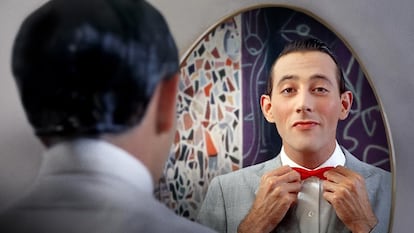

There were 40 hours of interviews. But even with 1,500 pages of transcripts, the subject of this documentary didn’t open up about the most mysterious chapters of his life. In fact, he didn’t even tell the crew that he’d been battling cancer for six years. And, in 2023, before filming was even finished, Paul Reubens died. Even so, Pee-wee as Himself (HBO Max) is not an unfinished work, and manages to surprisingly explore the rise to stardom, and the descent into disgrace, of one of America’s most celebrated actors and comedians. A uniquely talented actor who was forced to return to the closet to succeed and who, years later, became an outcast in the industry due to false accusations.
Paul Reubens, or his character Pee-wee Herman, may not be a household name outside of the U.S., but viewers have surely come across his face at some point. He was the star, writer, and promoter of Tim Burton’s first feature film, Pee-wee’s Big Adventure (1985). Reubens’ character also had a hugely popular children’s show, Pee-wee’s Playhouse, and even a Netflix reboot in 2016. The actor also made appearances in The Big Bang Theory, Blow, Batman Returns, Matilda, Mystery Men, Dr. Dolittle, and What We Do in the Shadows. But little was ever known about him. He preferred to remain in the shadow of Pee-wee, a childlike, bouncy, irascible character with an infectious laugh, and he would remain in character on talk shows, at premieres, and at stand-up comedy events. Pee-wee absorbed all of his personality. And yet his own life was truly captivating, as evidenced by the three Creative Arts Emmy Awards (including Best Documentary and Documentary Directing) the two-part biographical series won last week out of five nominations.
Who was Paul Reubens? The actor, who learned from classical theater, came to comedy almost by chance, when he landed at The Groundlings’ nascent improvisational school after failing to establish a “serious” acting career. He had only made small independent films, and during his time in comedy, he suffered another frustration: never making the cut for Saturday Night Live. Despite everything, he was free in his life, with a male partner, a supportive family, and never feeling rejected for his sexuality. At least until Reubens found success through Pee-wee Herman, a character created by chance that would become a Russian doll: a homosexual actor hidden inside a heterosexual comedian hidden beneath a fun and colorful childlike persona. In his personal life, he had a beard and long hair, but in public he never strayed from his high-pitched voice, slicked-back hair, makeup, and red bow tie.
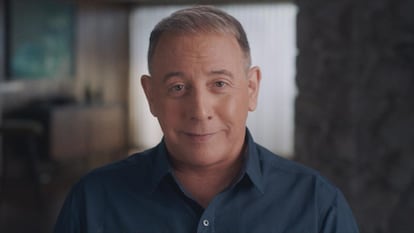
Happiness always played second fiddle in his life. And the passionate collector and classic television fan acknowledges this in the documentary: his ambition was greater. Pee-wee gave him that long-awaited success. He became a recurring guest on The David Letterman Show, starred in an iconic Broadway play and three films (including Burton’s successful and highly original debut), and exploded into fame with the children’s show Pee-wee’s Playhouse (1986-1991), which became a cult series for the MTV generation, watched by children and adults alike.
His rise was as swift as his cancellation. In 1991, police arrested Reubens for masturbating in a pornographic theater. Thus began a media witch hunt fueled by homophobia from conservative sectors. To quote The Simpsons: “Won’t someone please think of the children?” That’s what they accused him of when publicly criticizing him; how could someone like that have a children’s show? But what did “someone like that” mean? In reality, they singled him out for being part of the LGBTQ+ community. In the documentary, he recounts how he was assured that “people have very short memories, and they’ll soon forget,” but Reubens claims that two decades later he is still remembered for that highly publicized incident.
Even so, he knew how to change tack, and his ambition led him to pivot his career, opting for roles far removed from Pee-wee. He also started a public relationship with a friend, actress Debi Mazar, to improve his image, and once again went back into the closet. The industry loved him again, but then another blow came. In 2002, he was accused of possessing child pornography in his home. It turned out it was just a few vintage erotic magazines with men showing their torsos, but nothing prevented a new onslaught against his sexuality. In the end, those doing the cancelling are always the same.
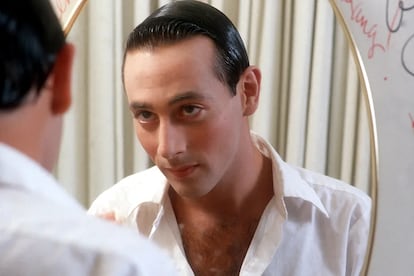
The important thing about the documentary is what it says, but also how it is told. Reubens, despite being an executive producer, is never a comfortable subject for director Matt Wolf, whom he constantly appeals to and changes the subject, seeking to avoid what he doesn’t want to say. In fact, the comedian delayed his statement on the 2002 accusation due to disagreements over the purpose of the interview. In the end, those questions were never recorded, although before his death, he left an audio recording of his version: “I wanted to make this documentary to show people who I am, and how painful and difficult it is to be labeled as something you’re not. When I heard the word ‘pedophile,’ I knew everything was going to change,” he said on his deathbed.
That final twist, and his attitude, forged a documentary different from what we are used to, far removed from those excessively laudatory films dedicated to comedians and singers that are lavishly distributed across streaming platforms. Wolf himself had doubts about how to recount these clashes, and in the end he introduced himself as just another character: “I never had put myself in a film, and was very reticent to do so. I’m pretty allergic to documentaries in which the filmmaker inserts themselves unless it’s essential to the story [...] Paul was so rebellious and so resistant to the process, I recognized that it was strong raw material for portraiture to really show who Paul was and how he was engaging in this process,” Wolf told The Hollywood Reporter. He even recalled in his own essay in Vulture magazine that there was another “censored” cut that didn’t include that side of him. It would have been interesting for his life story, but much less original, profound, and complex as a cinematic documentary. Reubens would have once again hidden behind another personality.
His cache of half-truths, however, remained until the very end. Wolf tried to convince Reubens to continue the interview, even showing him the first 40 minutes of the documentary. The last time he spoke to him was two weeks before he died, and he received his blessing. The director had no idea Reubens had cancer, and the final interview was scheduled to be recorded a week after his death. Thus, Pee-wee Herman will remain a wonderful, eternal mystery. Sometimes it’s better not to know everything.
Seven documentaries about comedians recommended on platforms
- Tig (2015). Netflix.
- Robin Williams: Come Inside My Mind (2018). HBO Max.
- The Zen Diaries of Garry Shandling (2018). HBO Max.
- Belushi (2020). Filmin.
- George Carlin's American Dream (2022). HBO Max.
- Andy Kaufman Is Me (2023). Filmin.
- STEVE! (martin) (2024). AppleTV+.
Sign up for our weekly newsletter to get more English-language news coverage from EL PAÍS USA Edition









































