
Charlie Sheen: The remarkable survival of an actor ravaged by addiction
The ‘Platoon’ and ‘Two and a Half Men’ star traces his life and career in a Netflix documentary, derailed by his endless partying and drug abuse
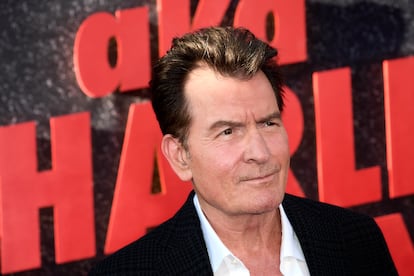

How on earth has Charlie Sheen made it to 60? How has he survived decades of cocaine — first snorted, then smoked as crack — endless parties with alcohol and friends? And his sexual excesses? Did he make enough to cover all the extortion money he gave to sex workers, including one to whom he reportedly paid as much as $1.4 million?
Netflix and a memoir provide the answer straight from Sheen himself. He stars in the documentary series aka Charlie Sheen, which premieres on the platform on Wednesday, September 10, in two 90-minute episodes. The book, written entirely by Sheen without a ghostwriter, is more reflective, judging by various excerpts published in the U.S.
However, the documentary is unbeatable thanks to the vast amount of material the actor has accumulated over his career and his years of wild behavior — and because on camera appear his friends, colleagues, his dealer, his fellow actors, two of his ex-wives (Denise Richards seems to be the only sane one on this rollercoaster), and even Heidi Fleiss, the infamous Hollywood madam who ran the city’s most lucrative escort business in the early 1990s.
Sean Penn says in the documentary that his friend has a spectacular biology because he has survived an unparalleled journey of addictions, and because cocaine users usually suffer a sexual decline — “except Charlie.” The first person to appear on screen, however, is not Sheen, but Jon Cryer, co-star of Two and a Half Men, who, pointing to his bald head, begins: “When the show started, I had hair.”
The documentary can only be watched one way: wide-eyed and jaw-dropped. Sheen, who has been sober for eight years (not the first time — well, not the second or third either — that he’s managed to stay away from alcohol and cocaine for a long stretch), looks into the camera and starts telling his story: he hides nothing, dodges no questions, and remembers everything. And everything means everything. Only a couple of times, out of respect for his ex-wives, does he hold back.

At the start, he confesses: “People don’t know me as a person, but as a concept, something belonging to a time and a place.” Indeed, Charlie Sheen embodies the idea of wild partying in the minds of half the planet. Not for nothing did he smoke seven-gram rocks of cocaine, spend hundreds of thousands of dollars on sex workers, and, in one brilliantly recounted anecdote, haggle over his admission to a rehab center for 24 hours because he had a meeting with Nicolas Cage (who doesn’t come off well) and his crew to serve as judges at a bikini contest in Malibu.
Sheen came into the world struggling for life, choked by his own umbilical cord. That’s why his real name is Carlos Irwin (after the doctor who saved his life) Estevez. The third child of acting legend Martin Sheen — himself the son of a Spanish immigrant — Charlie grew up on his father’s sets (yes, as a child he went to the Philippines for the filming of Apocalypse Now, where he helped his father recover from the heart attack that almost killed him) and followed in the footsteps of his brother Emilio Estevez, who kept the family’s original surname. When he finished high school, he asked his parents to let him have that summer free to attend auditions and see if he had any luck.
Unconsciously, Charlie Sheen was ready. For years, he had acted in home films shot on Super-8 by the Estevez brothers in their Malibu backyard (before it became a luxury residential area) with other local friends, including Sean and Chris Penn and George Clooney. “We drank, smoked weed, and had a great time,” Penn recalls.

His professional career begins: Sheen is hired for Grizzly II: Revenge, a B-movie (2.7 IMDb rating) of the worst kind, starring… George Clooney and Laura Dern. During that shoot, he’s considered for the lead in The Karate Kid, but his father warns him: he’s given his word and can’t abandon the other project. That opportunity slips away. In exchange, his friend Jennifer Grey asks him to play a role in Ferris Bueller’s Day Off, and he becomes the sensation of the moment… while also becoming a father for the first time.
From there, it’s Platoon (the documentary rightly highlights the similarities between many father-and-son films): the Oscar nominations for Oliver Stone’s film catch him shooting with the same director and with his father on Wall Street. What could go wrong? Sheen doesn’t dodge responsibility; he owns all his actions, even though at that time he hangs out with Nicolas Cage, who at that point was even more out of control than he was.
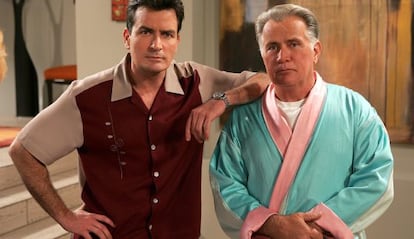
It’s August 1990, and Martin Sheen manages to get him into rehab for the first time (though, in reality, it’s a phone call from Clint Eastwood that convinces him). At the clinic, he reads the script for Hot Shots!, and there’s no way: once he leaves, he’s back at it because he has too much money and fame.
Through his addiction to sleeping with prostitutes, he meets another 1990s figure, Heidi Fleiss, the Hollywood madam and the most tragic character in the documentary, who calls him a “crybaby pussy bitch” because, pressured by the police — who were also going to charge him with pimping — Sheen testified against Fleiss, sending her to jail. Incidentally, the actor recounts that he lost his virginity at 15 to a prostitute in Las Vegas, paid for with his devoutly Catholic father’s credit card. “If you’re watching, thanks, Candy.”
From 1995, the downward spiral begins. Sheen recounts story after story: like when the shoot for Money Talks had to be halted because his nose bled for 18 hours from snorting cocaine, or when he showed up so drunk on another set that he fell asleep and, to wake up, shoved a bucket of ice up his anus (though he never forgot his lines). He moves on to crack, suffers an overdose, and even Slash from Guns N’ Roses advises him to rein it in.

During one of his periods of sobriety, around 2003, he married Denise Richards and began his work on Two and a Half Men, the hit sitcom by Chuck Lorre, one of the kings of world television. “Charlie Sheen is an icon of decadence,” said his co-star Cyer. “Everyone expects this Lothario guy. You start to realize a lot is going on there that he’s covering, Charlie is actually a mass of fears.”
Sheen switches from crack to pills, and this new addiction sparks irrational fits of rage. He divorces, remarries, and then returns to crack nine years later with his third wife, Brooke Mueller, who uses as much as he does. In the midst of this chaos, he wants to quit Two and a Half Men. Warner, having already sold two more seasons to TV networks, offers him anything he wants in 2009. With two million dollars per episode, he becomes the highest-paid actor in television history.
He won’t finish those two seasons: in 2011, he’s fired, reaching the peak of his fame, with hordes of people enjoying his downfall. His expressions — “Winning!” or claiming that his veins ran with “tiger blood” and “Adonis DNA” — echo across the U.S. Live Nation offers him a theater tour to tell his stories. For 100 days, he rambles outrageous tales from stage to stage, until fans of train wrecks grow tired.
Netflix requested that some of the surprises Sheen reveals in the final 20 minutes remain under wraps. In 2015, he disclosed that he is HIV-positive. How did he contract the virus? Has he passed it to anyone? The actor recently broke the news in previous interviews: during his crack years, he slept with men and also paid large sums to male prostitutes who blackmailed him. “I just needed to be free of that.” He said that he always used condoms and has not transmitted the virus to anyone.
Final coda: he gave up alcohol and drugs eight years ago for his daughter Sam; his son Bob now lives with him. Neither Martin Sheen nor Emilio Estevez appear in the documentary. The New York Times reports that they saw an early cut and decided not to participate because they wouldn’t add anything new. Charlie Sheen adores them both and feels their love in return. He adds: “I don’t argue with my father anymore.”
Sign up for our weekly newsletter to get more English-language news coverage from EL PAÍS USA Edition









































