
Martin Scorsese, Al Pacino, John Malkovich, Oscar Isaac, and Gal Gadot hunt for the original manuscript of the ‘Divine Comedy’
Julian Schnabel finally premieres ‘In the Hand of Dante’ at the Venice Film Festival, his eventful tribute to the Italian poet, which unforeseen events delayed for decades
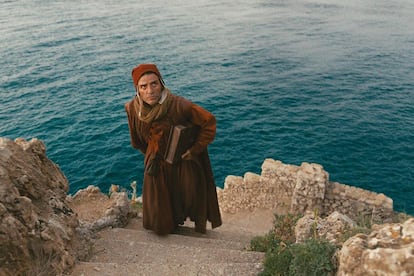

Dante Alighieri’s journey to hell in the Divine Comedy ends when he finally sees the stars again. A few of them also appear in Julian Schnabel’s latest film. And, in a way, they helped the director leave his own abyss behind. Herein is the film’s most involuntary homage to the Italian poet, the nerve center of the project, titled In the Hand of Dante. The feature spent years buried under all sorts of unforeseen events and could well have remained forever in some demonic circle. It premiered, however, on Wednesday at the Venice Film Festival, out of competition. And it displayed its multiple stars on screen: Oscar Isaac, John Malkovich, Al Pacino, Gal Gadot, Martin Scorsese, Jason Momoa, and Gerard Butler. Some had already defined it as a cult film, even before its release. After the screening, one might seriously doubt that. Paradise seems very far away. At least Schnabel has left purgatory.
The film spent two decades in limbo. In 2000, Schnabel shot Before Night Falls with Javier Bardem and Johnny Depp. The latter offered him a string of books to buy the rights to, so he could choose and adapt one. “I chose the most impossible,” the filmmaker told the press in Venice. That is, In the Hand of Dante by Nick Tosches. The peculiar writer, who specialized in biographies and died in 2019, invented in the novel his own search for the original manuscript of Alighieri’s Commedia and the means to authenticate it. In reality, this precious document doesn’t exist. Or hasn’t yet been found. In the fiction, from the book and now the film, the author finds it in a box in the Vatican Library. But the character ends up entangled in his journey, like that of his beloved poet, among swindlers, hitmen, and mobsters, all hunting for the priceless document. But he also finds love. After all, it is what “moves the sun and other stars,” as Dante wrote in the final verse of his masterpiece.
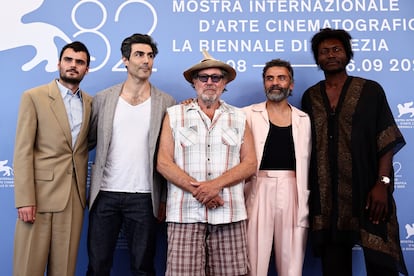
Meanwhile, Depp is no longer involved with the project. He was replaced by Isaac, who was also seduced by its “impossibility,” as he told the press. The actor plays both the contemporary protagonist and the Italian poet. The film sometimes travels from the present-day to Florence in the 1300s, and also visits Rome, Verona, Venice, Sicily, and New York. It also combines poems with swear words, fragments of the Commedia with gunfights, and reflections on history, religion, and art with touches of comedy. Perhaps it was the excessive wait, or his passion for Dante, but Schnabel tries to cover too much, without much clarity. “Everything that lasts too long eventually reveals its defects,” the film says. The footage, here, runs to almost two and a half hours.
Almost nothing, however, compared to the production times. Depp finally bought the rights to the novel in 2008. But filming was only ready to begin two years ago, now without its main driving force. It was halted then by the actors’ strike, which lasted for months, demanding better conditions from the major studios. Schnabel managed to assert his status as an independent artist and obtained permission to continue. He moved forward, filmed, completed his work. And he even obtained a spot in the selection at the Venice Film Festival, where the director had presented his previous film, At Eternity’s Gate, about Van Gogh. But, instead of the dreamed-of world premiere at the Lido di Venezia, In the Hand of Dante had an unwanted debut: it was leaked online. And, when the premiere was finally approaching, the final obstacle arrived: pressure against two of its actors, Gadot and Butler.
Both actors have expressed support for the Israeli government in recent years. For this reason, hundreds of their colleagues, especially Italians with some international acclaim, asked the festival in a letter not to invite them. The proposal, in fact, divided the very movement that signed it: united against the massacre in Gaza, but divided over a ban. The festival rejected the request as “censorship,” but neither of them attended. In their absence, Schnabel replied: “There is no reason to boycott artists. I selected them for their merits as actors; they did an extraordinary job in the film, and that’s what it’s about. We should talk about the film more than this.” The truth is that the film has shown great resilience. “Abandon all hope, ye who enter,” reads Dante at the entrance to Hell. Schnabel must be given at least one credit: he never lost it.
Eleonora Duse shares the adjective with Alighieri’s Comedy: she was also called divine. Some consider her the greatest Italian actress in history, perhaps the most skilled of her era. The superlatives, in any case, were piling up. “The eighth wonder of the new world,” as she is described at the beginning of Duse by Pietro Marcello, a portrait that was seen in the festival competition.
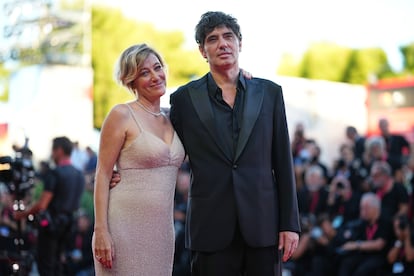
The film recounts the diva’s decline and her attempt to rise from the ashes in 1921, with her return to the theater. More tired, ill, insecure. But still overwhelming, excessive, brilliant, wonderful. It was a real challenge to embody her: Valeria Bruni Tedeschi, the protagonist, passed with a B. The film also depicts a time when other forces rose up, and raised their right arm. Marcello intersperses fiction with archival footage, as he did in the wonderful Martin Eden. Thus, we talk about the First World War, Mussolini, and the poet D’Annunzio, with whom Duse had a famous romance. But, this time, the combination seems less successful. The best part of the film is seeing the star again. How right Dante was.
Sign up for our weekly newsletter to get more English-language news coverage from EL PAÍS USA Edition









































