
Kherson: Born in the bunker, killed in the street
The regional capital of Ukraine under the fiercest siege by Russian drones maintains an underground, armored maternity ward

In Kherson, relentless attacks by Russian drones are killing residents in the streets. Meanwhile, new citizens are being welcomed into the besieged city within the walls of an armored maternity ward: a bunker. It is the solution authorities have found to handle births in the regional capital of Ukraine most under threat by the invasion orchestrated from Moscow. But the rise in attacks has ended up placing the medical center in what is considered a red zone, where the risk of death multiplies.
So far this year, through June 30, civilian deaths in the part of Kherson region under Kyiv’s control — which coincides with the right bank of the Dnipro River — total 138. Sixty-four of those fatalities were because of drones. And in recent days the trickle of victims has not stopped. Of the more than 151,000 munitions fired at the region by Russian forces in the past six months, over 98,000 were attack drones. That amounts to almost 550 a day (roughly double the rate of 2025), of which Ukrainian defenses manage to destroy or intercept about 95%, according to figures provided by Anton Samoilenko, deputy head of the Regional Military Administration.
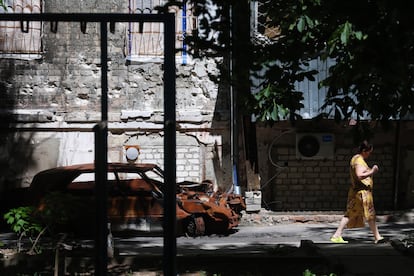
In the two days after EL PAÍS visited Kherson on June 29 and 30, a drone struck a bus, killing two passengers, and a woman died when another exploded in the apartment block where she lived. In addition, a man died while driving his car and a doctor was killed in an attack on a hospital.
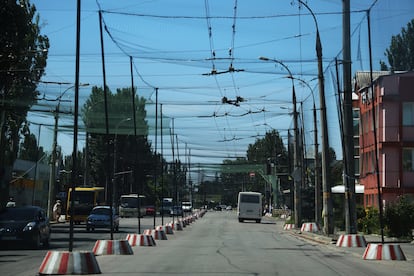
The presence of a Russian kamikaze drone in the sky — alerted by a detector device mounted beside the driver’s seat — forces the driver taking the EL PAÍS reporter to the Kherson perinatal center to take cover until the danger passes. The emptiness of the city’s streets — 75% of its residents have fled during the war — offers no comfort at all.
The pressure of the attacks was felt firsthand by nurse Liuvob Martynenko, 65. Through tears she says she was wounded on June 1 when a drone hit the ambulance in which she was traveling with a driver. He reversed quickly when he saw it coming, shouting “drone, drone,” but it was already too late. Footage from a street camera shows Martynenko running away in panic after the blast. “I don’t know how I’m alive,” she says, and while back at work in the underground maternity ward she shows the shrapnel marks on her left arm.

Despite everything, 57 babies were born between January 1 and June 28 in facilities adapted from an old Soviet bunker that were inaugurated in January 2025 with aid from the EU and the United Nations Population Fund. Last year closed with 136 births registered, according to UN data. These figures are not very high, but they double the number recorded by Kherson’s other maternity hospital, acknowledges the center’s deputy director, Volodymyr Gorbachevskyi, 59.
“We hear the attacks, but they don’t damage this structure,” says Ludmila Lohvynenko, 52, the head nurse. Pointing to the armored doors that separate the facility’s different areas, each with its own street exit, Lohvynenko recalls that on December 5 an artillery bombardment did affect the hospital’s first floor, which is above ground. It happened just as a baby girl was being born in the underground delivery room; her parents later named her Myroslava. Myr, in Ukrainian, means peace.
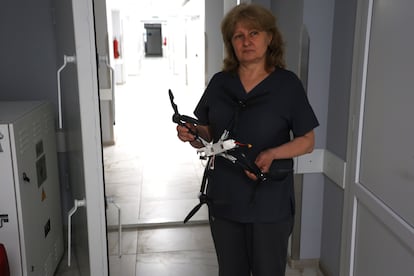
“They attack us so much that, despite the fear, we’ve become used to it,” Lohvynenko adds. She then gets up and returns with one of the unexploded drones Russian troops have used, which they keep as a memento.
Hairdresser Irina Dakaieva, 27, is pregnant with her first child, who will be named Kira. After a complicated pregnancy, especially since week 16, she feels safe in the hands of the nurses caring for her. “I was born here. My husband too; here we have our home and our parents,” Dakaieva says. The couple considered moving to another city for the birth but decided against it because that option also carried risks.
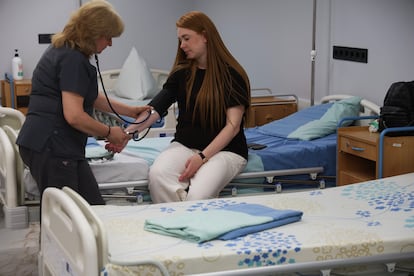
In the same room equipped with about 10 beds where Irina Dakaieva is staying, a nurse takes Olga Sahanska’s blood pressure. The 32-year-old dance teacher is already mother to an 11-year-old girl, Polina, and is now expecting a boy she will name Dmytro. The family lives in Tavriiskyi, the area farthest from Russian positions. That, she says, gives them a degree of normality in daily life. “We walk, which is safer than traveling by car,” she says, noting that she has only crossed into the red zone to reach the maternity ward.
A shield of fishing nets
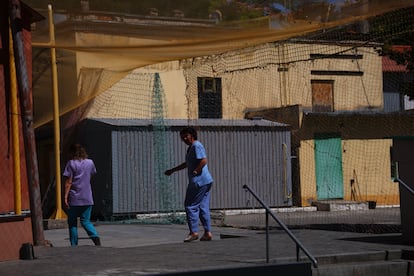
The area around the maternity ward is covered by a structure of fishing nets intended to mitigate drone impacts. There are up to 220 kilometers (136 miles) of these surface tunnels across the region, and a kilometer more is erected each day, according to sources in the Regional Military Administration. The characteristic whir of a drone warns of its approach to the bunker, but no one flinches. It’s just one among many. You can see it fly a dozen meters and hide behind the building before the blast.
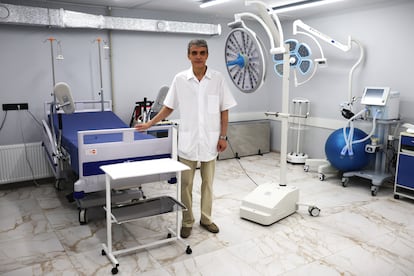
The attacks occur 24 hours a day, seven days a week, says Yurii Spirin, a 48-year-old surgeon, in his office at the Regional Hospital in another part of the city. “Every single day over the past three years we have received some victims,” he says. Many, he adds, arrive with injuries that require surgery by multidisciplinary teams. By day they fall in the street; at night, in their homes. “In Kherson it is impossible to lead a normal life,” Spirin concludes.
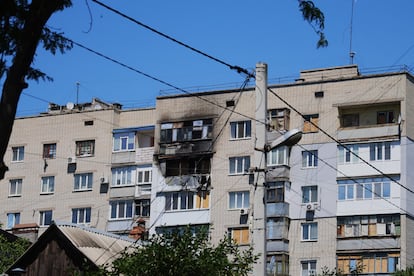
In one of that hospital’s rooms, alongside five other patients, Antonina Tokarchyk, 57, remains hospitalized. On June 20 she went to buy bread in the village of Kyserivka, about 12 miles from the city, and was unable to avoid the drone that exploded in front of her: a constant risk that she and many other residents describe as a “human safari.” Authorities themselves use that term to describe what they consider a hunt for civilians by the Russians.
Residents treated Tokarchyk, quickly applying two tourniquets — one on her left leg and another on her right arm. When medical personnel arrived, they found her in a pool of blood. A piece of shrapnel had lodged between her ribs without damaging her liver. “I found myself breathing and thought it was a miracle,” she says.
Two banks
About 60,000 of Kherson’s roughly 300,000 pre-war residents remain in the city. Many are pensioners who lack relatives or the financial means to leave; others stay to keep families together. The presence of residents, open businesses, and traffic increases as the urban core moves away from the right bank of the Dnipro, about two kilometers wide. Near its mouth at the Black Sea, the river’s curves mark the boundary with the invading forces, deployed on the left bank and who also controlled the right bank for about nine months in 2022.
Karina Samyilik, aged 15, with long eyelashes accentuated by mascara, doesn’t even flinch as the booms of Ukrainian anti-aircraft fire reverberate outside the supermarket in Kherson where she is walking with her friend Angelina Borucka, who is the same age. Samyilik’s mother is Russian and has settled in Ukraine, but they used to live on the left bank of the Dnipro — the side that remains occupied — so they had to flee. Together, they represent the future of a population facing an uncertain outcome to the conflict. They want to study medicine, although they fear that, if the war drags on, they may have to leave “for another city, or another country.”
Sign up for our weekly newsletter to get more English-language news coverage from EL PAÍS USA Edition









































