
250 years of US presidents and none as destructive to the office as Trump
Through corruption and an aggressive expansion of executive power, the Republican risks permanently reshaping an institution whose foundations lie in the Declaration of Independence

For a man so prosaic, Donald Trump lends himself readily to metaphors. The mixed martial arts bout he staged to celebrate his birthday and kick off the commemoration of the United States’ 250th anniversary invited comparisons to a Roman circus. The fiasco of the Lincoln Memorial Reflecting Pool, turned algae-green, mirrors the murky picture of an unpopular presidency. And the White House, transformed into a vast construction site, seems an allegory for his disregard for institutional decorum.
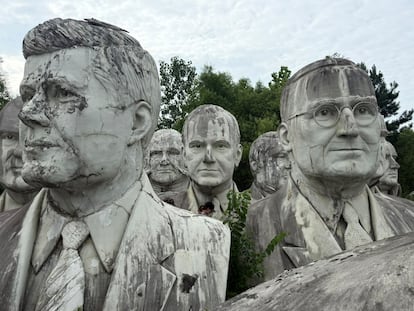
At a waste-recycling facility in Croaker, a small community in Virginia about three hours from Washington, the heads of 42 U.S. presidents have lain abandoned for the past 13 years on a marshy patch of land, exposed to the elements, birds, and summer wasp nests. As the nation reaches its 250th year — deeply divided and in a sombre mood — they too invite reflection on the damage Trump’s return is inflicting on the institution of the presidency. The office traces its origins to the Founding Fathers, who approved the Declaration of Independence on July 4, 1776; this Saturday marked the 250th anniversary of that event.
A year and a half after returning to power, Trump has shattered every precedent with his authoritarian impulses, his imperial ambitions, his disregard for the unwritten norms of the office, and his unabashed efforts to expand executive power. He has also used his position to enrich himself and his family. During his first 12 months back in the White House, his personal fortune grew by $2 billion, $1.4 billion of which came from his cryptocurrency ventures, according to figures published last week by the U.S. Office of Government Ethics.
As Maggie Haberman and Jonathan Swan write in Regime Change, the season’s political book in Washington, Trump has altered the very nature of the presidency and its image around the world. The institutional architecture built and maintained over eight decades has been, in every sense, dismantled, they argue.
In a country forged by precedent, historians, analysts and political opponents ask, like Haberman and Swan, whether the system will be able to absorb the shock of the Trump anomaly and return to its previous form once it has passed. Or whether, to return to the metaphor, the dilapidated condition of the presidential heads in Croaker is in fact a reflection — like the portrait of Dorian Gray — of the decay of an institution and a political system that were unprepared for the arrival of a figure like Trump.
“The Declaration of Independence addresses the question of monarchical authority; the Constitution includes mechanisms to prevent too much power concentrating in a single hand,” historian Daniel Immerwahr, author of How to Hide an Empire, an influential book on U.S. imperialism, explains in an email. “All this is highly relevant in the Trump era, and it’s revealing that the broad civic movement against him uses the name No Kings — language drawn from the [American] Revolution.”
Daniel Gullotta, a professor at the Salmon P. Chase Center for Civics, Culture, and Society, a conservative-leaning institute at Ohio State University, argues that “Trump is by no means the first president to test the Constitution’s limits, nor will he be the last.” “What protects us is precisely the founders’ premise that every president would try to seize more power than the office allows; that is why they designed a structure capable of containing such attempts.”
He continues: “They were not prophets, but they knew enough history to foresee that all manner of figures might arise. James Madison [the Constitution’s drafter] lived to see Andrew Jackson [a president who went down in history for his racist populism] in power and did not like it.”
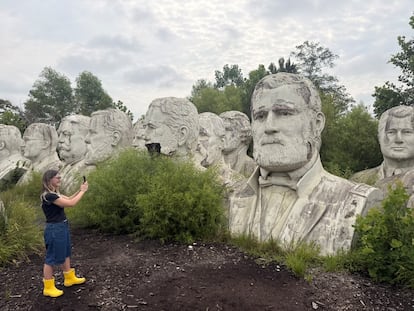
At Virginia’s presidential graveyard, Jackson’s head occupies a prominent position. Madison’s ended up in the back row, wedged between Thomas Jefferson and Millard Fillmore.
The 42 sculptures stand between 16 and 20 feet tall and weigh about 1.5 tons each. They are scattered across a private property that opens its gates only eight times a year to tourists drawn to a visit that seems tailor-made for TikTok. An artist named David Adickes created them for a sculpture park in nearby Williamsburg, a town renowned for its meticulously preserved recreation of colonial America.
The park opened in 2004, which means the lineup runs from one George to another — from Washington to George W. Bush —and stops just before the story becomes truly interesting, with the succession of Barack Obama, Trump, Joe Biden and, once again, Trump.
When the company behind the park declared bankruptcy in 2010, its owners hired a contractor named Howard Hankins, who owned the recycling plant, to dispose of the statues.
“He simply couldn’t do it, because of their artistic value and because Dankins has a passion for U.S. history,” says photographer John Plashal, who, together with Fred Schneider, has spent the past seven years organizing tours of the site where the presidential heads rest among rubble and heavy machinery.
The Presidents Heads tour includes a quiz that tests visitors’ knowledge of presidential history — which U.S. president delivered the longest inaugural address and served the shortest presidency? William Henry Harrison: nearly two hours speaking, only 31 days in office — as well as Plashal’s entertaining account of the many twists and turns in the sculptures’ history. “Those guys that look like they have advanced-stage leprosy,” he jokes.
A nonpartisan attraction
Throughout his presentation, Plashal carefully avoids any hint of partisanship. “This is family fun and a playground for photographers. Democrats, Republicans and independents are welcome. Sometimes someone makes a comment, but generally everyone behaves,” he warns.
During the first tour of the day last Saturday, it was impossible to find anyone who agreed with Trump’s claim that he is “probably” the greatest president in U.S. history. There were, however, two siblings, Rachel and Jake Anszelawicz, who had driven eight hours from Long Island, New York, to satisfy Rachel’s curiosity — she is a devotee of the “misunderstood” Ulysses S. Grant. There were also the Raders, a married couple from Tennessee. Thanks to one of those genealogy-tracing apps, the wife had recently discovered that she is a “distant relative” of George Washington.
There was also a retiree from nearby Richmond named Mike Florence, who said: “Please write that many Americans are ashamed to see what the current president is doing to our country.”
Russell Riley, co-director of the Miller Center’s Presidential Oral History program at the University of Virginia, describes what Trump “is doing” as a “constitutional dictatorship.” He is not the first, the expert says, citing wartime leaders — Abraham Lincoln, Woodrow Wilson — those who faced economic crisis (Franklin Roosevelt) or the aftermath of the 9/11 terror attacks (George W. Bush).
“All of them deemed it necessary to work beyond the usual limits of power to deal with extraordinary emergencies. Once those problems were overcome, the system always returned to institutional normality,” says Riley.
The historian is not so certain that the same will happen after Trump. He also points out that there is currently no “emergency” comparable to those earlier situations, despite Trump’s insistence on “inventing” them. The latest example? An alleged advance of communism within the Democratic Party following the victories of socialist candidates in the wake of New York City Mayor Zohran Mamdani.
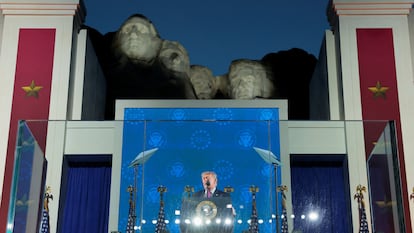
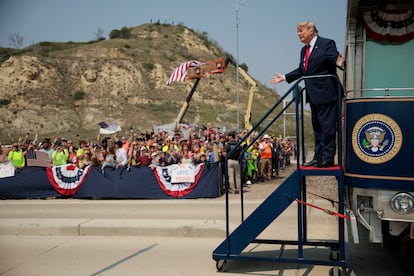
Trump invoked that specter — which, in his view, is haunting the United States — during the rally he held Friday at Mount Rushmore, the monument featuring the rock-carved heads of four presidents (Washington, Jefferson, Lincoln and Theodore Roosevelt) that inspired Virginia’s replica.
“Communism,” said Trump, who sees no reason why his own likeness should not one day join them on the mountain, “is a mortal threat to American liberty. [...] Because Communism is the enemy of free people. Everywhere, everywhere in the world — [it] never works. It’s the enemy of the Constitution. Above all, it’s the enemy of July 4th, 1776."
It was the third of four campaign-style events Trump had scheduled within just 10 days to mark the anniversary, in a display of personality cult unprecedented in modern U.S. politics.
“At the bicentennial [celebrated in 1976], Gerald Ford, who was in office following Richard Nixon’s resignation over Watergate, preferred not to be the center of attention and opted for an inclusive commemoration for all Americans,” Riley notes.
That year was also an election year, but the Republican did not use the celebration to his political advantage (and ended up losing the vote to Jimmy Carter). The same cannot be said of Trump. Republicans risk losing control of one or both chambers of Congress at the midterm elections in November, and the specter of communism is a godsend for Trump given the campaign appears favorable to Democrats and is being shaped by his unpopularity, the war with Iran, inflation and support for Israel.
If Democrats regain the House of Representatives, all signs suggest they will spend the remainder of the congressional term obstructing Trump’s agenda. During his first year and a half in office, he has governed largely through executive orders — deepening what analyst Fareed Zakaria sees as a long-term trend toward presidential power — and has weakened the legislative branch with the assistance of the judiciary, thanks in part to a sympathetic Supreme Court.
On the horizon looms the possibility of another impeachment to remove him from office. “He has nightmares not only about being the first president to go through that twice, but also about the possibility of becoming the first to do it a third time,” Democratic congressman Jamie Raskin, who led the prosecution in Trump’s second impeachment trial, tells EL PAÍS. “I have some advice for him: if he wants to avoid it, stop committing crimes that justify impeachment.”
Riley, the presidential historian, argues that if there is any institutional decline in the U.S. political system, it is most evident in the legislative branch. “Far from serving as a strong counterweight to the White House, it has degraded,” he says.
That decline, he adds, has been brewing for years, but with Trump it has become more “acute and evident.” “The executive branch, inflated and expansive, is completely displacing a legislative branch incapable of reacting almost as if it were being choked out by an invasive species.”
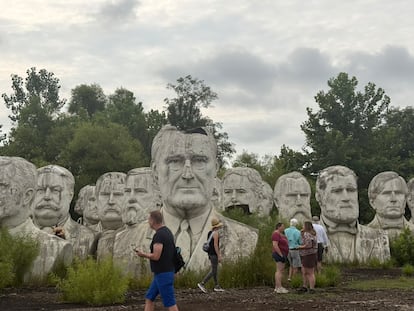
Weeds, too, are running rampant in Virginia’s presidential graveyard. Vegetation sprouts from the head of Franklin Delano Roosevelt, whose crown is punctured by a gaping hole after a bridge sliced off the top of it during the move. Jackson’s has even acquired a comical green ponytail.
The collection is now awaiting a new home. Hankins has sold the property, where — pending local planning approval — a retirement community, hotel, restaurants and retail area are to be built. The current plan is to relocate the 42 presidents to another site, although no restoration work is planned.
“They are charming in their current state of decay,” says Plashal, who estimates that the final tours will take place in September.
Whether the weather-beaten statues will survive the move is far from certain, the photographer warns. And once again, the imagination wanders down the path of metaphor.
Sign up for our weekly newsletter to get more English-language news coverage from EL PAÍS USA Edition









































