
Obstacles at Spanish consulate in Havana hamper Cuban migrants’ legalization efforts
Applicants for residency in Spain denounce a huge backlog to secure criminal records, scams to get appointments and problems from power outages
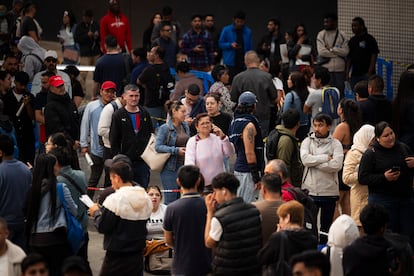

The Cuban community in Spain is encountering particular difficulties obtaining copies of their criminal records, a requirement to be eligible for the mass migrant legalization program announced by the Spanish government earlier this year. A perfect storm has left Cubans anxious about whether the documents requested from their country will arrive in time to apply for a residence and work permit in Spain. To the hardships already facing the Caribbean nation — including routine power outages that affect offices and agencies — is added the backlog that the consulate had already been experiencing since an earlier naturalization process opened for children and grandchildren of Spaniards. This has given rise, say some members of the Cuban community, to an underground business selling appointments at the Spanish mission in Havana for anywhere between €200 and €500.
In Cuba it is not enough to request the criminal records from the Ministry of Foreign Affairs or the Ministry of Justice: that is only the first step, and, the affected Cubans say, not where the problems are being detected. The country did not sign the Hague Convention and, therefore, its public documents must be legalized by the Spanish government — a task handled by the Spanish consulate in Havana. And that is where “the drama” has begun, says Father Bladimir Navarro, founder of Proyecto Cobijo, which assists the Cuban community in Spain. “I think it’s a question of inefficiency, but you also have to take into account the power outages the country is enduring. The lines are endless and chiringuitos are sprouting up that secure consulate appointments for an expensive price, €300 to €500,” the priest explains. “We fear the papers will not arrive in time for the legalization deadline. I myself have been waiting two years for nationality because my grandparents were from the Canary Islands,” he says.
Luis Ángel has been lucky. He requested those documents as soon as word of Spain’s migrant legalization program began to circulate; he has been in Spain for one year and five months, during which time he has worked “caring for the elderly, doing gardening and construction work.” But the process to obtain his records took him “between three and four months,” says the 29-year-old psychologist who prefers to hide his real name. “There is too much corruption in this matter,” he complains.
David, 26, remains on shaky ground. He relied on a company that manages parcels and documents to request the records from the island and, he says, he obtained them, but “they have been stalled at the consulate.” “The lawyer handling my case says the blame lies with the power outages, that there’s no way to work like this,” he says, referring to the recent electricity cuts in Cuba. “I’m very worried; this is a great opportunity and I don’t want to lose it. I’m anxious,” he adds.
The Spanish Ministry of Migrations, which is overseeing the legalization drive, explained at the time that migrants may submit their application accompanied by proof that they requested the criminal records but were unable to obtain them in time. They must also authorize the Spanish Ministry of Foreign Affairs to attempt to obtain them by diplomatic channels. In that case, three months are allowed. If those months elapse without success, the applicant will have another 15 days to secure them on their own. And that is the end of the opportunities. Some people are trying to get their records before submitting their papers; others are waiting for the records with their application already filed.
The office of Dailyn Camilo Valverde in Barcelona is one of the law firms currently processing hundreds of applications for Cubans seeking residence in Spain through the new program. “I have a caseworker in Cuba who handles these procedures, and the difficulties are not on the Cuban side but at the Spanish consulate, which must legalize the documents and has established a Machiavellian system for doing so,” she says. She explains: “First we must send the documents provided by the Cuban government so they can issue us a username and password with which we can request a consulate appointment. As of today, they are still sending logins for files we submitted at the end of February. Then comes the appointment obstacle. You have to constantly watch the website to see if any new appointment slots open up, and that is erratic: one day they release 50, then three days pass without any, and so on,” she says. So far they have managed to secure some consulate appointments for June 22, when the deadline to apply for regularization is June 30. “I have the case of a minor for whom I was asked for additional documents and given 10 days to send them, and I still don’t even have the login credentials,” she complains.
The backlog is so severe that the government has tried another route, Camilo Valverde explains. “Now some registry documents, such as birth and marital-status certificates, can be requested at the Cuban consulate in Barcelona so that their authenticity can be confirmed in Spain rather than at the Spanish consulate in Havana, but that does not work for criminal records,” she says. “The Spanish Ministry of Foreign Affairs will not accept bringing papers obtained in Cuba to Spain to be authenticated here; that route has not been achieved.” The lawyer says the bottleneck began in March; procedures requested in January and February arrived within a reasonable timeframe. “Now they are stalled; I have nearly 100 cases and my lawfirm is small.”
The Spanish Ministry of Foreign Affairs said by email that the consulate in Havana processes about 135,000 legalization applications a year and that there are currently “several thousand people with login credentials to access legalization appointments.”
“Our entire consular network,” they say, “is making a huge effort to absorb the increased demand caused by the regularization process.” They note there is a consular digitalization plan intended to save time and avoid travel, into which €115 million has been invested. They also say a new consulate has been opened in Camagüey, Cuba.
“What is happening at the consulate [in Havana] is certainly worthy of filing a complaint. Appointments are being sold for €200,” says the lawyer Camilo Valverde. Her account matches Luis Ángel’s testimony from Madrid. “I paid €200 just to get the appointment. It’s something known in Cuba by word of mouth. My family obtained it that way. We don’t know whether the people doing this used to work at the consulate or know someone there; we don’t know,” he says.
Luis Ángel left Cuba to study, first in Norway. “The situation on the island is socially and economically horrible, but above all I felt a lack of freedom because of police operations and so on… Now I just want to adjust my status to start a new path, to try to live a normal life with a work permit; that is our collective aim,” explains the young man, who from time to time sends money and food to his family in Cuba. “Little by little, because if we send a lot it spoils, since there is no power for the refrigerator. I send some money, but above all, food.”
Sign up for our weekly newsletter to get more English-language news coverage from EL PAÍS USA Edition









































