
Spain’s mass legalization of migrants puts government services to the test
Lawyers and rights advocates praise the move but complain about a lack of specific information regarding eligibility criteria, as they race to prepare for a caseload that could reach 750,000 applications


In Spain, private lawyers and organizations that work with migrants are concerned about the lack of specific information regarding the documents that foreigners residing illegally in the country will need in order to apply for the regularization program announced by the government. Migrant advocates are also warning about a lack of information regarding the government offices where these documents should be submitted, and the collaborating organizations available in each province.
Hundreds of thousands of migrants could now be eligible for one-year residence and work permits, following the approval of a decree by the Cabinet on Tuesday. The Ministry of Migration estimates that as many as 750,000 applications could be received by June 30, which will test the administration’s capacity to process such a high caseload. Meanwhile, non-profits are lamenting the lack of more detailed information in advance that might have facilitated the organization of a process that the government, led by a progressive coalition under Prime Minister Pedro Sánchez, has described as a “milestone.”
On Wednesday, the final decree will be published in the Official State Gazette (BOE). However, the application forms that will have to be submitted are still unavailable. “We spend all day checking the ministry’s website to see if the forms we’ll have to fill out have been posted,” explains Mónica López, director general of CEAR, one of the leading organizations working with migrants.
She says her team of lawyers is meticulously scrutinizing the decree, trying to decipher the fine print. They know that the five-month residency in Spain required of applicants can be demonstrated with “any legally valid proof, as long as it includes personal data that allows for verification of identity.” This broad language raises some doubts for lawyers, because they still don’t know if a bus pass, a medical report, or a proof of address will be considered valid documents. “Just in case, we are recommending [to foreigners] that they gather all the documents that could prove their identity,” explains López.
These aid groups, along with social services departments, will also have the authority to certify whether an applicant is in a vulnerable social situation, which is one of the optional requirements for being admitted into the process. Again, nobody knows exactly how applicants are expected to demonstrate this vulnerability, other than a phrase in the decree alluding to “the personal, economic, social, psychosocial, family, or housing circumstances” of the undocumented migrant.
“We hope that all these forms will be uploaded soon to the Ministry’s website or the Mercurio platform,” an alternative website that has also been set up for this purpose, says López, who sees Spain’s migrant regularization process as a necessary and positive measure.
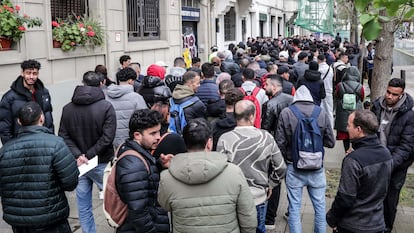
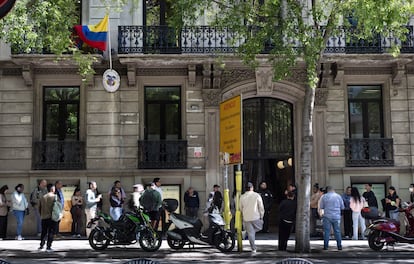
Proving that one has no criminal record will be the biggest obstacle for everyone, due to the difficulty of obtaining these documents from the countries of origin—there are already enormous lines outside consulates across Spain. Ministry sources explained to this newspaper that anyone unable to obtain their criminal record from their country of origin must submit a formal request accompanied by proof that the records have been requested, that they have not been received within a month, and that the Spanish Ministry of Justice is authorized to request them through diplomatic channels.
The government isn’t providing estimates of how many people might be excluded from the process for not having these documents. Instead, officials say they will address each issue as it arises. To this end, the government has opened approximately 450 offices throughout the country and has reinforced staff with more than 550 employees.
“We’ve been waiting a long time for this regularization, which we fully support, of course,” says López of CEAR, but at the same time, she fears “people’s anxiety.”
“Absolutely,” adds Beatriz Cantero Rivero, coordinator of Mujeres P’alante, an organization that has been working in this field for 20 years, when asked if they wouldn’t have liked a little more advance notice to prepare for the upcoming tide of applications. “What will the vulnerability report be like? Will there be an official template, or will we have to design our own? It would have been a relief to have had the forms available a month ago.”
“We are happy, but we are also suffering,” she adds with a laugh over the phone. To her, this regularization “is a matter of social justice.” But she adds that “the range of situations that will arise is enormous,” and they are not sufficiently informed about how to deal with them. “There are children, there are people without passports, because not everyone who arrives by boat has one, nor a travel certificate.”
Regularization is a complex process that can strain administrative services. Postal service personnel will also provide information and assistance to interested parties, as well as handle the administrative aspects of the procedures.
Several ministries and dozens of organizations participated in drafting the text of the regularization legislation, as well as the social platform that gathered more than 600,000 signatures that led to a citizen initiative to bring a bill to parliament. The bill stalled in Congress, and has now been expedited with a government decree that amends immigration laws. Migration Minister Saiz on Wedesday said it has “triple legitimacy: social, political, and economic.”
Before this, Spain carried out migrant legalization drives six times between 1986 and 2005, some of them under the conservative Popular Party (PP).
Sign up for our weekly newsletter to get more English-language news coverage from EL PAÍS USA Edition









































