
Over a million descendants of Spaniards have applied for citizenship, overwhelming consulates
Another 1.3 million are waiting for an appointment. The avalanche of applications in the final months before a deadline expired could delay the process for years. Most applicants come from Argentina, followed by Cuba and Mexico
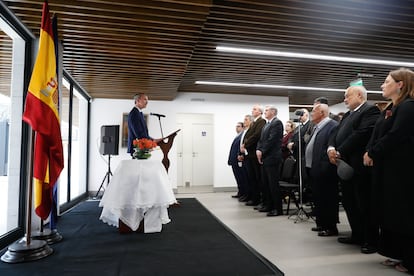

More than one million descendants of Spanish exiles or emigrants have already applied for citizenship under the Democratic Memory Law through the Ministry of Foreign Affairs’ consular network, while another 1.3 million have requested appointments to submit their documentation but have not yet been able to do so due to bureaucratic delays. Of the one million applications initiated, approximately half have already been processed and citizenship granted, although many are still awaiting formal registration, while rejections account for less than 2% of the total.
These are the figures handled by the General Council of Spanish Citizenship Abroad (CGCEE), an advisory body to the government representing the more than three million Spaniards residing abroad. Its president, Violeta Alonso Peláez, speaking to EL PAÍS, urged the government to provide the necessary resources to prevent this avalanche of applications from overwhelming the consular network, comprised of 178 offices, including 86 consulates general and two consulates.
The total number of those seeking to benefit from the new law, 2.3 million people, is 4.5 times the figure reached under its predecessor, the 2007 Historical Memory Law (503,439). Sources familiar with the process estimate that, at the current rate, some descendants of Spaniards will have to wait decades to see their citizenship granted, and the oldest among them could die without ever seeing it happen.
The eighth additional provision of the Democratic Memory Law granted a two-year period, extendable to three, for all those “born outside of Spain to a father or mother, grandfather or grandmother, who were originally Spanish and who, as a consequence of having suffered exile for political, ideological, or religious reasons, or due to their sexual orientation and gender identity, had lost or renounced their Spanish nationality” to apply for citizenship. It also included those born abroad to Spanish mothers who lost their nationality by marrying foreigners before the Spanish Constitution came into effect, and the adult children of those whose original nationality was recognized under the 2007 law, thus filling the gaps left by the earlier legislation.
The final deadline, after the corresponding extension, ended on October 21st, which triggered a flood of applications in recent months that has exceeded all expectations and also the capacity of the Spanish consular network to process them. This has led to a more flexible interpretation of the law, so that the applications of all those who requested an appointment online to submit their documentation before the deadline, but who have been unable to do so until now due to a lack of available slots at the consulate, have been accepted.
More than 40% of the applications, around one million, come from Argentina. After that, the consulates with the next highest number of applications are Havana (Cuba) with 350,000, Mexico City with 165,000, São Paulo (Brazil) with 150,000, Miami in the U.S. with 120,000, and Caracas (Venezuela) with 40,000. This data comes from the CGCEE, as the Ministry of Foreign Affairs did not respond to EL PAÍS’s request for comment.
Violeta Alonso underscored the need to expedite procedures and prevent these processes from dragging on for years. Among other things, the organization she heads has proposed that the more than 7,000 civil registries in Spain collaborate in registering new Spanish citizens, that additional staff be hired, or that more routine tasks, such as document digitization and data entry, be outsourced.
Alonso laments that the enormous amount of work generated by the implementation of the Democratic Memory Law has led to delays in the provision of other services, such as the registration of children of Spanish citizens born abroad. The president of the CGCEE warns that “a redeployment of the consular network is necessary,” since new Spanish citizens, once they obtain citizenship, will require other services from consulates, such as the issuance of passports, birth, marriage, and death certificates, and so on. “It’s not just a matter of increasing staff, although that’s also important, but in many cases, more physical space is needed,” she emphasizes.
It is estimated that the number of Spaniards residing abroad will increase from over three million to almost five million.
A report by the Association of Spanish Diplomats (ADE), the largest association within the diplomatic corps, noted last year that the latest official study found 28 facilities operating at full capacity, 68 with accessibility issues at their front doors, 14 lacking fire protection systems, and at least 17 in poor condition. “Many consular offices are failing to comply with Spanish occupational health and safety regulations,” the report warned.
Sign up for our weekly newsletter to get more English-language news coverage from EL PAÍS USA Edition









































