
The Latin American grandchildren of Spanish exiles return 100 years later
One million Spaniards emigrated to Latin America after the Civil War. Today, their grandchildren — many with dual nationality — are residents of the Spanish capital
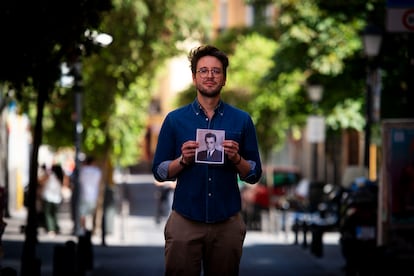

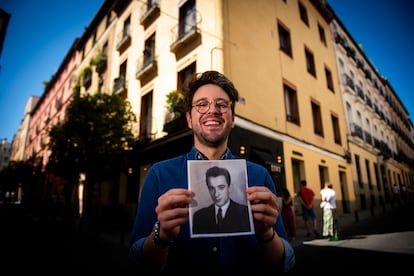
Juan Acevedo Fernández discovered by chance that he was living just steps away from his family’s past. He’s 34 years old and lives on Augusto Figueroa Street in the center of Madrid. One day, while searching for a document to renew his grandmother’s passport, he read an address that sounded familiar: Gravina 7, main floor. It was the building he saw every day when turning the corner.
He looked it up in the city’s property registry, verified the details, and stood frozen. “I said, ‘Wow, I’m living a hundred meters away.’ Without knowing it, I’d come back to the starting point,” he recalls. There, in that very building, on October 7, 1928, his grandfather Jesús Fernández Merino was born. Almost a century later, his grandson had returned to the place where it all began.
Consuelo Naranjo Orovio, former director of the Center for Human and Social Sciences at Spain’s CSIC research center, explains in her book The Migrations from Spain to Latin America since Independence that “between 1880 and 1930 [a period known as the ‘mass emigration’], just under 4.5 million Spaniards emigrated. All regions of Spain took part in this process. Argentina and Cuba were the main destinations, followed by Brazil, Uruguay, Venezuela, and Mexico. The 1929 crisis marked the end of mass emigration. Starting in 1945, departures to Latin America resumed, although the destinations changed and the composition of emigrants was different.”
The Fernández family’s story spans the Spanish Civil War, exile, and Spain’s rebuilding. In 1939, after the fall of Catalonia, a van from Spain’s National Telephone Company — the origin of what is now Telefónica — evacuated several Republican families through the Portbou border in Girona.
Jesús’s father was interned in the Argelès-sur-Mer camp, while the rest of the family settled in Poitiers, where Jesús grew up under Nazi occupation. In 1950, they emigrated to Caracas on a humanitarian flight.
Three years later, the French construction company Campenon Bernard sent him to Colombia to work on the Bajo Anchicayá dam in Valle del Cauca, on the Colombian Pacific coast. He married, settled down, and founded a distributor of Spanish technical books that became a well-known name in the industry. He never wanted to change his passport. “He said that if he became a citizen, he’d have to stop being Spanish — and he never wanted that,” Juan recalls.
At home, they ate dinner late, drank vermouth, and spoke with a Madrid accent. Long after-dinner conversations, books, and the way stories were told kept the family connection alive. “My grandfather used to say his perfect place was somewhere in the middle of the Atlantic, not knowing whether he was coming or going.”
In 2016, Acevedo began working in Bogotá for a Spanish communications agency. Years later, he was offered a transfer to Madrid. “My grandfather always wanted to return, but couldn’t. So when the chance came, it was an instant yes.”
When he arrived, he lived in several places in Madrid, all near old family addresses: Campoamor, General Pardiñas, Gravina. “I’m not starting from scratch. I’m continuing a story.” Acevedo has held Spanish nationality since birth, but he doesn’t think that’s what matters most. “I feel very Latin American, and also deeply Spanish. Every time I walk past Gravina, I feel like something has come full circle. That my grandfather is there, that the exile wasn’t in vain. I feel like we’ve all made a long journey back home. And this time, we’ve made it.”
Like Acevedo, more and more grandchildren of Spanish emigrants are returning to Madrid, completing a family cycle of departure and return. Some come for work, others to study — many with European passports from birth, and others having recently regained citizenship thanks to the Democratic Memory Law, which since 2022 allows descendants of exiles to obtain Spanish nationality without residing in the country. Migration, as always, flows in both directions — though some would rather forget that.
Between the 1950s and 1970s, more than 80,000 Spaniards settled in Colombia alone, according to the Francisco Largo Caballero Foundation, which published a study in 2009 on Spanish emigration to Latin America. Fleeing the dictatorship and the poverty of the postwar years, these Spaniards integrated into industrial, agricultural, and commercial sectors. In cities like Bogotá, Medellín, or Barranquilla, they built community networks that still endure.
In Colombia’s capital, for example, places like the Casa de España were cultural hubs of the Republican exile. Some children of exiles studied at the Colegio Reyes Católicos, which follows the Spanish education system and is now part of Spain’s network of public schools abroad. In many homes, memories of Spain survived through accents, recipes, and photo albums. Today, more than half a century later, the grandchildren of those migrants walk the streets of Madrid.
Diana Cid, a 27-year-old Venezuelan journalist, has lived in Madrid for a decade. Three of her four grandparents were Spanish. Her paternal grandparents, from the Spanish region of Galicia, emigrated to Caracas in the 1950s — he in 1957, she in 1960. They were farmworkers fleeing hunger.
“My grandfather was one of those thousands of Galicians who boarded a ship in search of work and opportunity,” says Cid. In Venezuela, her grandfather worked in agriculture, construction, and as a building superintendent. Her grandmother was a cleaner. They never returned, but never disconnected either. “They watched Spanish TV, talked about their hometown, and about how hard it had been to leave,” she recalls.
Cid grew up eating cocido gallego [a traditional stew] in Venezuela’s sweltering heat and humidity: “One morning it was arepas, the next, Galician bread with whatever was available.” Her memories are full of contrasts. “My grandfather brushed his teeth for the first time at 18 in Caracas. My grandmother tasted butter for the first time on the ship to Venezuela.” They were humble migrants, but they managed to get ahead. They bought a house, educated their children. “They built a life there that they never could have had in Spain.”
Today, Cid walks through the city her grandparents never returned to. She arrived with a Spanish passport and a clear sense of purpose: she wasn’t just passing through. “I always knew I wanted to stay.” The first time she visited Galicia, things clicked into place. “I understood why my grandfather always searched for greenery in Caracas. That landscape was his refuge.” For her, migration was also a way to recover a borrowed memory.
José Luis Díaz García, a 53-year-old industrial engineer, arrived in Madrid 14 years ago. Like many others, his story is one of opportunity and roots. His partner was Venezuelan, and he had Spanish nationality through his grandfather, who was born in the town of Ólvega, back when the region was still called Old Castile rather than Castilla y León. That’s how his grandfather wrote it in his diary, which Díaz read many years later. It tells the story of a man who left Spain in 1923, first traveling to Cuba and later settling in Colombia, where he founded one of the first photography shops in Pereira, in the heart of Colombia’s coffee region. He became Kodak’s second distributor in the country.
“He migrated with practically nothing and ended up building a fortune. He was a pioneer,” his grandson recalls. The business left behind a photo archive that is now part of the city’s history. “He had a strong character, was very charismatic, and turned everything he touched into an opportunity,” says the Spanish-Colombian Díaz.
According to Spain’s National Statistics Institute (INE), around 9.3 million people living in Spain today were born abroad — of these, four million were born in Latin America. Of that total, roughly 30% have acquired Spanish nationality, meaning many retain the citizenship of their country of origin. Behind many of these dual nationalities lie migrations that are, in fact, returns.
Díaz grew up with chickpeas, sevillana music, and copies of ¡Hola! magazine arriving by airmail. “My grandfather was a monarchist. He listened to shortwave radio and kept up with everything happening in Spain,” says Díaz.
That shared identity lived on in small details: the names of farms, family temperaments, certain traditions. When he landed in Madrid for the first time, Díaz didn’t plan to stay — but he did. “It felt like a revelation. I walked down Gran Vía and started recognizing things I had only ever heard about. Everything made sense.”
Decades later, he returned to Ólvega and even met the grandchildren of his grandfather’s siblings. “I feel a sense of responsibility as a migrant. You represent your country, but also the family that once left with nothing. My grandfather was welcomed with open arms in Latin America. Now that I’m here, I try to honor that story — with work, respect, and remembrance.”
Migration is one of the far-right’s favorite targets, but official data points to a quiet and legitimate transformation. More than one million Latin Americans live in the Madrid region, according to the latest INE figures. Often, those returning don’t even realize they’re walking the same ground where it all began. Other times, they seek it out intentionally. But all of them carry a story with them — the story of human migration, as old as humanity itself.
Sign up for our weekly newsletter to get more English-language news coverage from EL PAÍS USA Edition









































