
The Luxembourg paradox: A record number of working poor in the EU’s wealthiest country
The contrast between the high cost of living and housing and the difficulties faced by part of the population puts a strain on the social model of the small Central European state


Every morning, tens of thousands of people cross the border to work in Luxembourg, drawn by some of the highest wages in Europe. Countless others have emigrated from all corners of the globe to a country where wealth is measured in record numbers. Poverty, on the other hand, is hidden in less visible statistics and in lives that don’t fit the Grand Duchy’s image of prosperity.
A short woman wearing a striking leopard-print hat pays the 50 cents for her meal and joins the queue at the soup kitchen run by the NGO Stëmm vun der Strooss (Voice of the Street). She agrees to explain why she’s there — most of the other patrons won’t — on the condition that she doesn’t reveal too much information. Madame Moufida, 67, will suffice. A French national, she worked for over 15 years “in almost everything: hospitality, a museum, a healthcare center...” She explains that a bureaucratic issue is holding up her pension and that, while she tries to resolve it, she lives on €300 a month (around $355) and sleeps in a nursing home. The soup kitchen is a necessity for her.
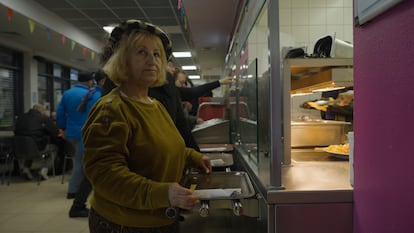
It’s not so bad for Jhoana Rojas, a 46-year-old Venezuelan lawyer who works as a cleaner. She lives with her husband, a construction worker, and their son is in France, just across the border. “It’s impossible here,” she says with a smile. She doesn’t consider herself poor, but money is tight. “I work nearby, and eating here doesn’t cost me that much,” she explains.
The 50 cents is symbolic. It’s requested so users can appreciate the service, explains Bob Ritz, a spokesperson for the NGO. But if someone arrives without money, they’ll still get a meal. There’s also free laundry, a clothing bank with all kinds of donated garments, showers, a medical consultation, and a social worker.
On this rainy Thursday in February, the menu consists of chicken and rice or sausages. Two elderly women, Ukrainian refugees, greet each other but sit at separate tables with their trays. Many of the diners are homeless, of all ages. Others have jobs. They earn minimum wage, or have weekly contracts, or work off the books. Some are delivery drivers, like a man from Madrid who says he never imagined living like this at 30.
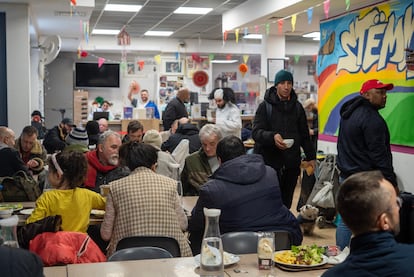
Ritz’s organization has witnessed a decline in the country with by far the highest per capita income in the EU. In 2015, they served 50,000 meals a year in this soup kitchen (they have three others); now they serve over 100,000. The profile of those who benefit has also changed. “Ten years ago, it was mostly homeless people who came; now we have more and more working poor,” he says as his colleagues take the opportunity to eat before they open the doors.
“In the last two years we have also seen single mothers with children and retirees whose pensions are not enough to live a decent life in Luxembourg,” he adds.
The cost of living, and especially rent, explains the peculiar distribution of the working population. Some 230,000 workers in a country of around 690,000 inhabitants come from neighboring countries: Belgium, France, and Germany. They are the so-called “border workers,” and increasingly, Luxembourgers are being forced out by high housing prices, as Djuna Bernard, a Green Party MP, explains in a downtown café.

With the highest percentage of workers at risk of poverty in the EU (13.4%), Luxembourg embodies an extreme paradox: high salaries in banking, insurance, and investment funds coexist with the precariousness of an increasingly large segment of the population. This precariousness is not mitigated by the highest minimum wage in the European Union, which in 2026 amounts to €2,704 ($3,195) gross per month. “With the housing situation and the risk of poverty, which is much higher for people of migrant origin, coming to Luxembourg is becoming less and less attractive, and that is a structural problem for the country because we need workers,” says Bernard.
This striking contrast, as Social Democratic MEP Marc Angel points out, is not an exception, but rather the most visible expression of an inequality that permeates all of Europe. The major destabilizing factor — in Luxembourg and throughout the Union — is housing, as a recent report by Eurofound, the European agency that studies living and working conditions, highlights. High rental costs, in particular, absorb a disproportionate share of the income of lower-income households, limiting their ability to cover other basic needs and exacerbating inequality, the agency notes.
“Eurofound warns that the middle class is shrinking across Europe, and this is causing many people to fall into the trap of the far right. For years the housing crisis has been considered a matter for member states, but it is a European problem and must be addressed as such,” says Angel, who, as a Luxembourger, is well aware of how the current government of his country, a coalition of conservatives and liberals, is tackling poverty.
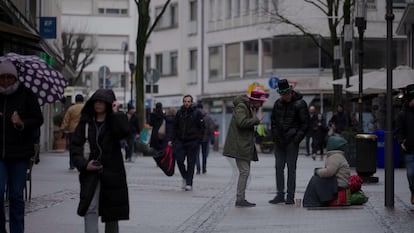
Begging has been the subject of heated debates in the country in recent years. At the beginning of 2024, the City Council in the capital decreed a ban on begging in the streets of a large part of the city center, with fines ranging from €25 to €250. It justified the measure by citing the increase in organized and aggressive begging, but critics like Angel and Bernard denounce it as a “criminalization of poverty.” “It’s a populist and very dangerous discourse, and all it does is hide the problem and shift it elsewhere, not address its root causes,” says Bernard.
Grand Rue, the main pedestrian and commercial thoroughfare in the city center, shows that begging has not disappeared. Last Thursday afternoon, several people could be seen asking for money. There are fewer than before, some passersby say, but the phenomenon persists, although more dispersed and, above all, less visible. Many, taking advantage of the fact that public transport is free in Luxembourg, moved to smaller towns when the ban came into effect. These small towns ended up complaining to the government because they lacked the resources to care for them.
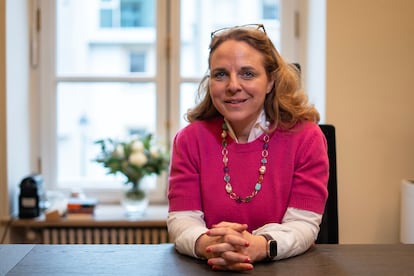
“The message was: don’t come here to beg, and I hope that was understood,” says Corinne Cahen, councilor for social action, in her office at City Hall, just a few meters from the Grand Rue. The liberal politician, a former minister of social affairs, maintains that there was a problem with people traveling to Luxembourg to beg because it is a wealthy country. Her government, she says, is focused on creating social housing to serve those who live in the country, “so that workers don’t spend almost their entire salary on rent.”
Ángel Batum, a 55-year-old from Málaga, Spain, crossed the line between work and precariousness a few months ago. He was employed as a formwork carpenter on weekly contracts until an attack at Luxembourg’s central train station landed him in hospital. When this newspaper found him at the soup kitchen, he was still recovering, unable to work, and unable to return to Spain because his documents were stolen. “Here you get a plate of food, a shower, clothes — they’re very charitable — but when it comes to work and housing, forget about it,” he lamented.
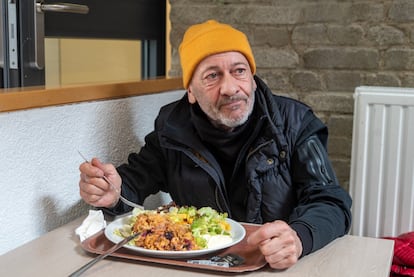
He has seen both sides of Luxembourg. The first time he emigrated to the country, five years ago, he had a job contract and a place to live. A completely different life, he says. Now he sleeps in a shelter that only opens in winter.
“There’s no middle class here. You either work and have money, or you don’t work and end up begging in the streets.” “People come thinking Luxembourg is paradise, that it’s easy to get a job paying €4,000 or €5,000, but when they arrive they realize they can’t find work or anywhere to sleep and have to resort to soup kitchens.”

Sign up for our weekly newsletter to get more English-language news coverage from EL PAÍS USA Edition









































