
Destruction of millennia-old Gaza City robs inhabitants of the landscape of memory
Architects, urban planners and historians describe devastation that goes beyond physical eradication of infrastructure to undermine the identity of the Palestinian people
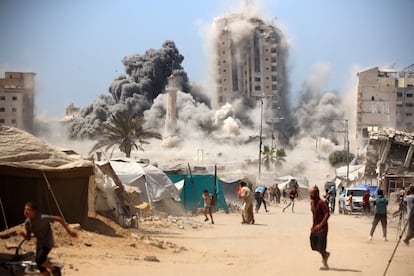

The rubble of Gaza City is not only comprised of stones and walls. “These ruins are now the witnesses to our pain,” says 38-year-old Doaa Ulyan, in a hoarse audio message sent from the Palestinian lands where she spent her childhood and youth. Despite all the difficulties brought by the Israeli occupation, and the blockade that has been in place since 2007, Ulyan had built “a happy life.” She loved her work at a development program funded by the World Bank. She had a light-filled house from which she could glimpse the Mediterranean Sea and where she lived with her two children, 14-year-old Rezeq and 10-year-old Abdullah, who went to school and played soccer.
They’ve all managed to survive these two years of Israeli military offensive. But of the life they had before, whispers Ulyan, only “ashes” remain.
Attacks have destroyed the landscape she once knew. Their neighborhood, Al Rimal, the jewel in the crown of the Gazan capital due to its cultural dynamism, schools and skyscrapers, has been reduced to rubble. On September 5, the Israeli military dynamited the Mushtaha Tower, Gaza’s tallest building, which was located on the same street as Ulyan’s house before it too was destroyed in an attack. More than 53 million tons of ruin now cover an area where all is gray.
“If you destroy the city, you destroy the living conditions of its inhabitants. Not just in the biological sense, but also the cultural one. It’s an indirect way to kill,” the architect Eyal Weizman says via telephone from London. He is the founder and director of Forensic Architecture, and describes “a slow death” caused by these other “less spectacular” methods, as compared to “the shooting, the bombing and the hunger.”
It is also possible to kill by destroying that which allows a population to survive. “Human beings are like mussels without a shell. Our shells are the houses, hospitals, institutions and infrastructure we need to build to sustain life,” the architect continues. “We know that 40% of dialysis patients in Gaza have died because there are no hospitals,” he says.
The official list of deaths on the Gaza Strip exceeds 68,000 names. Another 11,000 corpses remain underneath the rubble, according to numbers from the United Nations. But many other victims, like the dialysis patients mentioned by Weizman, are invisible.
Israel has not only killed. It has also erased the landscapes that allow people to recognize their own history, to situate their memories in their proper setting. “They’ve destroyed nearly everything. There is no longer anywhere that preserves our memories,” laments Doaa’s sister, 32-year-old Malak Ulyan, from her new home in Granada, in southern Spain.
Malak recalls one of the places from her childhood that the Israeli offensive has taken from her. “It was called Al Baqa (Bouquet of Flowers) and it was a seawall that extended into the water for several meters. It was shaped like an enormous boat.” She remembers how the children of Gaza loved “that sensation of navigating a big ship” on the high seas, one they could only imagine given that the Israeli blockade banned such vessels from landing on their shores. Israel only allowed small fishing boats to enter this area of the Mediterranean, and required they stay within a short distance from the beach.
Scorched earth
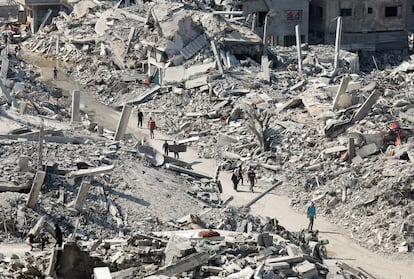
The Israeli attacks have turned the lands of millennia-old Gaza — a territory that has been home to a succession of cultures for more than 5,000 years — into a tabula rasa “where you can’t distinguish between highways and sidewalks, the private and the public, the agricultural and urban,” describes Weizman. “Everything has become like the surface of the Moon, an indistinct desert with no inscription”.
In August, before Israel’s last invasion in September of the Gazan capital prior to the ceasefire that entered into effect on October 10, Google Maps updated its satellite images of Palestinian lands. Not even the expression “scorched earth” can accurately describe it: aerial shots of at least 92% of its housing stock destroyed and damaged (according to United Nations figures). All universities have been bombed or blown up, and eight of every 10 roadways have disappeared or are unusable.
Weizman does not use the term “urbicide” (the deliberate destruction of a city) to describe this devastation. Instead, he speaks of genocide. Lebanese urbanist Soha Mneimneh agrees, by telephone from Beirut. “Urbicide is yet another phase of genocide. The risk lies in focusing too much on the destruction of buildings and not on that of people,” she says.
Malak Ulyan has not only lost the beloved places of her childhood in this war, like the Al Baqa wall or Palestine Street, which she took to get to school and which Israeli tanks destroyed on September 30. Most importantly, the bombs have taken the lives of three of her teenaged nephews and nieces — “I never forget them,” she repeats — as well as friends she grew up with.
She lists their names: Nesma and her sister Haya, the “very close” Israa and Nora. “Nora,” says Malak with difficulty, was a “smiling, dear girl, who had a heart as pure as water.” As teenagers, Nora secretly lent her a mobile phone at their high school, Al Rimal, which was also partially destroyed in a bombing.
A key, a scent
The smell of Malak’s childhood is now also just a memory, that of the jasmine and orange blossom planted in the gardens of the “small and tranquil” houses on Al Nasr Street in Gaza City. In one of them lived her maternal grandparents. Her grandfather guarded a treasure: the key that opened the door of the family’s home in Wadi Hunayn, in the center of what is now Israel.
In 1948, at the beginning of the exodus of the Palestinians, the Jewish militias that preceded the Israeli military destroyed the town and expelled its inhabitants. The Ulyans’ grandfather was one of the 200,000 Palestinians who took refuge in Gaza. That same year, 750,000 people fled or were expelled from their land during the Nakba (which translates to “catastrophe”), the original sin of Israel’s creation. In the offensive that began in October of 2023, the Israeli military destroyed the Ulyans’ grandparents’ house, their jasmine plants and their orange trees.
Israel is now applying the Nakba’s same pattern of “ethnic cleansing and destruction” to Gaza, says Mazin Qumsiyeh from Bethlehem, in the West Bank. He is a biologist and director of the Palestine Institute for Biodiversity and Sustainability. “You can’t colonize without ecocide, without genocide, without urbicide,” says the professor. To take over “the land” it is necessary “to kill the indigenous population” and build anew “in the image of the colonizer [the Israelis],” says Qumsiyeh. “War is also an architectural issue,” insists Weizman, because “it destroys and remodels at the same time.”
Destroy to rebuild
Salman Abu Sitta is 88 years old. He was 10 when a group of European Jews — he cites some of their names, a Russian, a Ukrainian, a German — from the Haganá militia razed his town of Maeen Abu Sitta, “some two or three miles from the border wall” that now encloses the Gaza Strip and that did not exist at the time. The engineer and historian, who has dedicated his life to rebuilding the memory of Palestine, became a Gazan refugee.
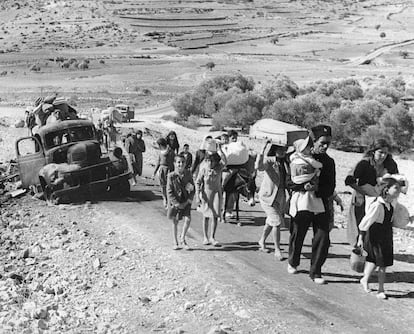
Those armed European men, Abu Sitta remembers, destroyed the landscape of his town, setting it on fire and razing its homes and the school his father had built. They would later build atop the site where the Palestinian community had stood. Four of the kibbutz that were attacked by Hamas on October 7, 2023 were located on the lands that had been plundered from the Abu Sitta family. The historian believes that, similar to what happened during the Nakba, Israel looks to “destroy the Palestinian people, its memory and its identity” with its attack on Gaza. So far, this goal has not been successful. “I will never forget my homeland,” he says.
In Gaza, Israel has invented a new kind of destruction, says Weizman. “I call it the uprooting, or rootless destruction,” he says, meaning, “using an excavator, digging its shovel into the ground and razing everything on and below the surface.”
This has even happened in cemeteries. Malak and Doaa’s grandfather was buried with his wife in Gaza’s Sheikh Redwan cemetery, which is among the burial sites that Israel has bombed, even running bulldozers over graves in some cases. The Ulyan sisters do not know what has become of their grandparents’ tomb.
“The city is also the site of memory,” says Weizman, and cemeteries “maintain our relationship with the past, with our ancestors.”
In Gaza, the past is long. Palestinian lands, says Weizman, have been “inhabited continuously for between 5,000 and 9,000 years.” “If you dig anywhere on the coast, you will find archaeological remains. It’s like a linear archaeological site,” he notes.
The territory was populated by Canaanites, Philistines, Assyrians, Babylonians, Persians, Egyptians, Greeks and Romans before becoming part of the Umayyad, Abbasid and Fatimid caliphates and finally, the Ottoman Empire and the British Mandate of Palestine. Herodotus mentioned Gaza as early as 4th century BCE. Alexander the Great and Napoleon passed through the area.
On September 14, the Euro-Med Human Rights Monitor organization stated that Israel “deliberately targets historical, archaeological, religious, and cultural sites in Gaza, especially in Gaza City,” in the pursuit of “erasing the material and spiritual symbols of the Palestinian people.” At least 110 historic sites have been destroyed or damaged, according to UNESCO.
Weizman is not optimistic about plans for their reconstruction. The strategic goal “of this genocide was to expel the Palestinians from Gaza,” he says, something that Israel “has not achieved throughout this war.” There is also an attempt underway to create concentration camps in the south,” he says. Weizman believes that these reconstruction plans “could be the continuation of the genocide through other mediums.”
“The construction companies will say that they cannot work with people at these sites. So they will concentrate the population in certain places. All the plans I have seen for the reconstruction of Gaza are based on the footprint of destruction,” says Weizman.
At the moment, U.S. President Donald Trump’s ceasefire has allowed Israel to gain military control of 58% of the Gaza Strip. Palestinians cannot enter this space, which takes up more than half of what was once Gaza. If they do, they are shot. More than two million people are now crammed into the remaining 42%, living among ruins.
Sign up for our weekly newsletter to get more English-language news coverage from EL PAÍS USA Edition









































