
US inflation jumped to 3.3% in March, the highest level in two years, driven by the war in Iran
Prices record their sharpest monthly increase — 0.9% — since May 2022, at the outset of Russia’s invasion of Ukraine
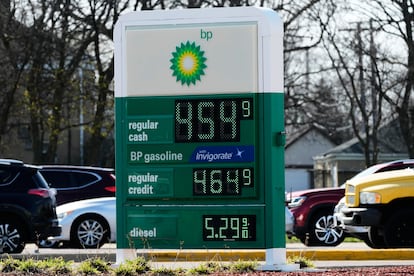

The consequences of the war in Iran are unavoidable. Inflation is resurging as missiles fall on Tehran, and the specter of a new price crisis is rekindling fears among central banks. Inflation climbed to 3.3% in March in the United States — the highest level since April 2024, during the comedown from the price surge triggered by Russia’s invasion of Ukraine — according to the Bureau of Labor Statistics (BLS), which compiles these figures.
“The Consumer Price Index for All Urban Consumers (CPI-U) increased 0.9% on a seasonally adjusted basis in March, after rising 0.3 percent in February,” the agency said in a statement. This is the largest monthly increase in four years; prices haven’t risen this sharply in a single month since May 2022.
Prices rose most notably for airfare, clothing, furniture and household goods, education, and new vehicles. Prices for healthcare, personal care, and used cars and trucks fell during March.
The spike in prices was fueled by rising energy costs. “The index for energy increased 10.9 percent in March, the largest monthly increase in the index since September 2005. The gasoline index increased 21.2 percent over the month, the largest monthly increase since the series was first published in 1967,” said the BLS. The increase in gasoline prices accounted for almost three-quarters of the total monthly increase across all categories. Diesel prices rose by 30.7% during the month, the largest monthly increase since February 2000.
Nearly four years after Russia invaded Ukraine, another war is making headlines. The U.S. and Israeli attack on Iran in late February has triggered another unprecedented energy crisis. Tehran’s reaction has been to close the Strait of Hormuz, a strategic waterway through which a fifth of the world’s oil passes. Crude oil prices have skyrocketed as a result. Brent crude, the European benchmark, reached around $120 a barrel, almost 70% higher than at the start of the conflict.
This maritime route also carries a significant portion of the world’s natural gas and other essential chemicals for the pharmaceutical and fertilizer industries, which are critical to the agri-food sector. The most visible consequence of this is the rise in fuel prices. In the United States, a gallon of gasoline is over $4, while diesel is trading at around $5.5 and has already reached record highs in a dozen states.
“The shelter index also increased in March, rising 0.3%. The index for food was unchanged over the month as the index for food away from home rose 0.2%, while the index for food at home fell 0.2%,” said the BLS report.
Core inflation, which excludes the most volatile items in the shopping basket, such as food and energy, rose 0.2% in March.
The renewed pressure on prices puts the U.S. Federal Reserve in a difficult position. The institution had been looking for arguments to deepen its rate‑cutting policy, something U.S. President Donald Trump has publicly called for. Now, with inflation rising, the goal of lowering borrowing costs at least once more this year becomes more complicated. Analysts say everything will depend on how long the conflict in the Middle East lasts and whether oil traffic through the Strait of Hormuz remains closed. In any case, there is growing support for the idea that, instead of cutting rates, the Fed should consider raising them.
IMF Managing Director Kristalina Georgieva said Thursday that central banks must be prepared to raise interest rates if inflation continues to rise.
“There have been calls recently in certain quarters to raise interest rates to counteract the commodity inflation we’re seeing,” explained Damian McIntyre, an analyst at Federated Hermes. “That seems inappropriate, given that this inflation isn’t stemming from excess demand that the Fed could curb with a rate hike.”
Sign up for our weekly newsletter to get more English-language news coverage from EL PAÍS USA Edition









































