
Nina García, editor in chief of ‘Elle’: ‘My mission is to share Latino excellence in the United States so that no one is ashamed of their heritage’
The first Latina to take the reigns of one of the industry’s most important magazines talks with EL PAÍS about the recent wave of changes in the fashion world, and representation in the media
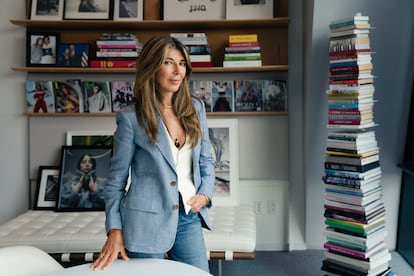

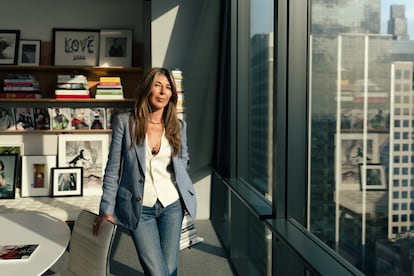
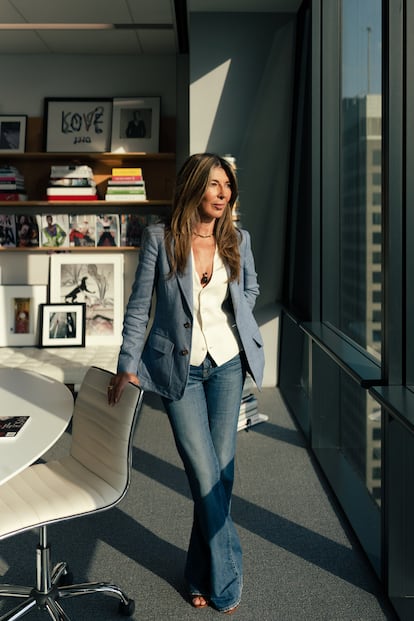
From the 24th floor of the Manhattan’s Hearst Tower, Nina García directs the U.S. edition of Elle, one of the great titles in fashion, with 50 editions worldwide. Though now part of the Heart media empire, it was founded in 1945 by a French woman who bet on the concept of a women’s magazine that mixed articles on fashion, beauty and politics. This year, that publication is celebrating its 40th anniversary by staying true to its DNA, though the digital revolution has pushed it to become an entertainment platform with a focus on pop culture. “My daily job is to think about how we connect with the audience, how we get to more people, how we create a cover that goes viral. It’s a big challenge,” comments García on a phone call with EL PAÍS, on a pause in her busy New York Fashion Week schedule.
The story of this 60-year-old Colombian, the face of the American Dream and author of four books — among which are the bestsellers The Little Black Book of Style and The One Hundred — is undoubtedly characterized by her long-ago decision to emigrate. “I left my country when I was 15 year old. My parents were very worried about what was happening with the FARC and drug trafficking [in the 1980s] and with a lot of work, they gave me the opportunity to study in the United States. I got my high school diploma and went to college, but I was on my own. I didn’t know anyone. I only had a dream,” she remembers.
After getting degrees from Boston University and the Fashion Institute of Technology, she began her career in the Perry Ellis public relations department and some time later, touched down at Elle as an associate editor. There she stepped into the position of fashion director until 2008. Then, she began as creative director at Marie Claire before returning to Elle in 2017 as head of the publication. “It was a wonderful way to complete the circle,” says the current editor-in-chief, who is also known for her role as a judge on the first reality competition for fashion designers, Project Runway, where she has teamed up with supermodel Heidi Klum, Michael Kors, Christian Siriano and Zac Posen for 21 seasons of a show that seems unending.
Q. The major fashion houses are reporting less earnings, and are switching up their creative leads. Everything appears to be in motion. Is the fashion industry in crisis?
A. When I got started, this business was very insular and now, it has become incredibly public. We are at the other extreme of the spectrum. Today, there are many more shows and you have to be everywhere. For creatives, that means enormous pressure. There is also a contradiction in the way that we consume luxury, then and now. How are you going to continue to want to be exclusive when you are communicating exactly the opposite? The world in which we live is going through a lot, and fashion is a mirror. I’ve always said that. There is a wave of uncertainty and we’re feeling it. All these businesses are changed, creating strategies and restructuring internally… But we trust that we will continue to evolve.
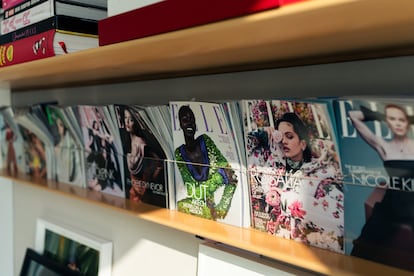
Q. The new head of editorial content for the U.S. edition of Vogue, Chloe Malle, leans towards reducing the number of printed copies and offering collectible issues. How does the future of print look to you?
A. Print has power. You know that what you are reading has been factchecked, read and edited by many people. Nowadays with AI, I see things on my telephone and I don’t know what to think — is it a real or fake image? Still, I’m not one of those people who thinks AI is bad. I believe that it will help us to optimize a large part of our content, but now more than ever, it’s necessary to factcheck and trust in what you read. Print will never die.
Q. How difficult is it to build a career as relevant as yours in New York, as a Latina and an immigrant?
A. In my early days, the great editors were nearly all blond, with blue eyes and British: Anna Wintour (former Vogue editor and now the company’s chief content officer), Tina Brown (former editor in chief of Vanity Fair)… I didn’t have any reference points. It was hard to get a visa and a job, but I fought very hard to demonstrate my worth at every opportunity that arose. Was there racism? Undoubtedly. There always has been, but when you come across it you have two option: let it affect you or keep going forward. Even traveling was a problem, because I had a Colombian passport. You have no idea everything I had to go through, but none of it stopped me. I wanted to pay back my parents’ effort with my professional success.
Q. In 2017, you became the first Latina to be editor-in-chief of one of the world’s great fashion magazines. Eight years later, you’re still the only one.
A. That was a wonderful moment. I am so proud of this brand, because its vision of fashion has always been very inclusive, celebrating women of all races, sizes, nationalities. The magazine turns 40 years old in 2025 and for months, we have been looking back at old issues. It’s incredible to see proof of how that perspective has always been there. It feels like a magazine from today.
Q. Still, fashion’s interest in inclusion and diversity seems to be fading these days.
A. Not for us.
Q. Since your return to Elle, Latin talent has become an ongoing feature in the publication’s editorial line.
A. That is my mission. Nearly 20% of this country is Hispanic. We are very quiet and scared, but we have to be proud of all the wonderful things that we bring to this country. It’s a difficult moment. It’s important to be empathetic with others, but I want us to feel proud of being Latinos, for no one to be ashamed or not want to be open about it. We continue to be underrepresented in positions of power in Hollywood, on boards, and there are so many of us that part of my motivation is visibilizing all the creativity and wonderful examples of Latin excellence in the world. When we work with women in music or in Hollywood, I always think about Latina representation. Our September issue this year has Rosalía on the cover, but Karol G and Shakira have been on there before. I promise there will be more Latina covers in the future.
Q. You have expressed your admiration for the work of Mexican American designer Willy Chavarria. What is your opinion of his recent collaboration with Adidas, which is being accused of cultural appropriation in Mexico?
A. From the beginning of time, creatives have taken inspiration from others, but I understand that sometimes, that’s not the way it’s perceived and that other people think that it is taking advantage of the work that an entire community has done for a long time. In this case, there’s no one answer. It’s a gray area.
Q. New York Fashion Week is taking place right now, and critics have been calling for an update to the event for years. What do you think about that?
A. I believe that there is a changing of the guard in fashion. Many new designers have been gaining speed. The catwalks are being revitalized, so I have a very positive view of New York Fashion Week. We can’t keep thinking about what has been. There is an evolution and it is different, but it continues to be exciting.
Q. Last month was the debut of the 21st season of Project Runway. What has been the key to the success of the show, which has been on the air for more than two decades?
A. I think it lies in the fascination that comes from seeing the creative process of a designer. Seeing them create something from nothing. It is also a very strong brand because we never have shied away from addressing certain subjects. Fashion is a reflection of our culture and we have had incredible moments, like when Mondo Guerra (the winner of season eight) revealed that he lives with HIV, or when a contestant proposed marriage to their partner when gay marriage still didn’t exist. It is a program with a lot of integrity and despite having been on different channels (it now airs on Disney+), it has maintained its essence. As a judge I am very honest. I want them to understand what they have done well and what they haven’t, but I never try to convince them not to go forward. Being cruel is not my thing. In this life, there is something for everyone.
Sign up for our weekly newsletter to get more English-language news coverage from EL PAÍS USA Edition









































