
Chameleons spread across Spain as experts urge people not to take them home
A new distribution map confirms stable populations beyond Andalusia, including Murcia, Alicante and Valencia
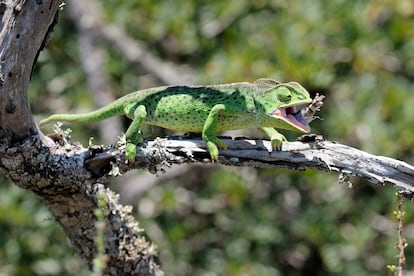

Bright green, brown, dark, speckled or almost disguised as a shrub, the chameleon — the king of camouflage — is expanding its territory across the Iberian Peninsula, which is home to the largest European population of the protected species. It has moved beyond its historic strongholds in the Spanish provinces of Málaga, Cádiz and Huelva to establish itself in new areas of Almería, Granada, Murcia, Alicante and Valencia, advancing along the Mediterranean coast. But it is not traveling alone. Much of its expansion is driven by people.
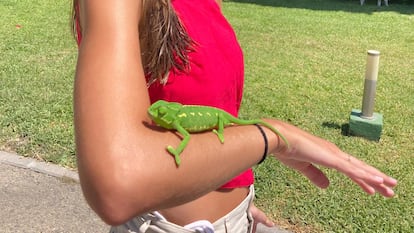
“It moves from place to place because people take it with them. It’s a reptile people like, unlike snakes. No one would think of picking up a viper! And besides, it doesn’t bite, it doesn’t spit, and it’s beautiful,” explains Emilio González Mirás, president of the Serbal Association and one of the authors of the new distribution map for the species.
Designed to go unnoticed, the common chameleon (Chamaeleo chamaeleon) rarely leaves the branches where it lives. It is Europe’s only arboreal reptile and can spend several months perched in shrubs or trees, where it sleeps, feeds… It only comes down to the ground to move from one shrub to another. This happens more often in summer, during the breeding season.
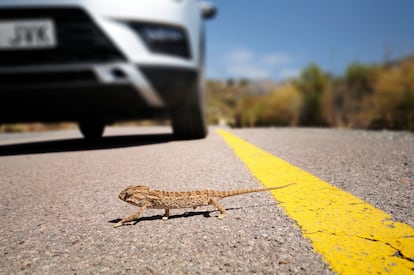
On the ground, it moves very slowly — unless it is fleeing — and only within its immediate surroundings, which makes it impossible for individuals to reach locations hundreds of miles away on their own without intermediate populations, as has happened, for example, in Valencia.
“It can only be explained by human intervention,” González Mirás stresses. To make up for this slow pace, its extremely long tongue shoots out at more than 20 kilometers (12 miles) per hour, striking its prey in just a few hundredths of a second.
The risks for the reptile, which measures between 15 and 30 centimeters, multiply when it leaves its shelter. Not even its extraordinary eyesight — which allows it to move its eyes independently and focus on two different points at once — protects it from being eaten by other animals, run over, or captured by someone who takes a fancy to it, This is illegal, as it is a wild species listed under special protection, meaning it cannot be captured, transported, traded, or have its nests and habitats destroyed.
Color changes are of little use to the reptile at such moments. It relies on them not only for camouflage, but also to signal stress, show its state of health and communicate with other chameleons. “Pregnant females, for example, put on something like a polka-dotted flamenco dress to make it clear to males that it’s not the time to approach,” explains Juan Pablo González de la Vega, a herpetologist and co-author of the new distribution atlas for the species.
“If you’ve never seen a chameleon before — which is most people —you might think it’s lost and that nothing’s wrong with taking it home,” says González Mirás. But there is a problem: they do not cope well in captivity and, if they escape, they can die, either because of the climate or because they fail to find a mate. The advice is simple: “Come and see me if you like, but leave me where I am and enjoy me there — because I’m not lost,” the biologist adds.
Color also helps them regulate their body temperature: they darken in the cold and become lighter when the heat intensifies.
A pregnant female moved to a new location by someone could create a new population. “Depending on the age of the female, they usually lay between five and 40 eggs, and some may survive and begin to establish themselves,” suggests González de la Vega. Mating begins in summer, females bury their eggs in September, and the young hatch between June and July of the following year. And it is precisely at this time — when they move around the most — that both human activity and traffic increase, along with the risk of being run over.
Urban development along the coast has also led to the disappearance or decline of urban and peri-urban populations. In these environments, dogs and cats are also responsible for a high mortality rate in the species, whose original arrival in the Iberian Peninsula remains unclear. “Whatever its origin, it is now considered a naturalized species fully integrated into Iberian fauna,” González Mirás notes. It is also present in most countries across North Africa, the Middle East, the Arabian Peninsula, Greece, Turkey, Malta, Sicily and other Mediterranean islands.
Sign up for our weekly newsletter to get more English-language news coverage from EL PAÍS USA Edition









































