
The blue dragon: The spectacular sea slug behind beach closures in Spain
This summer, it was sighted in Cadiz, Valencia, Alicante, and Lanzarote. Its sting can cause skin irritations similar to those of a jellyfish
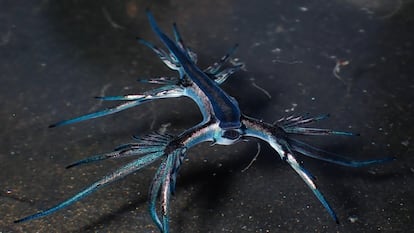

Last Wednesday, a swimmer spotted two specimens of the blue dragon (Glaucus atlanticus), a spectacular species of mollusk or sea slug, on the beaches of Vivers, in Guardamar del Segura in the Spanish province of Alicante. The beach was closed to bathing until the following day. The same measure was taken at Santa Bárbara beach in La Línea de la Concepción, in Andalusia, and at La Garita and Famara beaches in Lanzarote, in Spain’s Canary Islands.
The closures were due to the fact that, although the slug measures no more than four centimeters, it can sting and cause skin irritation or burning. “These are mild and exceptional injuries; they are not comparable to those from a Portuguese man-of-war, which the blue dragon feeds on and which carries a far greater number of stinging cells in its long tentacles,” explains Juan Lucas Cervera, professor of Biology at the University of Cádiz and an expert in sea slugs.
Regardless, blue dragons should not be touched, in case they cause an allergic reaction, and local authorities are asking the public to report any sightings of them.
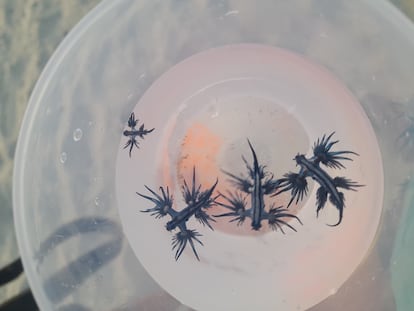
When the two blue dragons appeared in Guardamar del Segura, “it was half an hour before the lifeguards’ shift ended and we didn’t know if there were more specimens stranded or close to the coast, so we activated the protocol and raised the red flag,” explains José Luis Sáez, the town’s mayor.
A monitoring operation was deployed, but no further specimens were detected. Even so, they remain alert, as they do with jellyfish — usually the so-called fried-egg jellyfish, which are fairly harmless in the area, and with the feared Portuguese man-of-war, which has appeared on occasion.
“There could always be a user who experiences a severe reaction,” the mayor adds, while at the same time sending a message of reassurance, describing it as “a very isolated episode that has ended up as just a holiday anecdote.”
In Cádiz, half a dozen specimens caused the red flag to be raised on Sunday, August 17, at Santa Bárbara beach in La Línea de la Concepción. Another specimen was also found in August at Canet de Berenguer beach, in Valencia. In Mallorca, one was located in the deep waters of the Tramuntana mountains — a remarkable discovery, since there had been no scientific record of any in the Balearic Islands since 1916.
For Cervera, “closing beaches due to three or four specimens is an overreaction because there is no scientific evidence that they are a danger.” This excessive caution may be due to the fact that “to date, the presence of the blue dragon is not very common in our waters, and it remains to be seen whether it becomes more frequent from now on.”
What’s more, Cervera adds, “because it feeds on the Portuguese man-of-war, which is very toxic, people think this species must also be dangerous.” The blue dragon nibbles a bit on that type of jellyfish — “it doesn’t swallow it whole” — and in doing so it takes in the stinging cells, which are still immature, accumulates them, and stores them as a defense system. “The tentacles of the Portuguese man-of-war have coiled darts under pressure that fire when they touch another organism and inject a neurotoxin that affects the nervous system,” explains Cervera.
The species lives on the ocean surface, drifting with the currents. “They float upside down, like when we float on our backs, to camouflage themselves with the sea’s blue color, and on their underside they are white, blending with sunlight when seen from below. It’s a defensive strategy,” he says. This feature distinguishes the blue dragon from other sea slugs, which stay in the intertidal zone or at greater depths. On the Iberian Peninsula, around 300 species have been described, and new ones are still being discovered.
The blue dragon roams the waters of the North and South Atlantic and the Pacific in temperate waters, but sightings in the Mediterranean, as is now happening, are rarer. “The species was cited [in a scientific publication] in the second decade of the 20th century in the Balearic Islands, although the first record was in 1839 in the Canary Islands, but then a long time passed before it was detected again,” Cervera notes. This is in contrast to the Portuguese man-of-war, which has a wider distribution in the Mediterranean.
The arrival of these specimens has been linked to rising Mediterranean temperatures, which at the end of June exceeded 28ºC (82ºF), with thermal anomalies of five degrees. The researcher stresses that there is still not enough evidence to confirm this link, since studies are lacking on the species’ ecology and the most favorable environmental conditions for it. “What would be very interesting is to carry out monitoring, and whenever someone sees a specimen, they should take a photo and send it to us so we can keep a record,” he suggests.
Sign up for our weekly newsletter to get more English-language news coverage from EL PAÍS USA Edition









































