
Spain faces its worst wildfire season in 30 years, with 40 active blazes and more than 30,000 evacuated
The Copernicus satellite monitoring system estimates that 350,000 hectares of land have been affected by fires this year
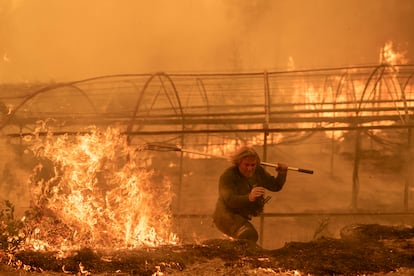
The wave of wildfires in Spain continues to rage out of control, devastating large swathes of the country, with particular intensity in the northwest, in the provinces of Ourense, León, Zamora, and Cáceres. In recent hours, more than 40 outbreaks have been recorded, 23 of them at level 2 on the Potential Severity Index (IGP), according to Civil Protection, and the burned area this year already exceeds 344,000 hectares, according to preliminary estimates from Copernicus.
Since August 12, the situation has forced 31,130 people to evacuate their homes, according to Virginia Barcones, Director of Civil Protection and Emergencies, in a press conference following a meeting of the State Coordination Committee (CECOD) on wildfires.
Most of the fires are in the Spanish region of Castile and León, where there are 26 active blazes, according to the regional government.
Nine forest fires remain active in the Galicia region, all in the province of Ourense, after devastating 62,000 hectares, according to a report released Monday morning by the regional Ministry of Rural Affairs.
In Extremadura, the fire that started in the Cáceres village of Jarilla has burned 12,000 hectares. Some 315 personnel — including firefighters, aerial units, and members of the Military Emergency Unit (UME) — are working on the extinguishing efforts. Spanish Prime Minister Pedro Sánchez will travel to Cáceres on Tuesday to assess the situation on the ground, according to La Moncloa, the seat of government.
Spain’s meteorological agency AEMET warns that the risk of new outbreaks is very high or extreme across most of Spain, though it forecasts a notable drop in temperatures in the northwestern half of the peninsula.
On Sunday night, a firefighter died and another was injured when their fire engine overturned while battling blazes in the province of León. The accident, whose causes remain unknown, occurred on a forest track in the town of Espinoso de Compludo, near Ponferrada.
This brings the death toll to four from the wildfires ravaging Spain. On August 11, a man died in Tres Cantos (Madrid), and two volunteers were killed after being caught by flames in Quintana y Congosto (León). The deaths of the two volunteers last Tuesday and Thursday prompted authorities to call for greater caution from local residents who volunteer on the front lines of the fires, urging them to follow the directions of the teams coordinating the response.
The past 10 days of wildfires have taken a brutal toll on Spain. If one considers the area affected by forest fires, 2025 is already shaping up to be the worst year in the past three decades in Spain. This is indicated by the provisional data managed by the government and the European Forest Fire Information System (EFFIS), part of the European environmental monitoring program Copernicus.
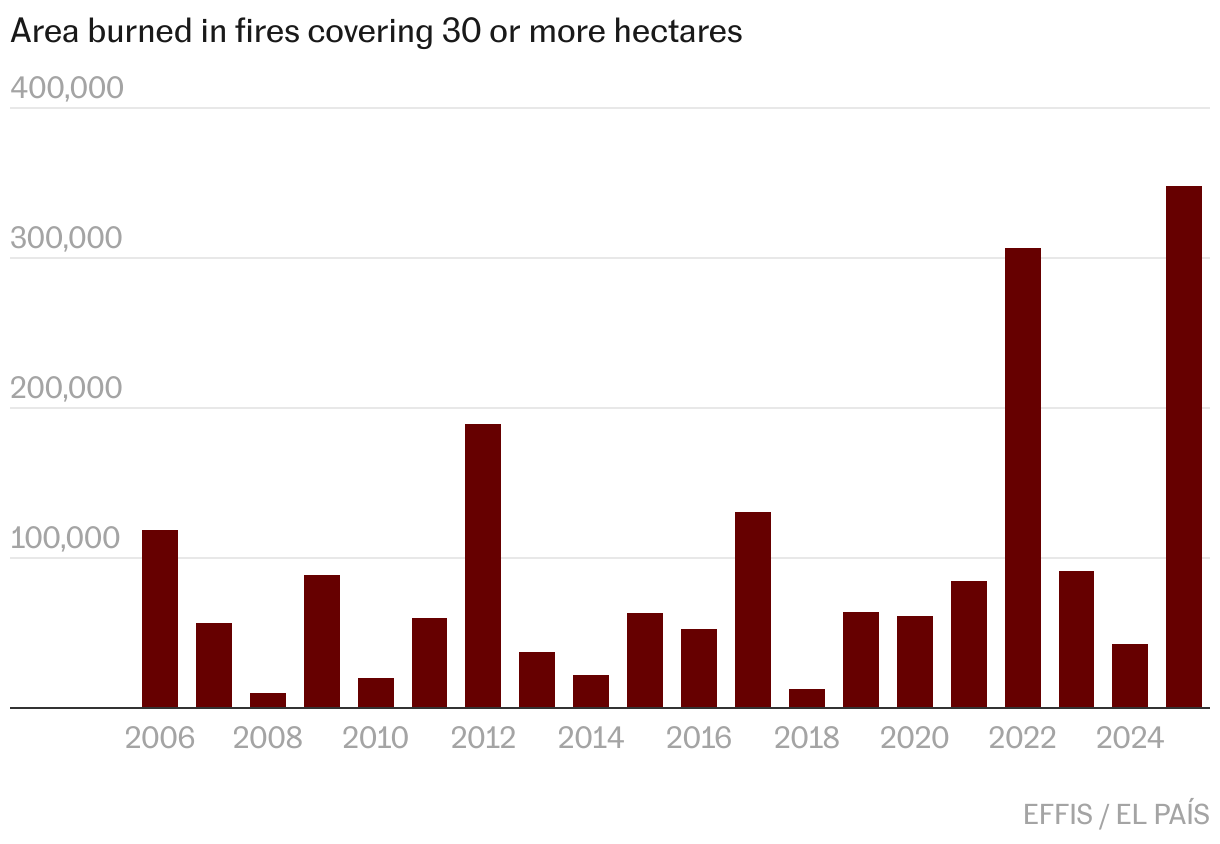
The estimates published by EFFIS on its website early Monday afternoon put the area affected by fires in Spain since January 1 at 348,110 hectares. These are provisional figures, which can still change and fluctuate almost by the hour. They are based on satellite observations used to establish the perimeter of fires larger than 30 hectares. If confirmed, 2025 would already rank as the worst year in the historical series compiled by Copernicus, which begins in 2006. Until now, the top spot was held by 2022, when the total burned area was just over 306,000 hectares, according to the same source.
Regardless of the final figure, one of the most striking aspects is that up until the beginning of this month, 2025 had not been a bad year: the burned area was in line with the average of the last two decades. On August 5, EFFIS had recorded just over 47,000 hectares affected by fire in Spain. But by Monday, the figure had jumped to almost 350,000. In other words, in just 13 days, nearly as much land has burned in Spain as in the whole of 2022 — which was already considered the worst year since 1994. For this reason, 2025 is shaping up to be the worst in the past three decades.
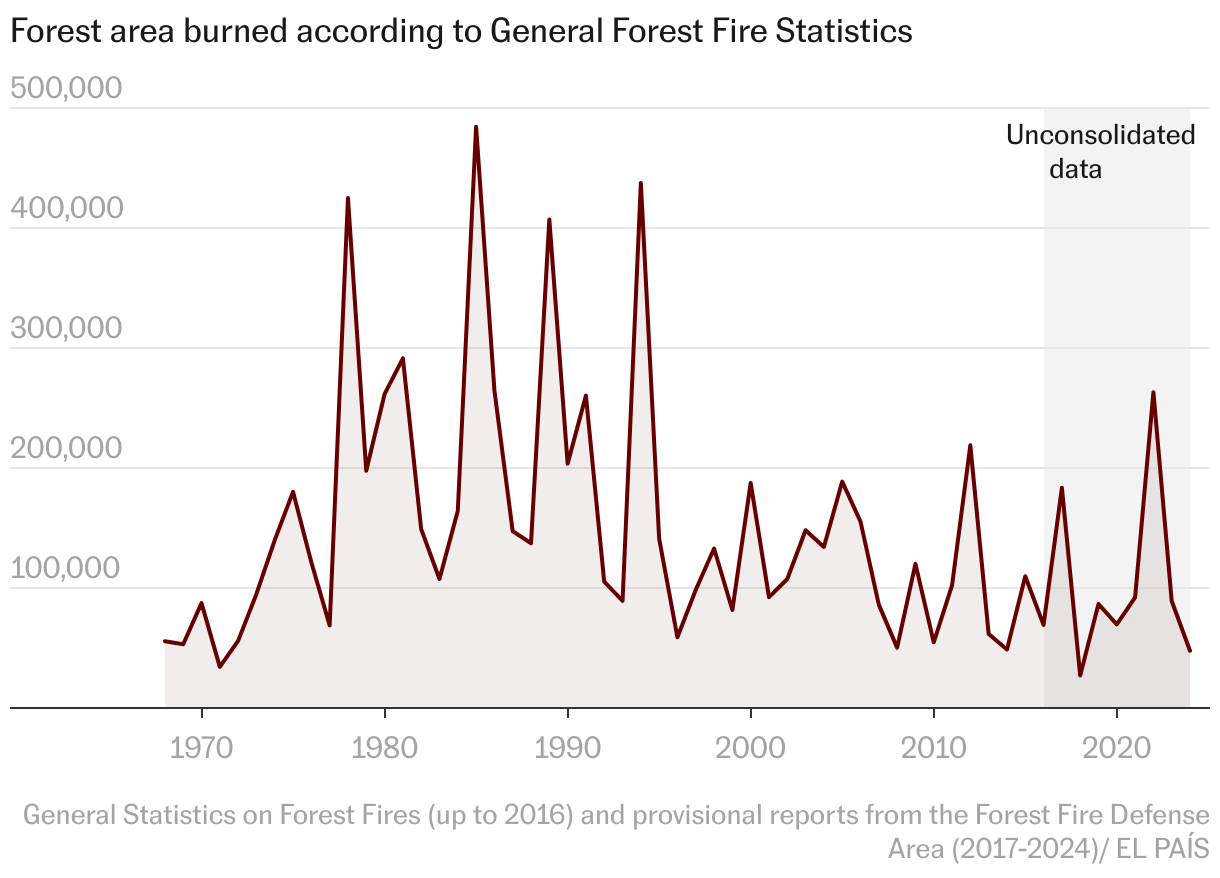
The data from the Spanish Ministry for Ecological Transition also point in the same direction, although they lag behind those of Copernicus and usually come in lower than the European agency’s estimates of affected surface area. This is because the ministry does not only measure perimeters, as EFFIS does, but counts only forest mass — leaving out farmland. For that reason, comparisons between the two sets of figures should be made with caution. Still, both show the same trend: a hellish August.
On Sunday night, the Ministry for Ecological Transition published provisional wildfire statistics on its website, covering up to August 10. At that point — just over a week ago—officials from the department estimated that the total forest area affected by fire in 2025 stood at 138,788.97 hectares. That figure is less than half of what EFFIS now calculates, but the ministry’s data are already eight days old and therefore do not reflect the damage from the worst phase of the fire wave sweeping the country.
In any case, the ministry’s data point to the same trend as Copernicus: in just five days — between August 5 and 10 — the burned area increased 3.5-fold.
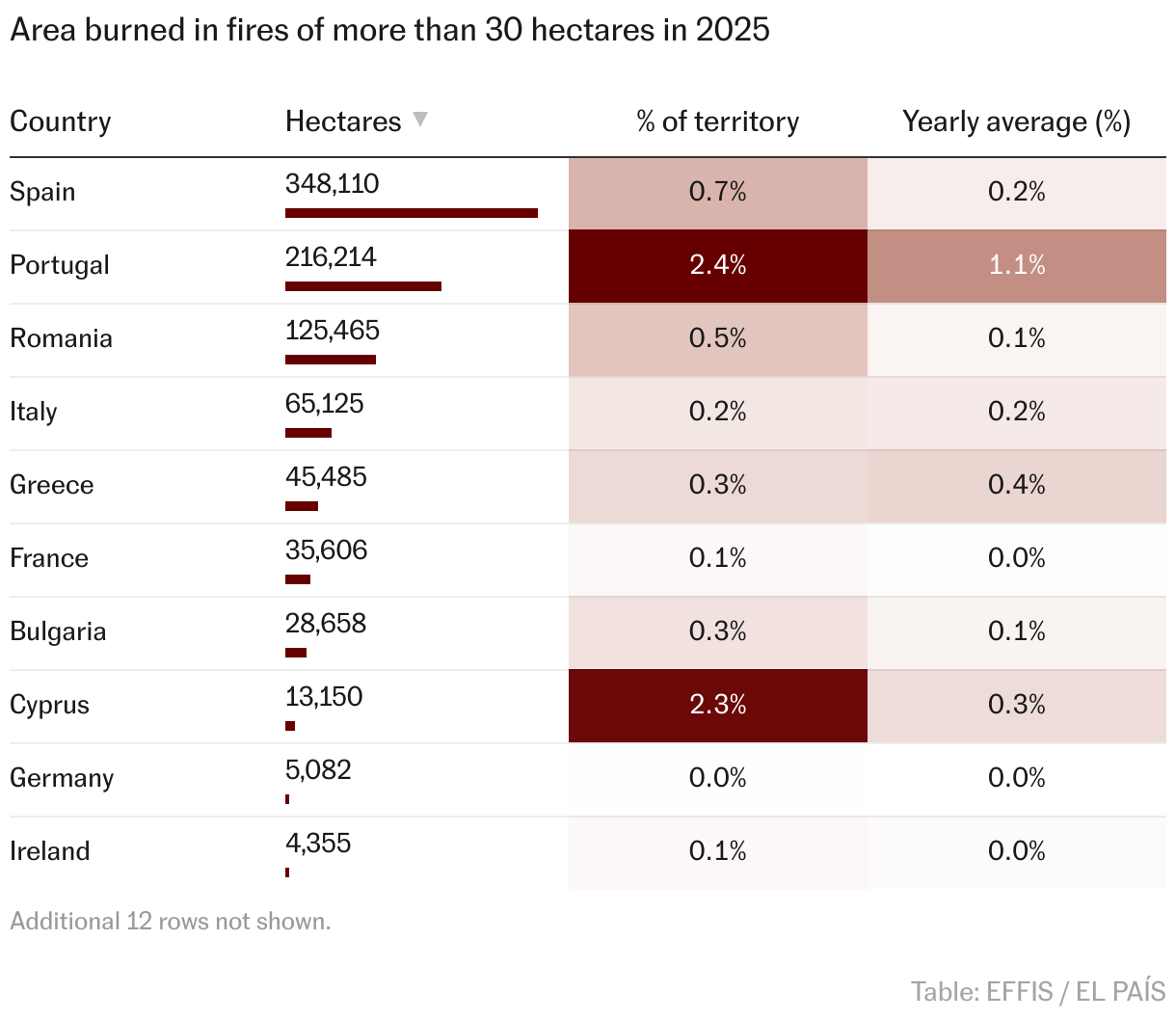
After this wave of August wildfires, Copernicus ranks Spain as the European Union country with the largest area burned so far this year. The second is Portugal, with 216,214 hectares, which has also been suffering the effects of the heat wave — expected to finally end this Tuesday after 16 consecutive days.
Sign up for our weekly newsletter to get more English-language news coverage from EL PAÍS USA Edition









































