
From Mont Blanc to Rome: Heat waves are suffocating Europe
From the mountains to the streets of Europe’s major cities, record-breaking temperatures are revealing the fierce impact of climate change


With a stubborn heat wave gripping much of the continent, Europe is sweltering. From the peaks of Mont Blanc in France to the scorched slopes of Vesuvius in southern Italy, extreme temperatures are causing deaths from heatstroke — such as that of an agricultural worker this Tuesday in Lleida — and are fueling wildfires in Spain, Portugal, the Balkans, and Turkey. Northern countries like Germany, unaccustomed to forecasts of 38°C (100°F) and 39°C (102°F) in the coming days, are not spared, nor is the United Kingdom, now experiencing its fourth heat wave of the summer.
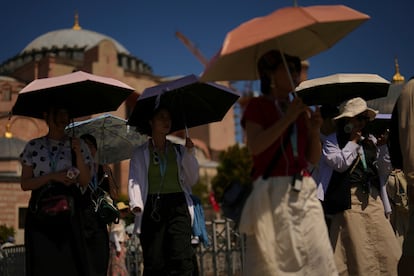
Images of empty streets in major European cities, traversed only by determined tourists seeking relief — as in Rome — are mixed with scenes of flames in Spain’s forests or at the very edge of towns like Tarifa and Tres Cantos, near Madrid.
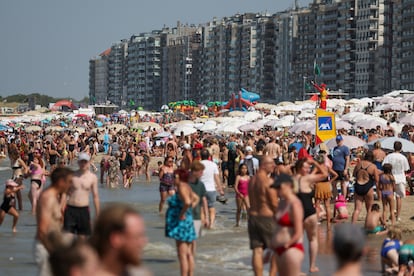




In Spain, the heat wave — the second of the summer — has already lasted 11 days and, according to the latest forecast from the State Meteorological Agency (Aemet), could continue until Monday, August 18. If the daytime hours have been brutal — with temperatures reaching 45.5°C (113.9°F) this Tuesday in the city of Badajoz and 43.9°C (111.0°F) on Monday in Híjar, Teruel — the nighttime hours have offered no respite for sleep in much of the peninsula, nor in the Canary Islands, where the heat wave began over the weekend and has been exceptionally intense, with lows of 31.9°C (89.4°F) in La Suerte, on Gran Canaria.
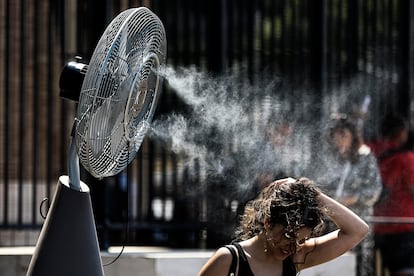
The Balkans, with alerts for temperatures of up to 39°C (102°F) in Albania and Montenegro, as well as Greece and western Turkey, are also suffering the impact of increasingly long-lasting, intense, and frequent heat waves.
Behind these extreme phenomena lies climate change, showing its most ferocious and evident face to both citizens and politicians. Since 1975, there have been 75 heat waves in the Iberian Peninsula and the Balearic Islands (not counting the two this summer), and 57 in the Canary Islands. Only four of them have lasted 11 days or more.
In neighboring Portugal, the high temperatures — especially in the interior — that have persisted for days are fueling multiple wildfires, and in France, with 29 areas under fire-risk surveillance, the alert is highest in Aude, near the Spanish border, where the massive blaze that broke out last week — the worst of the century in the neighboring country — has yet to be extinguished.
Below is a look at the situation in Europe, by country:
France, record temperatures up to 42°C (108°F)
Raquel Villaécija, Paris
Nearly the entire map of France, except for the far northwest, is currently shaded orange or red, under alert for extreme temperatures. The country is experiencing a historic heat wave — the second of the summer — with temperatures reaching 42°C (108°F), something unprecedented even for August. This Wednesday, five departments are under maximum alert (down from 14 yesterday), and 69 are under orange alert out of a total of 96.
In addition, 29 areas are under fire-risk monitoring, and in Aude, a department near the Spanish border, the alert is at its highest because the massive wildfire that broke out last week — destroying 16,000 hectares in just two days and considered the worst of the century in France — has not yet been fully extinguished. Firefighters managed to bring it under control over the weekend, but high temperatures raise fears it could flare up again.
The heat has forced the cancellation of about 20 trains between Paris and southern France, the region most affected by the high temperatures. The prefect of Rhône, the department including Lyon in the south, has suspended outdoor construction work from midday and prohibited public demonstrations in non-air-conditioned spaces — which are rare in the country.
In the south, thermometers have shattered records, with nearly 42°C (108°F) in Bordeaux, Bergerac, and Saint-Émilion, or 40°C (104°F) in Toulouse, Dijon, and Lyon. In Paris, the maximum temperature has reached 36°C (97°F). According to Météo France, France’s national meteorological agency, this heat wave will last at least through the week. The one at the beginning of summer lasted almost two weeks and ranks among the three longest France has experienced.
A detail highlighting the exceptional nature of the situation: to reach freezing temperatures on Mont Blanc, Europe’s highest peak in Haute-Savoie on the Franco-Italian border, one must ascend 4,600 meters — nearly the full height of the peak, which is 4,806 meters (15,778 ft).
In a country where air conditioning is uncommon, the French are finding ways to cool off. The heat has been so intense that in Chelles, a town near Paris, residents have bathed in the river despite water pollution warnings. The same is happening in Paris, which has opened three river swimming areas this month. A week ago, 35,000 bathers had visited these spots; by Monday, the number had risen to over 53,000.
Germany sees more days of fire risk than any year in the past 30
Almudena de Cabo, Berlin
Germany is also facing a heat wave after a rainy July in many parts of the country. On Tuesday, temperatures already rose to 36°C (97°F) in many areas and are expected to climb further in the coming days, especially in the south and southwest. The German Weather Service (DWD) reported that on Wednesday and Thursday, temperatures could reach 38–39°C (100–102°F), accompanied by humidity and “extreme heat.”
With the heat comes an increased risk of storms, in some cases severe, with the possibility of torrential rains in certain regions. In Bavaria, the DWD warned of storms with hail and hurricane-force gusts due to temperatures that could reach 39°C (102°F) in the state.
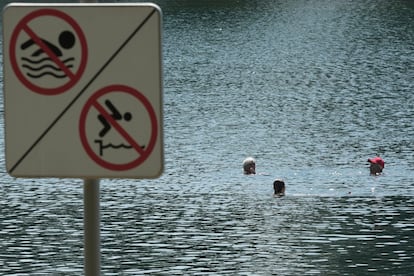
In Berlin, where temperatures are set to reach 35°C (95°F), a group of protesters used the new heat wave to call again on Tuesday for the lifting of the 100-year-old ban on swimming in the Spree River, which runs through the city center.
The heat wave follows several weeks of rain. However, despite this precipitation, the spring had been especially dry, and the risk of forest fires in some areas, such as around Mannheim, returned to critical levels. So far this year, Germany has already experienced more days with forest fire risk than the average of the past 30 years, and the wildfire season does not end until October. Nevertheless, despite the fires recorded so far in 2025, only 0.01% of Germany’s total land area has been affected.

Italy: Tourists queue at fountains, Pope holds audiences indoors
Lorena Pacho, Rome
Most of Italy is under orange or red alerts this week due to the high temperatures scorching the country. This new heat wave is hitting northern and central regions particularly hard, with forecasts of temperatures reaching 40°C (104°F) in the coming days. In Rome, highs reached 38°C (100°F) on Tuesday and Wednesday, while Milan saw 37°C (99°F). Meteorologist Giulio Betti explained that this extreme heat event is bringing temperatures 4 to 7°C (7–13°F) above the seasonal average.
In Rome, where summers are usually sweltering, August typically sees fewer tourists than other times of year. These days, visitors are queuing more at fountains and municipal water dispensers than at major monument entrances.
“I keep checking for fountains on the street; if I don’t see one nearby, I get nervous. Today we had to stop several times to cool off, otherwise it would be impossible to keep going,” says Simona Mayer, an Argentine tourist traveling in Italy with friends, as she refreshes her neck at a small spring near the Vatican. “Yesterday the sole of my shoe melted while walking,” says Estela López, showing her damaged footwear. “I need a gelato,” urges her sister Laura. “What heat!” is the phrase most locals repeat on the streets these days. High humidity is making the heat feel several degrees higher than the actual temperature.
Because of the extreme heat, the general audience the Pope usually holds on Wednesdays in St. Peter’s Square will be held this week inside the Paul VI Audience Hall at the Vatican.
In southern Italy, nearly two miles of the slopes of Mount Vesuvius have been burning since last Friday. According to authorities, the fire has destroyed over 500 hectares (1,235 acres) of vegetation. Although the blaze is under control, firefighters have not yet extinguished it completely. High temperatures and strong winds are complicating the containment efforts.
United Kingdom: Water shortage amid heat
Eva Millán, London
In the United Kingdom, the fourth heat wave of the season has prompted an amber alert — the second most serious level — across parts of England, due to concerns over the impact of high temperatures on health services and rail travel. While temperatures are not expected to break this year’s record of 35.8°C (96.4°F), set on July 1 in Kent, they will remain high throughout the week, peaking at 34°C (93°F) this Tuesday.
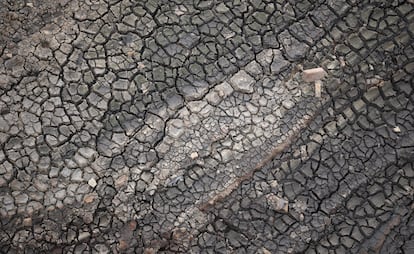
In fact, heat is not the most pressing issue; water scarcity is. The U.K. has just experienced its sixth driest spring since records began in 1836. The National Drought Group, which includes the Meteorological Office, regulators, the government, and water companies, warns of “significant” nationwide complications, especially in England.
As a result, severe environmental and agricultural impacts are already visible, with seriously affected crops, rivers at dangerously low levels harming wildlife, and a heightened risk of wildfires. Many areas of the country have imposed restrictions, including bans on using hoses.
Turkey: Residents urged to stay indoors during extreme heat
Andrés Mourenza, Istanbul
Since last Sunday, Turkey has been experiencing its second major summer heat wave, with temperatures surpassing 40°C (104°F) across wide areas of the west, south, and southeast of the country — 3 to 6°C (5–11°F) above normal for this time of year. Nighttime lows are not dropping below 25°C (77°F). In response, the General Directorate of Meteorology has advised people to avoid going outdoors during the hottest hours. In Istanbul, some relief comes from a light northern wind, slightly reducing the perceived heat.
In other regions, however, strong winds have worsened conditions. The Marmara, Thrace, and Aegean regions (western Turkey) are suffering from a year-long lack of rain, which became particularly severe in July when precipitation fell 70–80% below normal levels. The combination of drought, high temperatures, and strong winds has created an explosive mix, worsening several wildfires along the Aegean coast, a popular vacation destination.
Sign up for our weekly newsletter to get more English-language news coverage from EL PAÍS USA Edition









































