
Real pastrami is not from New York (nor does it cause orgasms)
This tasty way of preserving meat originated in Romania, where it is made not only with beef but also with lamb, pork and goose

In the most famous scene from When Harry Met Sally (1989), the character played by Meg Ryan fakes an orgasm at Katz’s Delicatessen in New York City, while her on-screen partner (actor Billy Crystal) enjoys a beef pastrami sandwich. When her simulated sexual pleasure ends, the woman at the next table tells the waiter, “I’ll have what she’s having.” This film boosted the popularity of the already famous restaurant and, at the same time, contributed to perpetuating a somewhat inaccurate image of pastrami. In reality, this method of preparing meat neither originated in New York City, nor, despite its name, does it have Italian roots, nor, of course, does it cause sexual orgasms (I’ll leave the gastronomic ones to each individual’s taste).
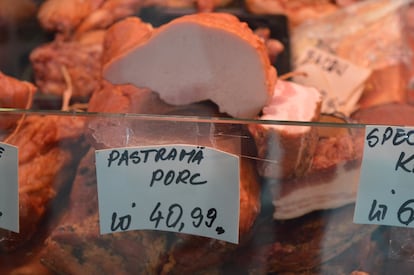
In fact, pastrami originated more than 4,700 miles (7,600 km) from New York. Specifically, in Romania, where it’s called pastramă, a term derived from păstra, a Romanian word meaning “to preserve,” clearly referring to the ultimate goal of the salting, spicing, curing, and smoking process these meats undergo before consumption. And notice the use of the term “meats” rather than simply “beef,” because in Romania, it’s not just beef that’s preserved this way; there’s pastramă made from other meats like goose, chicken, duck, pork or lamb. The butcher shops in Obor market, the largest in Bucharest, the Romanian capital, are the best example of this. There you can find meat from all these animals undergoing the process that turns it into pastramă, either fresh for cooking or as a cold-cut ready for consumption.
Something similar happens in restaurants. There, it’s offered to diners not in thin slices between two slices of bread, as in the U.S., but in chunks on a plate, accompanied by mămăligă (a pasta made with cornmeal that is used as the equivalent of bread in Romanian cuisine) and hot peppers. At Vatra in Bucharest, known for its traditional dishes, the menu includes a stir-fried mutton dish that, this reporter can attest, is quite an experience for the tastebuds. What defines authentic pastramă isn’t so much the type of meat, but the process it undergoes before reaching the table.
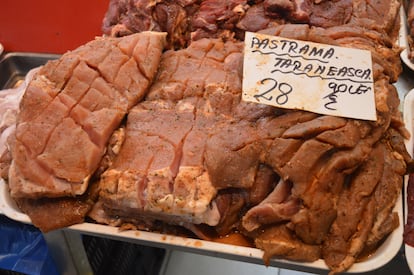
In the traditional Romanian method, the meat is first deboned and bled. Then, after making incisions in the thicker parts, it is seasoned by rubbing it with a mixture of thyme, paprika, pepper, rosemary, basil and allspice, following the recipe of renowned local chef Radu Anton Roman. Finally, the meat is covered with a thin layer of salt. After curing, the meat is ready to cook, although it is sometimes smoked. Naturally, the flavor varies depending on the cut of meat, the spices used (there is no single recipe), and, of course, whether or not it is smoked. It was traditional in this European country that, in early autumn and coinciding with the grape harvest, Romanians would eat sheep pastramă —either slow roasted or cooked in a pan with some oil and wine— accompanied by a glass of must and mămăligă, cheese, red onion, potatoes or varză salad (cabbage, a vegetable that is omnipresent in the recipes of this European country).
This method of preserving meat was brought to the U.S. in the late 19th century by Romanian immigrants. According to some studies, between 1881 and 1914, approximately 75,000 people from Romania (many of them Jews from the Bessarabia and Bukovina regions) left their homeland and settled in New York. Within a few years, the dish became popular in this and other American cities, although with substantial variations. For example, beef pastrami became more common than pastrami made from other meats, some say due to price, as beef was much cheaper than goose or mutton. Part of the preparation process also changed. The name pastrami —the first written reference to this term is from 1895— came later, supposedly due to the influence of the term salami, an Italian sausage that was already very popular in the United States at that time.
The truth is that, in the end, the renamed pastrami became a classic in New York delis, where it’s typically served between two slices of rye bread spread with mustard and accompanied by pickles, becoming the famous sandwich that is now the most iconic image of this dish. In Romania, however, the dish has remained faithful to tradition, both in the types of meat used and in the way it’s prepared. As for the orgasms induced by its consumption—real or imagined—there’s still no word on either side of the Atlantic.
Sign up for our weekly newsletter to get more English-language news coverage from EL PAÍS USA Edition









































