
Specter of US intervention runs through Mexico, Brazil, and Colombia
Progressive governments in the region, facing imminent or ongoing elections, have denounced interference as pressure from the White House has escalated
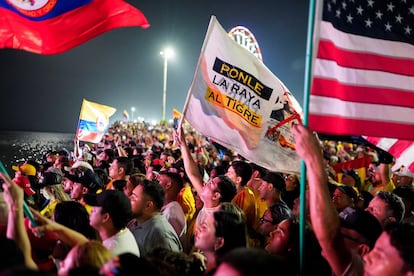
The “total endorsement” that Donald Trump recently gave to Abelardo de la Espriella — who, in addition to being a far-right presidential hopeful in Colombia, has been a U.S. citizen since 2023 — was denounced by his left-wing rival, Iván Cepeda, as “the intervention of a foreign government” in an election campaign that will be decided on June 21.
Beyond the anomaly represented by Espriella’s dual nationality, Trump’s support for candidates sympathetic to Washington has become routine since his return to power, even though U.S. diplomacy traditionally avoided taking such explicit sides — however interventionist it may have been by other means for decades. In recent times, the White House has openly supported Javier Milei (Argentina), José Antonio Kast (Chile), Nasry Tito Asfura (Honduras) and Laura Fernández Delgado (Costa Rica).
All of this is part of a strategy that, like almost everything in Trump’s foreign policy, views Latin America primarily as an internal problem. From that perspective, the U.S. president and his ideologues — the secretary of state, Marco Rubio, and Trump’s close ally Stephen Miller — see no objection to pushing until the left-leaning pieces on the region’s political domino board fall under Washington’s pressure. The goal is to shape a map of exclusively right-wing governments, ideologically aligned with the interests of their northern neighbor. And in that master plan, the next targets are Colombia, Brazil and the jackpot: Mexico.
The resurrection of the old “war on drugs,” launched in the 1970s by President Richard Nixon, and the reactivation of the dusty Monroe Doctrine — which for two centuries has proclaimed that America (the continent) is for Americans (understood only as U.S. citizens) — are the theoretical scaffolding for this campaign of domination of what, once again, Washington views as its “backyard.” Those ideas are made clear in two essential documents for understanding the present and future of a permanently fraught relationship.
On the one hand is the U.S. National Security Strategy. Published in December, it set a priority: “To restore American preeminence in the Western Hemisphere.” It came with an addendum — the “Trump corollary” — summed up as a “a common-sense and potent restoration of American power and priorities.” As has been evident since then, if necessary this includes backing sympathetic candidates, the military capture of Venezuelan president Nicolás Maduro, or the strangulation of Cuba to bend it to U.S. interests.
The other document is the 2026 National Drug Control Strategy. Published in May, it proposes a more aggressive approach to the global chain of production and trafficking of narcotics; it ignores — as usual — the problem of U.S. demand, and puts the spotlight on Colombia and Mexico. The document serves to justify actions by the Trump administration such as the campaign of extrajudicial killings (more than 200 to date) of crew members of alleged narco speedboats, accused of crimes that are not punishable by death in the United States; joint operations against cartels already under way in Ecuador, with pressure to launch them in Guatemala; and the promotion of the label “narco-terrorism” as a semantic justification for all of the above.

Against this backdrop, the three governments of countries not explicitly aligned — Mexico, Brazil, and Colombia — have raised their tone as pressure has increased. In recent weeks the thesis that sovereignty is eroding due to U.S. interference, with varying intensity, has already been placed on the table at a decisive moment for the three countries. Colombia awaits the presidential runoff, Brazil holds its general elections in October, and Mexico has parliamentary elections next year.
Mexico: narco-politics in the judicial crosshairs
From day one of Trump’s second term, Mexico has been in his crosshairs. The designation of six Mexican drug cartels as terrorist organizations — the largest number on the list — was far more than rhetorical; the White House opened the door to military interventions on the southern neighbor’s territory. Under constant pressure, Claudia Sheinbaum’s government has negotiated the remaining U.S. demands — from trade to migration — in an intense bilateral relationship. It was rare for a week to pass without some Republican senator, a Cabinet member, or even Trump himself hinting they intended to take on the problem themselves, with or without Mexico’s cooperation.
President Sheinbaum repeatedly defended the limits of national sovereignty and tried to put the idea of “shared responsibility” for the drug and violence problem on the agenda. But something changed on April 19. An accident in the Chihuahua mountains revealed that two CIA agents were conducting joint operations with the state prosecutor’s office. The Mexican president reacted forcefully, denouncing that they had no authorization, and from there everything moved at breakneck speed. Less than two weeks later came the explosive indictment by the Department of Justice against Sinaloa governor Rubén Rocha and nine other senior state officials for ties to a faction of the Sinaloa Cartel.
Bilateral relations escalated to a new, more critical phase with increasingly little room for Mexico to maneuver. The government demanded more evidence and announced its own investigation, while from the other side of the border signals multiplied that more accusations against Morena governors were about to be released. At the same time, political and parliamentary levers were activated. Last week Mexico’s ruling majority approved a constitutional reform to allow elections to be cancelled by invoking foreign interference. “Is this really a legitimate interest to combat organized crime or are they trying to influence the 2027 election in our country?” the president asked rhetorically Sunday during a mass event.
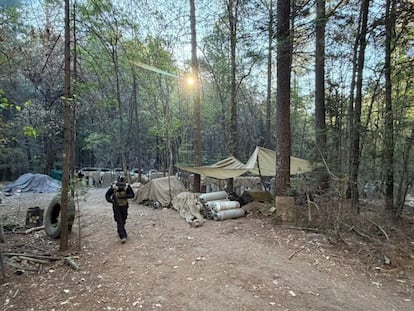
To top it all off, former president and figurehead of the Mexican left Andrés Manuel López Obrador reappeared in public on Wednesday, closing ranks with the president by denouncing “interventionist practices under the pretext of fighting drug trafficking.” He elaborated that “some U.S. officials are plotting to weaken [Mexican governing party] Morena and strengthen the right-wing opposition in Mexico with the idea of restoring a compliant, corrupt, mafia-like and cruel government that is vulnerable, subordinated and faithful to their interventionist designs.”
Brazil: drug terrorism and a possible new tariff shock
The first interference in Brazil’s elections — the explicit attempt to sabotage the trial against Jair Bolsonaro in 2025 — stunned both Lula’s government and the instigators themselves, the Bolsonaros. The new maneuvers now undertaken by Washington no longer surprised anyone. By adding Primeiro Comando da Capital (PCC) and Comando Vermelho (CV) to the U.S. list of terrorist organizations, alongside Al Qaeda, ISIS, the Palestinian group Hamas and the Lebanese militia Hezbollah, the Trump administration has plunged straight into Brazil’s debate on public security, one of the electorate’s main concerns.
Lula’s government, which skillfully and patiently neutralized the bulk of the 2025 tariffs, has not been able this time to persuade Trump to refrain from a plan to militarize the fight against crime as the Bolsonaros demanded. The U.S. announced the move the day after Flávio Bolsonaro — who intends to challenge Lula in the elections — asked Trump for it during a visit to the Oval Office. Lula prefers to attack the PCC and CV through financial measures, not heavy weaponry.
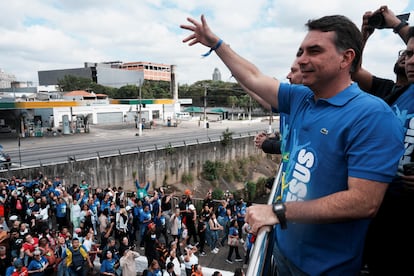
President Lula cried foul, arguing that labeling both gangs as terrorists unilaterally and outside the UN process is a frontal attack on national sovereignty and opens the door to military intervention.
Washington has more firepower in reserve. The Trump administration is seriously weighing imposing a new 25% tariff on Brazil for unfair trading practices, including the hugely popular instant payments system Pix, which competes with U.S. credit cards. The final decision rests with Trump. The United States is preparing a second extra tariff against Brazil, China and much of the world for the use of forced labor. Meanwhile, Lula and Bolsonaro Jr. have entered a full-scale, heavy rhetorical war. The president accuses his rival of being a traitor, while Bolsonaro accuses him of protecting narco-terrorists and says he asked Trump not to approve the new tariffs.
And because this is geopolitics, Iran has inserted itself into the spat between the United States and Brazil with an AI-generated video in which the Statue of Liberty attacks Christ the Redeemer, which returns the blow and wins. It was distributed after the tariff threat by Iran’s embassy in Tunisia, Tehran’s animated propaganda arm in the war against the U.S. and Israel.
Colombia: Trump breaks into an election campaign
Trump waited until after Colombia’s first round to intervene directly in the campaign. After approaches by several of his confidants — led by U.S. senator of Colombian descent Bernie Moreno — the news did not come as a surprise. In a post on Truth Social on June 2, the U.S. president backed far-right candidate Abelardo de la Espriella, a criminal defense lawyer from the Caribbean who has built his campaign on criticism of bureaucracy, a call for a tough line, and rejection of elites he calls corrupt — values that resonate with Trump himself. De la Espriella immediately thanked him and promised to build the largest network of alliances and treaties with the United States in the country’s history.
Gustavo Petro, who has been campaigning openly against De la Espriella and in favor of his own candidate, Senator Iván Cepeda, responded by condemning the interference and calling on Colombia to carry on with its process regardless of the U.S. president’s opinions. The statement comes at a particularly tense moment in the relationship between the two presidents: after a series of crises in Trump’s first year — including the announcement of a trade war that never materialized and the suspension of Petro’s U.S. visa — the Colombian president’s visit to the White House in February had smoothed tensions. Petro went so far as to say he had a good relationship with Trump.
Sign up for our weekly newsletter to get more English-language news coverage from EL PAÍS USA Edition









































