
Lula: ‘We cannot accept the way the United States has treated Brazil this week’
The Brazilian president wants to negotiate with Donald Trump, but he also warns that, if not, he will seek new partners
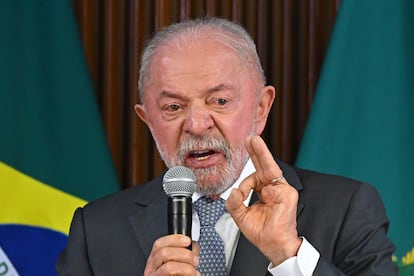

Since Donald Trump’s return to the White House, Brazil’s relationship with the United States has swung up and down like a roller coaster. It has been improving slowly and only through intense Brazilian diplomacy, but at any moment it can deteriorate rapidly again with a new blow from Washington. “We cannot accept the way the United States has treated Brazil this week,” President Luiz Inácio Lula da Silva declared on Wednesday at a cabinet meeting in Brasília. Lula was referring to the Trump administration’s threat to impose new tariffs days after the U.S. designated two Brazilian criminal gangs as terrorist organizations. The left-wing president has again wrapped himself in the national flag and accused the Bolsonaros — former right-wing president Jair Bolsonaro and his son, the senator Flávio Bolsonaro — of being traitors to the homeland for encouraging Trump’s interference.
Lula’s planned response to Trump follows the same recipe he used last year: diplomatic negotiation. “I will send another letter to President Trump (…) They are driving the world toward unnecessary violence,” he told his ministers. He also revealed that he had first ruled out attending the G7 summit in Paris in mid-June, but has now decided to go. The summit, he said, will give him an opportunity to explain Brazil’s position to Trump in person, namely that the new U.S. tariff surge rests on false premises.
Washington announced on Tuesday that it is weighing punishing Brazil with a 25% tariff for unfair competition, and on Wednesday it included Brazil in a package with many other countries it wants to sanction for using forced labor.
If Washington refuses to negotiate, Brasília will not stand idly by, warned the veteran Brazilian politician: “They have the right not to want to negotiate. But we are not going to cry about it; we will seek other partners. If they do not want to buy, we will sell to whoever wants to buy. If they do not want to invest here, we will look for other investors.”
With 210 million inhabitants, Brazil prefers a multipolar world and varied alliances to being submissive to Washington. This week its foreign minister, Mauro Vieira, visited Beijing. On his return, the foreign minister took part in an event in Paris where he briefly crossed paths with the U.S. trade representative, Jamieson Greer. And, according to Folha de S. Paulo, the American official told him he maintains a fluid dialogue with Brazil.
For Lula, sovereignty is untouchable. And defending it vigorously against Trump has so far benefited him in the polls. It also harms his rival Flávio Bolsonaro. The cabinet meeting was held under the slogan The PIX is ours, a reference to a payment system used by millions of Brazilians that the United States sees as a threat to American credit card networks that dominate the market.
Because Brazilian diplomacy never burns all its bridges, the president focused his criticism on Secretary of State Marco Rubio. It must have stung Brasília that the latter placed Brazil alongside Nicaragua, Cuba and Venezuela, Latin American countries that the secretary does not consider allies of the superpower.
“We are a great country, we have a long history and we cannot accept the way the United States treated Brazil this week,” President Lula said. “This Marco Rubio does not like Latin America, and he likes Brazil even less. He is a frustrated Latin American,” he added.
Less than a month ago, Trump found a slot in his agenda to receive Lula. It was their second formal in-person meeting, and it was cordial. The visit capped months of patient Brazilian diplomacy to repair the relationship with Trump and to have the 2025 sanctions and tariffs fully lifted, the latter of which were overturned by the U.S. Supreme Court.
Lula’s happiness over the thaw was short-lived. The Republican president also found time to meet Flávio Bolsonaro. The Brazilian senator and prospective candidate aiming to prevent Lula’s re‑election October asked him to designate the Primeiro Comando da Capital (PCC) and Comando Vermelho (CV) as terrorist organizations, a move Rubio announced the next day. For Bolsonaro’s son, that measure can bolster his hardline crime rhetoric, but the tariff surge is another matter. The far-right politician is trying to distance himself from the new punitive tariffs.









































