
Iran offline: The longest internet shutdown ever imposed by a country
The digital blackout ordered by the authorities is disrupting daily life for millions, leaving people unable to communicate normally, work remotely, or access information
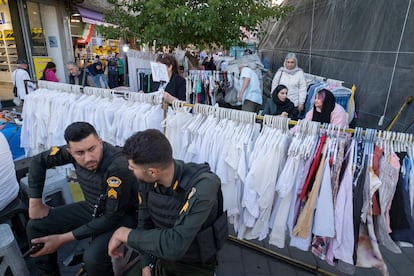
Iran has been under a digital blackout for 80 days — the time that has passed since the United States and Israel launched their war against the Islamic Republic — decreed by the authorities for “security reasons,” preventing citizens from having normal access to the internet. This difficult-to-circumvent blockade is increasingly complicating daily life, making remote working impossible, cutting off communication, and severely limiting access to information in a country of 92 million inhabitants.
This internet blackout is now the longest of its kind (imposed nationwide by a country’s government) on record, according to NetBlocks, an organization that monitors internet traffic and censorship, which reported the information on Wednesday, the 75th day of the shutdown. NetBlocks director Alp Toker told EFE that this is “the longest nationwide blackout on record in a digitally connected society,” surpassing Myanmar’s blackout in February 2021 (which lasted 72 days) and the one Sudan has been experiencing for several weeks.
Thousands of citizens try to circumvent the restrictions with illegal solutions, such as the use of alternative technologies, while the regime tries to establish a new model, a substitute for the network called Internet Pro, which is much more limited, restricted to certain groups, and expensive.
For Sara, an English teacher who depends entirely on online work with students outside Iran, the internet is not just infrastructure; it is her livelihood. During one of the recent outages, when connectivity collapsed, she closed her laptop and took a bus to Armenia, one of the few countries offering visa-free entry to Iranians.
“Even though my hostel in Yerevan [the Armenian capital] is in a basement, with no natural light, and I share a room in my 40s, paying $400 a month, at least when I open my laptop and have internet, I’m no longer anxious,” she says, speaking under a pseudonym.
It was not the first time Sara had tried to adapt to increasingly unstable conditions inside Iran. In the spring and summer of last year, when the government introduced daily electricity rationing and different parts of the city were left without power at rotating hours, she attempted to continue working. “Every day, I would check which part of the city still had electricity. Then I would grab my laptop and go there, moving from café to café, just to find a place where I could work,” she recalls.
She also lived through a nearly five-day internet blackout during the 12-day war between Israel, the United States, and Iran in June 2025, when her work stopped completely. But over time, a pattern became clear: in moments of political and social crisis, the first response is often to disconnect the country.

Access to the internet and electronic communications was widely cut across Iran from the first hours of the attacks on February 28. In the following days, phone calls and text messaging were partially restored, but according to NetBlocks, despite the ceasefire, public internet access remains completely cut off.
Iran has a long history of shutdowns, including the nationwide blackout of November 2019, as well as repeated disruptions during the 2022 protests and the 2025 war. Localized shutdowns have also been frequent. For those who have lived through them, the experience is not only technical but psychological.
“It feels like being blindfolded,” says Banafsheh Jamali, an Iranian feminist activist in Canada who experienced the 2019 shutdown. “You don’t know if it will be lifted or what you’ll face when it is.”
Because when access returns, the shock can be just as destabilizing. When the internet was restored in January 2026, many users were confronted with images of mass killings during the protests.
Controlled and unequal access
Over the years, Iranian authorities have promoted concepts such as a “national,” “halal,” or “clean” internet. Users, however, more often refer to it as the “filternet,” because of the number of filters and the degree to which platforms are blocked. Now, after two months of total shutdown, officials have begun discussing a new model called “Internet Pro,” a tiered system of access.
“What we are witnessing now is a shift toward a situation in which there is no longer an open internet in Iran,” says Amir Rashidi, an internet security and digital rights researcher. “The internet is being transformed from a public right into a privilege. It has always been filtered and expensive, but it was still the internet. Now we are reaching a point where access is no longer equal; what is being sold under the label of ‘Internet Pro’ offers different layers of connectivity to different groups, lawyers may have one level of access, for example, without YouTube or Facebook, doctors another, and businesspeople yet another.” Rashidi fears this segmentation could expand even further, with categories such as gender or ethnicity being used to authorize or deny access.
Iranian government spokeswoman Fatemeh Mohajerani has said internet access will return to normal after the emergency period ends. Rashidi, however, argues that wartime shutdowns have already altered digital behavior in more permanent ways.
“So far, there has been a kind of resistance among Iranians; they would avoid domestic platforms and apps, even at a cost, because international traffic is twice as expensive as domestic traffic,” he explains. “But prolonged internet shutdowns in wartime have changed user behaviour and accelerated their migration to domestic services.”
Lives on hold
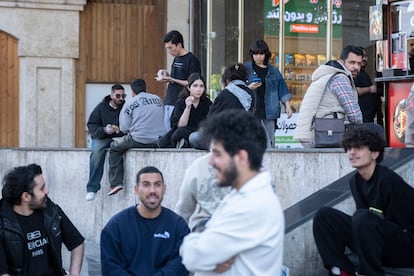
Many Iranians have developed improvised — and often risky — ways to stay connected. The import, sale, and use of U.S. Starlink technology, for example, are prohibited, and violating this law can be punished with imprisonment. Authorities have recently announced several arrests related to this.
Kaveh Ghoreishi, a Kurdish Iranian journalist, says the risks are especially acute in regions such as Kurdistan, where the Iranian state treats almost everything as a security issue. He describes local coping strategies: in towns near the border with the Kurdistan region of Iraq, some people purchase phones there, keep SIM cards, and use those networks to connect. Others travel directly to border areas to catch cross-border signals.
These individual solutions, such as satellite access or cross-border networks, cannot compensate for the lack of stable connectivity. The consequences of prolonged disruption affect multiple generations: from teenagers who have grown up online to older users who once spent retirement hours on Instagram.
Small businesses have been particularly affected. Many of them, often run by young women and operating outside formal institutions such as the Chamber of Commerce, rely almost entirely on online platforms to survive.
Elaheh (a pseudonym), an online consultant and small business owner, left Iran after repeated shutdowns undermined both her income and stability. Since all her clients operated online, the repeated service disruptions in 2026 ultimately destroyed her business.
“I built something for myself,” she says. “I was active, effective in my community. And now this is where I stand.”
She had to let most of her employees go while continuing to pay rent on the workplace from savings. “Three weeks after the war began, I woke up one morning and told my mother, ‘I have to leave.’ I chose Sri Lanka,” she says. “I’m in my mid-30s. I want a child, a family. But even basic rights feel out of reach.”
“When I speak about this, people say, ‘Well, that’s what immigration is.’ But this doesn’t feel like immigration,” she continues. “I was pushed out. I am, in the truest sense, displaced.”
Sara, too, faces an uncertain future. Her three-month residency in Armenia is nearing its end, and her options remain limited: move to Turkey (also for three months), or return to Iran by land, only to re-enter Armenia and restart another temporary cycle.
“Another three months,” she says. “Another pause. Another uncertainty.”
Sign up for our weekly newsletter to get more English-language news coverage from EL PAÍS USA Edition









































