
From M.I.A. and Nicki Minaj to Snoop Dogg and Lil Wayne: What’s behind rappers’ support for Trump
The growing trend within the urban genre can be explained by factors such as the Paycheck Protection Program and his decision to pardon some artists
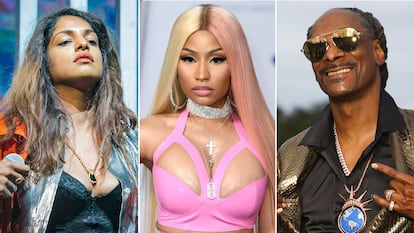

In January, the world was stunned when Nicki Minaj declared herself Donald Trump’s “number one fan,” years after criticizing his immigration policies. In the past, Minaj had been particularly outraged by the separation of children at the border. “Island girl, Donald Trump want me go home,” rapped the Trinidad‑and‑Tobago‑born artist in Black Barbies, a track she released at the start of the businessman’s first term. In 2020, she still opposed Trump, but in one of her more recent appearances, she boasted about holding a Trump “gold card” — a fast‑track visa the businessman grants in exchange for $1 million.
In fact, Minaj is far from the only prominent hip‑hop figure to have shown support for Trump’s Republican Party. The most recent example is British rapper M.I.A., who was dropped from her joint tour with Kid Cudi after comments she made on stage on May 2 in Dallas. “We can’t do Illygirl [pronounced like ‘illegal’] because some of you might be in the audience,” she said, to boos. The artist, who was born in London and raised in Sri Lanka, has expressed support for Trump on several occasions in recent years.
Minaj and M.I.A. are part of a broader trend that is becoming increasingly visible in the urban music scene. Several rappers — from Kanye West to Snoop Dogg, Lil Wayne, Lil Pump, Azealia Banks, and Sexyy Red — have backed Donald Trump’s policies in recent years, in some cases despite having criticized him in the past.
To understand this shift to the right, it’s important to consider the factors that have brought this reactionary wave to culture and entertainment, and how it’s taken shape specifically in the United States. It’s also worth noting the political (and monetary) strategies Trump has used to secure the support of some artists.
Trump’s pardons
While Kanye West’s support — he appeared in the Oval Office in 2018, telling Trump he loved him — seemed more rooted in anti‑establishment sentiment, other rappers’ backing appears to have a far more tangible explanation: Trump got them out of jail.
Lil Wayne was arrested in 2020 on illegal firearms charges and was facing up to 10 years in prison. On January 20, 2021, just hours before leaving office, Trump pardoned him. Days before receiving the pardon, Wayne had posed with Trump at Mar‑a‑Lago and praised his reform plan for the Black community. After his release, Wayne not only continued to support Trump publicly but also referenced him in several songs, including Tuxedo (2023).
Kodak Black was in a similar situation. The rapper was serving a sentence on weapons charges when Trump also pardoned him in January 2021. Since then, Kodak has become one of the Republican’s most active supporters. In 2024, he released the campaign song ONBOA47RD, even crediting Trump as a co‑writer.
Snoop Dogg was initially one of the fiercest critics of Trump, but later showed a notable shift. The artist performed at a pre‑inauguration event in January 2025 alongside rappers Soulja Boy and Rick Ross, at an event honoring Trump that billed him as “the first crypto president of the United States.” Amid the backlash, Snoop remained silent, but Soulja Boy later said he took part because “they paid me a bag.”
Back in 2021, Snoop Dogg publicly thanked Trump for pardoning Michael “Harry O” Harris, co-founder of Death Row Records. The rapper supported the campaign to reduce Harris’s sentence, who helped finance the label’s launch in 1992 with $1.5 million given to Suge Knight. Thanks to Death Row Records, artists like Snoop Dogg, Dr. Dre, and Tupac Shakur fueled the West Coast rap boom of the 1990s.
In addition to the pardons, another key factor behind this shift was Trump’s Paycheck Protection Program (PPP). During the coronavirus pandemic, his administration rolled out financial aid aimed at supporting small businesses. For many artists and figures in the hip‑hop scene, that money provided immediate economic relief during the crisis — something that ultimately helped shape how part of the community viewed him.
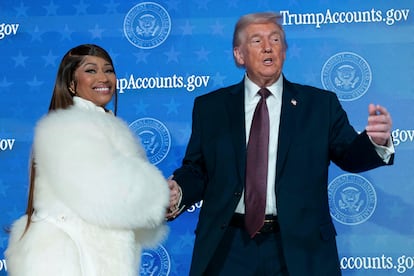
Sexyy Red, one of the most popular female rappers on today’s scene, became one of the most vocal supporters of this program. In a podcast with Theo Von, she said: “Yeah, they support [Trump] in the hood. At first, I don’t think people was fuckin’ with him. They thought he was racist, saying little shit against women. But once he started getting Black people out of jail and giving people that free money. Aww baby, we love Trump. We need him back in office. We need him back because, baby, them checks. Them stimulus checks. Trump, we miss you.”
Rapper YG’s support for Trump is even more striking. The Compton artist, who in 2016 released the anti-Trump anthem FDT (an acronym for “Fuck Donald Trump”), softened his stance years later and pointed to the PPP as one of the reasons why many people in the African American community had “forgiven” Trump.
Understanding the cultural shift
Although rap has historically exposed and challenged political, economic, and social inequalities, it is not immune to the reactionary wave that has intensified in the last decade. As researcher Laura Camargo notes, this trend is driven by factors such as economic insecurity, the commodification of all areas of life, the significant weakening of public services, the erosion of shared spaces and public life, the breakdown of community ties, and the sense that the future has effectively been “canceled.”
This worsening of a global structural crisis, combined with the inability of institutions to respond effectively, has provided a platform for far‑right parties and, of course, for Trump and other key figures who have tapped into the frustration and resignation of the working class. In the United States, this has helped shape one of the major cultural phenomena associated with the MAGA movement and Trumpism.
“MAGA is a white supremacist project,” political scientist Mario Aguiriano tells EL PAÍS. “This is something that is deeply rooted in U.S. political culture, always latent, and that has gained new strength in this context of social and political crisis.”
The expert points to recent developments in U.S. politics —such as the restructuring of Immigration and Customs Enforcement (ICE) “as a paramilitary force aimed at spreading racial terror,” or the erosion of the Voting Rights Act of 1965 — which, he says, “should be seen as a delayed victory for Confederate America, for Jim Crow America, and for the Klan.”
According to the expert, this situation explains the instrumentalization of these figures in the so-called culture war. “It suits Trump very well to use a type of ‘lackey’ figure that has always existed: people willing to pander to him while ICE deports other Latinos, while the African American vote is suppressed,” says Aguiriano. “It’s not that they’re deceived; it’s also a matter of class. Even white supremacy itself is a means to win over the population to a class project spearheaded by the Musks, the Thiels, the Bezos. Nicki Minaj or Justin Quiles [a reggaeton artist who supported Trump during the 2024 campaign] are millionaires who know that nothing will happen to them, and that, in fact, they may be rewarded.”
In this context, investigative journalist José Bautista, a contributor to The New York Times, agrees that the rise of these discourses, both in urban culture and among the working class, is tied to worsening material conditions.
“Many working-class sectors in the U.S., particularly the African American and Latino communities, feel and experience firsthand the decline in their material conditions,” he says. “The cost of living is high, it’s very difficult to find housing, working conditions are very poor, there are problems with insecurity... Far-right parties and Trump in the United States have been very successful in connecting with these feelings of frustration. They do so with very aggressive and polarizing rhetoric, but it resonates with the feelings of the working class.”
When the far right is the new punk
In a context of rising nationalism, Trump symbolizes the growing distrust of democracy and liberal systems. His rhetoric is based on what Ruth Wodak calls “politics of fear,” which consists of singling out certain groups as responsible for the country’s problems and presenting them as a grave threat to the nation, while portraying “real” citizens as victims in need of protection.
“The crisis we are experiencing is accelerating the collapse of formally inclusive ‘liberalism,’ which had been the hegemonic ideology in the West for the last few decades. Its replacement is a new authoritarian chauvinism, proudly imperialist, fiercely anti-immigrant, etc.,” explains Aguiriano.
According to the political scientist, this radical shift to the right permeates the entire cultural world. “Rap and urban culture, of course, are among those affected. After all, despite their historical link to the working class, we shouldn’t see rap and urban culture — anywhere, and especially not in the U.S. — as bastions of class consciousness in the strong, socialist sense. On the contrary, the hegemonic discourse in these fields tended to be liberal: an apologia for individualism, personal success achieved through hardship, expensive cars, drugs, and so on. Its main spokespeople were, in fact, multimillionaires. Given this context, it’s no surprise that many have drifted toward Trumpism.”
Since the 1990s, Trump has been seen as more than just a millionaire who inherited his wealth. Trump was a pop culture icon, a wealthy magnate who rubbed shoulders with figures like rapper Diddy, and lived in a gilded tower in Manhattan. His name was synonymous with power. References to Trump appear in dozens of well-known songs: Incarcerated Scarfaces by Raekwon, Country Grammar by Nelly, What More Can I Say by Jay-Z, and We Gon’ Make It by Diddy, among others.
In recent years, that aspirational image Trump represented in U.S. culture has been reinforced by his anti‑establishment rhetoric: a billionaire businessman who, within a populist framework, presents himself as a disruptive outsider.
“When you analyze any Trump speech, you see that he projects the image of an approachable man — a very ‘manly’ man, a hard form of masculinity, someone who challenges the establishment even though he belongs to it,” Bautista explains.
The journalist also notes that the president “projects the image of economic success, even if he inherited everything. That overlaps, at times, with certain codes of contemporary hip‑hop: financial success and tough masculinity.”
Sign up for our weekly newsletter to get more English-language news coverage from EL PAÍS USA Edition









































