
Venezuela identifies new mosquito capable of transmitting malaria in mining region
It can breed in mining pits and withstands drought. While not cause for alarm, the finding highlights the epidemiological challenges facing a country that eradicated this disease in the 1960s
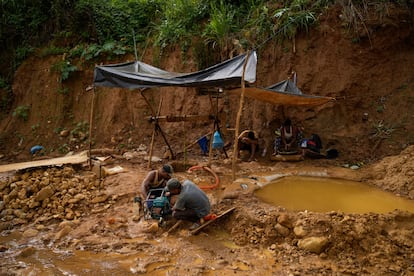
Ítalo Pizarro is a teacher and leader of the Indigenous Pemón community of San Miguel de Betania. He has never been a miner, but he lives surrounded by mines in the Sifontes municipality of Bolívar state, Venezuela — one of the epicenters of both mining activity and malaria transmission in the country. He has had malaria five times, most recently in 2015, 2016, and 2017. Now the disease is once again a concern: one of his five‑year‑old students has malaria for the eighth time, and her mother for the fifteenth.
A new discovery
Malaria is a disease mainly transmitted through the bite of an Anopheles mosquito infected with one of the five parasite species that cause it. Plasmodium vivax, one of the less aggressive types, has been the main cause of malaria in Venezuela.
However, in recent years, a group of Venezuelan scientists has identified in Sifontes the mosquito Nyssorhynchus rondoniensis, another efficient vector capable of carrying the parasite Plasmodium falciparum — the strain responsible for the highest rates of illness and death from malaria worldwide.
There is no immediate cause for alarm. Just over 1% of the mosquitoes are infected with P. falciparum. Moreover, as María Eugenia Grillet, a biologist and lead researcher on the study, explains, this source of malaria in Venezuela is not entirely new. “It is possible that the Ny. rondoniensis mosquito has been there for years, feeding mainly on animal blood, and that we were misidentifying it. But now, with molecular techniques, we have been able to get a better understanding of its taxonomy.”
This is how researchers were able to recently confirm the presence of this mosquito in Venezuela — despite the great geographical distance, it had previously been recorded only in western Brazil, in the states of Acre and Rondônia, where it was first identified in 2022 by a group of Brazilian scientists led by Maria Anice Mureb. In that case, the mosquito was not infected.
Jorge Moreno, a field entomologist specializing in malaria and vector control, explains that the discovery in Venezuela was accidental: “What we were actually studying was the population of the Anopheles darlingi mosquito — the main malaria vector in the Americas — and its relationship with the surrounding environment. This mosquito is now limited to southern states and no longer exists in Venezuela’s north‑central coastal region. But this other species appeared during the analysis,” he says.
Samples collected in 2017, 2022, and 2023 were sent to the Wadsworth Center in the United States. The results confirming the presence of Nyssorhynchus rondoniensis in Venezuela were published in the journal Acta Tropica.
New mosquito; not-so-new habitat
The study was carried out in informal mining settlements—El Granzón, Tierra Blanca, and San Rafael—mixed communities where housing and basic services have developed partly through planning and partly in an ad hoc, unregulated way along the Sifontes road corridor. It also included more typical rural communities such as Puerto Beco, Pelota, Payapal, and Morrocoy, which have more permanent physical and social structures.
These villages, Moreno notes, “are no longer strictly mining or strictly Indigenous areas.” Thanks to the study, he adds, “the relationship between mining activity, the Anopheles mosquito population, and malaria is also evident.”
As settlement patterns have changed, so has the behavior of Ny. rondoniensis. One key difference is that it can now breed in mining pits and any standing water, not just in the large natural bodies of water it previously required. Another change is its resistance to drought, which explains why it was detected during the dry season.
It has also been found not only along forest edges but in peridomestic areas — the transitional spaces around homes between living areas and the mining or natural environment. In practical terms, this means the mosquito no longer needs to enter houses to bite. Unlike other Anopheles species, Ny. rondoniensis remains active throughout the night, rather than biting mainly in the early evening.
For Grillet and Moreno, there are several signs that the species may be beginning to colonize a new habitat. This could lead to changes in the mosquito’s abundance and composition — especially in an Amazonian region increasingly affected by deforestation driven by unregulated mining.
The same problem
Although there is little publicly available official data from Venezuelan health authorities on malaria control, the disease persists, and residents of communities like Pizarro’s continue to suffer from it or witness its spread.
Armando Obdola, a Pemón leader and president of the NGO Kapé Kapé, which promotes sustainable development for Indigenous communities, says infections are rising and links this to internal migration. “As mining has shifted from informal to somewhat more organized operations, there is now greater availability of fuel, and more machinery and transport. So more people from other municipalities and states are arriving in Sifontes. The mosquito is already there — it bites here and there, everyone gets infected, and that’s how it spreads.”
Pizarro agrees with Obdola on the urgent need to regulate mining, given its wide‑ranging impact on public health: poor tracking of infections, shortages of supplies, a lack of specialized medical staff for testing and treatment, insufficient prevention efforts, and under‑equipped health centers.
A local source who asked to remain anonymous summed up the urgency: “I live about 12 kilometers [7.5 miles] from one mine and work about 10 kilometers [6 miles] from another. All of our communities in Sifontes are surrounded by mining interests.”
Venezuela has been one of the countries hardest hit by malaria in the Americas. In 2017, it accounted for more than half of all cases in the region — 53%, according to the World Health Organization. That year, 456 malaria‑related deaths were recorded in the country.
Nearly a decade later, and still facing a complex humanitarian emergency, malaria remains a major challenge. Venezuela’s latest national epidemiological bulletin does not report malaria deaths, but it shows that as of the last week of March 2026, there were 25,259 cumulative cases, an 8.3% increase compared with the same period in 2025. Of those, 16,962 cases were in the state of Bolívar.
The current phase of Venezuela’s National Malaria Elimination Plan (January 2024 to December 2026) aims to reduce malaria illness and deaths nationwide by at least 60% compared with 2022 levels. It focuses on priority areas, including the Sifontes municipality.
To better understand efforts to control malaria in endemic regions, inquiries were sent to Mariana Hidalgo, head of the Immunoparasitology Laboratory at the Venezuelan Institute for Scientific Research, and to Pemón leader Donald Martínez, regional coordinator of Bolívar state’s public health institute. Neither responded by the time of publication.
Looking ahead
Venezuela’s Amazon region — the largest in the country — includes the states of Delta Amacuro, Amazonas, and Bolívar. Around 17 Indigenous groups live in Bolívar alone, all affected by illegal mining. However, there are only seven primary healthcare centers serving these communities.
These facilities, located in San José, San Antonio de Roscio, San Martín de Turumbang, Araimatepuy, San Miguel de Betania, Santa María del Vapor, and Inaway, fall short of Brazil’s Amazon “Base Pole” model — primary healthcare units set up within Indigenous villages to monitor diseases. The clinics in Sifontes, for example, lack the operational capacity and are not designed exclusively to serve nearby Indigenous communities, as is the case in the Brazilian model. The hospital in Tumeremo and the urban clinic in Dalla Costa are also overwhelmed.
Pizarro explains the problem and the challenge: “Because of the distances to the Indigenous communities, providing care is complicated. Malaria control personnel visit when they can and bring very few medications, which don’t even cover 50% of the cases. The residents, whether Indigenous or not, require more attention. With the arrival of another mosquito, the communities would be very frightened, fearing they could die due to lack of proper treatment.”
Malaria can be treated, reversed, and even eradicated with timely prevention, diagnosis, and care. Venezuela achieved this before: in 1961, it was certified by the World Health Organization (WHO) as the first country in the world to eliminate malaria from most of its territory. That milestone depended on more than mosquito control — it reflected an understanding that social conditions directly affect ecosystems. Ultimately, human health depends on a healthy environment.
Grillet explains: “Although less malaria is found in areas with greater forest protection, deforestation from mining has continued to increase, when the solution for our health is precisely to control mining activity.”
Sign up for our weekly newsletter to get more English-language news coverage from EL PAÍS USA Edition









































