
Joschka Fischer, former vice-chancellor of Germany: ‘Putin will not stop; he will continue to advance westward’
The former foreign minister, who brought the Greens into government, points out that Europe must prepare for the end of American protection: ‘We’ll see if NATO survives’
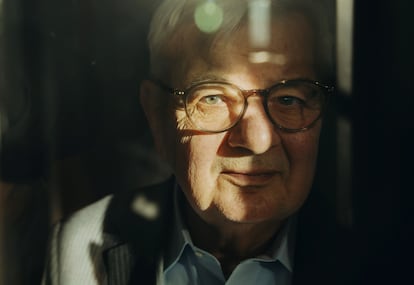

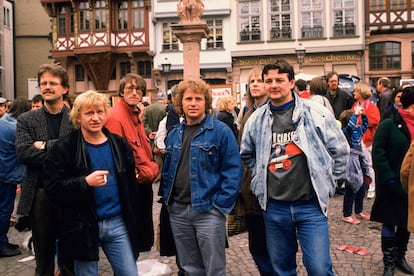
There are images that never fade from a country’s memory, from its political and popular consciousness. One of them is that of Joschka Fischer (Gerabronn, Germany, 78 years old) wearing sneakers and being sworn in as a minister in the state of Hesse in 1985. For the first time, the Greens, a grassroots movement born a few years earlier, entered a regional government. It was a turning point. Thirteen years later, Fischer would become vice-chancellor and foreign minister in the first federal government with the Greens, allied with Chancellor Gerhard Schröder’s Social Democratic Party.
All of that was a long time ago. Now Joschka Fischer is a venerable grandfather who often visits Andalusia in Spain, where his grandchildren live, a perceptive observer of the world and author of political essays, his most recent being Die Kriege der Gegenwart und der Beginn einer neuen Weltordnung (The Wars of the Present and the Beginning of a New World Order), but he has not lost his passion for arguing and persuading. In the room where the conversation takes place, in offices in the center of old West Berlin, there is a photograph of a G-7 foreign ministers’ meeting in Canada, with a dedication from the host, alluding to his youthful struggles: “Joschka, a true anarchist, never a Trotskyist.”
Question. In your latest book, you write: “The decisive geopolitical question in the coming years is: ‘What does the United States want?’” What does the United States want? Do we know?
Answer. I think it’s clear what it doesn’t want. It doesn’t want to take responsibility for Europe, and that’s why it is questioning NATO. How far [U.S. President] Donald Trump is willing to go in domestic policy we’ll see in the fall, if there are free and fair elections. The transatlantic alliance still exists formally, but in substance, it no longer does.
Q. What are the consequences of that?
A. Europe is alone for the first time since the end of World War II. We are alone with a threat on the eastern flank of Europe and NATO. It is a completely new historical situation.
Q. Is Europe ready?
A. No
Q. What should it do?
A. We must prepare for the end of American military protection. We’ll see if NATO survives. We Europeans would do well not to renounce NATO, to keep the European part united, and to invest massively in security. We have no other option.
Q. Should Europeans try to win over Trump by feting him like NATO Secretary General Mark Rutte does?
A. I can’t fault Rutte, but I also can’t criticize Pedro Sánchez [the Spanish prime minister who, unlike Rutte, is standing up to Trump]. They are both right.
Q. They follow opposing strategies.
A. And this highlights the difficulty of the situation. Europe needs to adopt a clear position and, at the same time, must try to take advantage of every opportunity to maintain the relationship [with Trump] for as long as possible.
Q. In 2003, on the eve of the invasion of Iraq, you told then-U.S. secretary of defense, Donald Rumsfeld, “I’m not convinced.” What would you do today if you were foreign minister?
A. I don’t know. As foreign minister, one has to try to take advantage of the available margins of influence. On the other hand, I’m glad I don’t have to. I know myself…
Q. Would you act more like Sánchez, or like Rutte?
A. Just as Rutte couldn’t. But that’s not a criticism of him.
Q. Back in 2003, there was already talk of a transatlantic crisis because of the Iraq War. Could anyone have imagined that things would get to the point they are today?
A. That was the beginning. The Iraq War played a significant role in Trump’s rise. Trump believed this [the current conflict with Iran] would be a Venezuela 2.0 — although instead of capturing the regime leader [as happened in January with Nicolás Maduro], they killed [Ayatollah Ali Khamenei] — and that the regime would fall, but it remains firmly in power and the promised destruction of the nuclear program has not occurred. The regime has managed to close the Strait of Hormuz, which was predictable. The objectives of the war have not been achieved. If the regime remains in power, and becomes more radicalized, the biggest loser will be the Iranian people.
Europeans must think in European terms when it comes to security, because we are alone. It’s not just about Ukraine: Behind it is Europe
Q. At first it was believed that the intervention could be good for the Iranian people, after the massacres during the January protests.
A. I wouldn’t regret the fall of this regime, quite the contrary. It’s a murderous regime that hasn’t hesitated to shoot tens of thousands of protesters in the streets. They shot people at close range. It’s terrible. But, if we analyze the facts, [the U.S. military intervention] wasn’t well thought out.
Q. Was Sánchez right to say “no to war”?
A. Participating in that war would have been irresponsible. Spain’s position is commendable, although I would have preferred a greater commitment to Ukraine, especially considering Spain’s history. It reminded me a lot of General Franco’s coup and the Civil War.
Q. Do you think Spain should spend more on defense?
A. The issue of rearmament is, first and foremost, a matter for the major member states, not for Luxembourg.
Q. Are you referring to the 5% of GDP NATO spending target, which Spain does not want to meet?
A. Yes, but what I mean is that we Europeans must think in European terms when it comes to security, because we are alone. It’s not just about Ukraine: Behind it is Europe.
Q. Regarding Iran, in Germany, Federal Chancellor Friedrich Merz disagreed with Sánchez. He said at the beginning of the war that he wanted to avoid lecturing the U.S. and Israel, and downplayed the argument of defending international law to oppose the intervention.
A. I would proceed with caution regarding international law. Is it in accordance with international law to massacre one’s own population? I believe we need international law, but it is unacceptable for a government to massacre its own population, and in that sense, it is a difficult situation from the perspective of international law. That also happened with [Serbian leader Slobodan] Milošević.
Q. Are you comparing it to Kosovo in 1999?
A. In Kosovo, what happened was that the Security Council was blocked by the Russian veto. It was unacceptable that the killings, expulsions, and rapes were protected by international law.
Q. And you said at the time: “Never again war,” yes, but also “never again Auschwitz.” That is, never again indiscriminate massacres of civilian populations. Could it be argued that this also applies to Iran and that we should help the Iranian people, the opposition, the young people who are being massacred, even through armed conflict?
A. If this were all Trump and [Israeli Prime Minister] Benjamin Netanyahu were concerned with, I would say yes, but of course, there are also broader political objectives. I understand Israel to some extent. I have been to Iran several times, and I have always told them that Israel will never accept an Iranian nuclear weapon. It’s not just Netanyahu; it’s Israel, and also the Israeli left. But what we are experiencing in the Middle East is Israeli hegemonic ambition. I fully understand the anger following October 7 [2023, when Hamas-led militias attacked Israel]. But what has happened in Gaza cannot be ignored, and I fear that Israel has done itself a great deal of harm. Because Israel has always rested on three pillars: the pillar of its own strength, the pillar of its close relationship with the U.S., and the pillar of humanitarian and political legitimacy, as the only democracy in the Middle East and the only safe haven for Jews, for the Jewish diaspora, so that something like the Holocaust will never happen again. And this last pillar has disappeared. In the long run, this will represent a very serious loss for Israel.
Q. You already mentioned Ukraine and Russia. If Trump really does withdraw [U.S. support], can Europe stop Russia on its own?
A. If we can’t, we have a huge problem. That’s why we must do everything possible to support Ukraine. As long as Ukraine continues to fight and is able to do so, it acts as a guarantee of security for us, because [Russian President] Vladimir Putin will not stop; he will continue to advance westward.
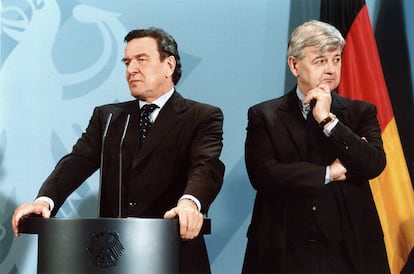
I don’t want to say anything about Schröder. I worked closely with him for seven years, and we worked well together. I do not share his opinion about Russia or Putin at all
Q. If we’re talking about the prehistory of the current situation, we have to talk about Gerhard Schröder, chancellor during the coalition years with you, and close to Putin. Did you already notice that closeness back then?
A. I don’t want to say anything about Schröder.
Q. Why?
A. I worked closely with him for seven years, and we worked well together. I do not share his opinion about Russia or Putin at all.
Q. In your book you write that you see a duopoly between China and the United States in the future.
A. A new world order is taking shape, determined by the major global powers, with China and the U.S. at the forefront. The way the U.S. behaves under Trump is playing into the hands of the Chinese every day. It weakens the U.S. and strengthens China.
Q. So are we heading not toward a duopoly, but toward a monopoly?
A. Let me remind you that 1492, Christopher Columbus’s famous voyage, marked the beginning of a Eurocentric world. With the rise of China as a leading power, this Eurocentrism, this Eurocentric view of the world, has definitively come to an end.
Q. And what does this mean for Europeans?
A. If we stay as we are, decline is guaranteed. Europe must become a power.
Q. You talk of Europe, but not the West.
A. In my opinion, the West has reached its end. The West was the transatlantic West. North America and Europe. That was the West, and Trump has destroyed it.
Q. We talk about Trump and the United States, but in Europe there are many “little Trumps.” The far right is strong, also in Germany.
A. It’s a challenge for everyone, but especially for Germany, because we have a particular history. Right-wing extremism between 1933 and 1945 not only committed the genocide of European Jews, but also devastated all of Europe. We must learn from that. Right-wing extremism wants a return to the nation-state, and that would mean the ruin of Europe.
Q. Do you have the impression that the ideas you fought for, such as Europe, the Enlightenment, or liberalism in a broad sense, have lost?
A. No.
Q. But the situation is far from good.
A. It’s not good because of its own mistakes. The politics of the democratic center are not enough to retain voters. It’s about building a strong Europe. The European idea is the alternative to the far right.
Q. You held positions of responsibility. Could you cite any mistakes you or your government made, or any trends you did not anticipate?
A. I think we all forget about the issue of power.
Q. The issue of power?
A. We have all placed too much trust in the U.S. It is a difficult issue, the issue of power, especially from a German perspective.
Q. European history has taught Germany that power politics is not good.
A. But it’s there, it’s there. And a country as large in the heart of Europe as Germany, with a very dubious history, cannot detach itself from it. I understand very well why the German reaction to two defeats in world wars, a dictatorship, and a genocide was pacifist. But that was only possible thanks to the presence of the U.S., and many good things came from that. But a major deficit remained regarding the issue of power. As Europeans, we must now respond to this, not only in Germany, but in Europe — under the pressure of Putin in the East and Trump in the West — as Europeans.
Q. Who is more dangerous for Europe, Trump or Putin?
A. Trump has more power and I think he acts very irrationally. But I wouldn’t underestimate Putin. Both the war in the Middle East and the one in Ukraine are being fought on our doorstep. The Middle East is our closest neighbor.
Sign up for our weekly newsletter to get more English-language news coverage from EL PAÍS USA Edition









































