
Merz tries to replace Macron at the helm of Europe
The German chancellor, despite being unpopular at home, is pushing international initiatives as the French president loses ground
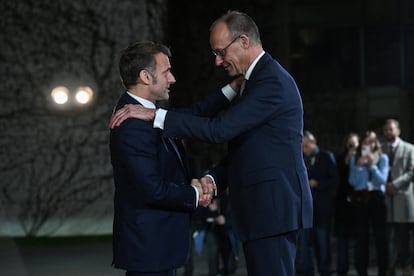

Friedrich Merz is effectively taking over the virtual seat of European power that Emmanuel Macron has occupied for years. The summit on the future of Ukraine, held on December 14 and 15 in Berlin, reinforced the German chancellor’s leadership and signaled the French president’s waning influence.
With the momentum of being new to the position, as well as the credibility afforded by an unlimited military budget, the Christian Democrat Merz is multiplying initiatives, both within the European Union and through international diplomacy. At the same time, he’s consolidating his position as a key interlocutor for President Donald Trump. This comes at a time of heightened hostility from the U.S. administration toward the European Union. There’s also a Russian threat that, according to political and military leaders, could lead to a direct confrontation before the end of the decade.
Merz will not be able to lead alone: he’ll need allies. At home, he also faces problems that are hindering his international efforts, from the rise of the far-right — which is already surpassing him in some polls — to economic stagnation and divisions within his governing coalition with the Social Democrats.
The contrast with Macron is significant. The French president took the helm in Europe after winning power in 2017 with visionary speeches and the audacity of his youth. However, as he faces the last year and a half of his term, he’s contending with a precarious domestic situation, uncontrolled public spending, and the prospect of being succeeded by the far-right in the Élysée Palace.
Macron still wields considerable influence in the EU. And, as France is the only country in the bloc with nuclear weapons, it possesses unparalleled military power. But on issues such as the trade agreement with Mercosur — the South American trade bloc — or the future of the Franco-German-Spanish fighter jet, he appears to be an obstacle to his European partners (or, at least, to the Germans).
“Merz’s moment of leadership has arrived,” says Joseph de Weck, from the Institut Montaigne, a Paris-based think tank. He’s also the author of Macron: Der revolutionäre Präsident (2021), translated from the German as Macron: The Revolutionary President.
According to De Weck, a decisive factor occurred last winter, when the Bundestag adopted a constitutional reform that eliminates budget caps on military spending. “In the medium term,” he explains, “the German Army will be the largest in Europe.” The same reform includes a massive investment plan, which gives the chancellor a level of spending leeway unmatched by any other European country. “Germany’s financial capacity is something that impresses Trump,” he adds.
The German media, which is usually critical of the chancellor, is now showering him with glowing praise. On Monday, the sensationalist tabloid Bild exclaimed, emphatically and patriotically, “But how did he achieve this success?” It referred to the meeting in Berlin between Ukrainian President Volodymyr Zelensky and Trump’s two envoys, Steve Witkoff and the Republican’s son-in-law, Jared Kushner, that included key European leaders.
The article emphasized that, according to initial plans, Witkoff and Kushner were supposed to meet with European negotiators in Paris, the usual venue for such diplomatic gatherings, on Saturday, December 13. However, at the last minute, the meeting was canceled in favor of Berlin. According to Le Monde, the change “caused displeasure” in France. Perhaps, for this reason, the Élysée Palace did not officially announce Macron’s participation in the Berlin summit until Monday afternoon, in a sign of the shifting center of gravity.
“We have experienced a great deal of diplomatic activity these past few days, perhaps the greatest since the start of the war [in Ukraine] on February 24, 2022,” Merz declared, at a press conference alongside Zelenskiy. “Now, we have the opportunity for a genuine peace process for Ukraine. The seed is still small, but the possibility is concrete.” Merz and Zelenskiy subsequently announced that Witkoff and Kushner had offered Ukraine sufficient security guarantees to deter a Russian attack following a future ceasefire. The European leaders then agreed to send an American-backed multinational force to Ukraine once peace was achieved.
But the agreement reached in Berlin is, in reality, fragile and vague. Russian President Vladimir Putin is opposed to a ceasefire. Trump’s commitment is, as always, volatile. And even current NATO members don’t consider the U.S. security umbrella entirely reliable: what will it mean for Ukraine? Even in Germany, there’s a hint of debate about whether German troops should be part of the still-hypothetical multinational force.
Another recent initiative put forward by Merz — the use of frozen Russian funds in the EU to finance Ukraine — also presents considerable risks. Although this measure has been under discussion in Brussels for months, it was an article that the chancellor wrote in the Financial Times back in September that sparked the debate. The fact that he proposed it unilaterally — not in an official forum and not alongside Macron or other leaders — speaks volumes about his abrupt and impulsive style. In this instance, he’s acting as a driving force for Europe, certainly, but he’s doing so with his characteristic style, which often gets him into trouble. There’s now resistance to this tactic in Belgium and other countries. And, despite the confidence displayed by the chancellor’s inner circle, it’s uncertain if he will be able to persuade other EU members.
“Now it’s Merz who’s taking the initiative. It’s Merz who’s taking the risks… and he can take them because he’s [seen as] credible to the rest of Europe. He’s the man of the future,” De Weck notes. “A promise from Macron doesn’t hold up as well anymore, because who knows who will be in the Élysée Palace in 18 months?”
There’s another risk to Merz’s nascent leadership: Donald Trump. The German chancellor, like other European colleagues, is walking a fine line between flattery and defending his own interests. Meanwhile, the U.S. is launching verbal assaults at the EU and liberal democracy. The Trump administration is doing so with documents like the National Security Strategy, which accuses EU leaders like Merz of “subverting the democratic process” and incites far-right parties to “resistance.”
This may sound like a declaration of political war. But there they were, in Berlin: Witkoff and Kushner, members of Trump’s inner circle, alongside Merz and other European leaders, united and smiling.
Still, Merz’s answer is clear: nothing will be the same again. Right now, it’s about making the transition to the new world as painless as possible. “Trump didn’t appear overnight and American policy won’t change overnight, either,” he warns. “The decades of Pax Americana are over.”
Sign up for our weekly newsletter to get more English-language news coverage from EL PAÍS USA Edition









































