
Twenty-five minutes of panic in Teotihuacán: An old revolver, a troubled mind, and a crime inspired ‘from beyond’
EL PAÍS reconstructs the shooting at the archeological site, which left two dead and 13 wounded, with the account of the authorities and video testimonies from the victims
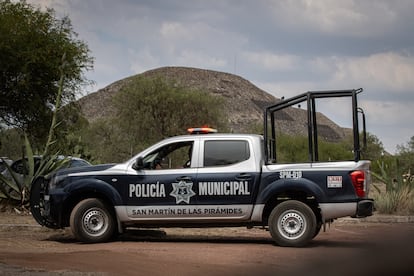

It wasn’t the first time he’d stayed in a hotel near the ruins and spent the day planning something big and sinister at the pyramids, something that in his mind resembled those school or church shootings so common in the United States. Last Sunday he did it again. He arrived by bus from the north of Mexico City, rented a room in a nearby hotel, and on Monday morning entered the Teotihuacán archaeological site in the State of Mexico. For his big day, he chose to wear black pants and a plaid shirt. In his backpack, he put some sheets of paper on which he had handwritten what he was about to do with an old revolver and 42 rounds of .38 caliber ammunition.
It all happened in just a few minutes, less than half an hour. At 11:20 a.m., the authorities in the State of Mexico received the first report. Three minutes later, they had images of Julio César Jasso Ramírez atop the Pyramid of the Moon. He had a revolver in his hand and was pointing it at a dozen tourists whom he had forced to lie on the ground. “Get up, bitch! Cut that fucking plastic, you have one fucking minute. If you don’t, I’ll shoot you.” It was Jasso speaking to one of the tourists in the group he was threatening. Someone was recording with their cell phone. At first, the camera was pointing upwards, showing the innocent, clear sky of the State of Mexico. When Jasso spoke again, the camera went black while continuing to record. They had probably covered it to avoid being discovered, and now everything was happening off-screen.
Jasso is heard again, with a child crying in the background. “Stop staring at me so much. You don’t look death in the eye, you bastard.” There are families with young children. Most are foreigners: Americans, Dutch, Brazilians, Russians. He tells them he just killed two Koreans: “I slaughtered them like dogs.” Something that didn’t actually happen and one of the reasons authorities believe that Jasso, 27, “was disconnected from reality” and “had psychopathic traits.” In another recording, he says: “You guys who came from fucking Europe aren’t going back. If you move, I’ll sacrifice you. This place was built for sacrifices, you bastards. Not for you to come here and take your fucking shitty photos.”
Jasso, his face covered with a balaclava, calmly strolls toward the backpack, positioned a few meters from the tourists. He loads his pistol and fires into the air, then fires down the pyramid, where more tourists are watching and filming the scene with horror and astonishment. A Canadian tourist died during the shooting. The bullet entered her leg and then reached her chest. Authorities have not specified when that shot was fired. They only confirmed that there were 14 bullets in total and that most of the 13 wounded suffered injuries from falls while desperately fleeing from the top of the pyramid.
On two occasions, he carried his 1968 Smith & Wesson, which, according to the official version of events, cost him 40,000 pesos (around $2,300), although the origin of this antique weapon — almost a relic — with its six-round chamber, has not been verified. Nor has the origin of the 42 .38 caliber cartridges he was carrying in his backpack been confirmed; this type of ammunition is used by the Mexican police.
Seven minutes had passed since the first reports. The National Guard, which had a detachment deployed at the archaeological site, sprung into action. At 11:20 a.m., under the command of a first sergeant, 30 soldiers were already at the foot of the pyramid. In the audio recorded by one of the victims, Jasso can be heard saying: “I need someone. You, get out of here, and tell these bastards I have hostages here, and if they try to climb up, I’m going to kill them.” From one of the National Guard vehicles, orders are heard over a loudspeaker: “Drop your weapon!” Jasso ignores the order and fires at the officers, who begin to climb the sides of the pyramid. At the same time, another local police officer manages to climb up the back. When Jasso realizes this, he tries to escape by climbing to the top of the pyramid, which is 45 meters tall, all the while continuing to fire.
The officers returned fire, wounding him in the leg. They had him cornered. It was 11:45 a.m., and Jasso decided to shoot himself and end his life. The same fate as Eric Harris and Dylan Klebold, the two teenagers who, on April 20, 1999, entered their high school in Columbine, Colorado, armed with assault rifles, murdering 12 students and a teacher, wounding 24 others, and then shooting themselves in the school library.
In Jasso’s backpack were books about this infamous and macabre episode in U.S. history that has become part of pop culture. In handwritten notes also found in his backpack, he had written that he was guided by an “inspiration from beyond” and that he “followed orders from supernatural entities.” According to authorities, Jasso’s homicidal profile is that of a copycat psychopath, an imitator who replicates symbolic crimes.
Sign up for our weekly newsletter to get more English-language news coverage from EL PAÍS USA Edition









































