
Shooting at the archaeological jewel of Teotihuacán deals another blow to Mexico’s image
The attack at one of the most-visited pre-Hispanic pyramid complexes left one Canadian tourist dead and 13 people injured, two of them minors
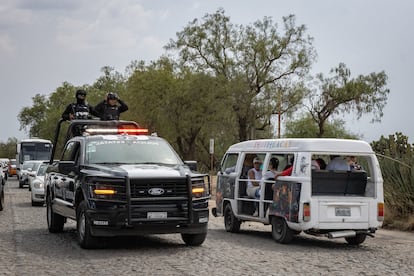

Images of tourists cowering under the fire of a gunman atop the Pyramid of the Moon at the Teotihuacán archaeological site have dealt a severe blow to Mexico’s international image as a safe destination in a year when the country, a co-host for the tournament, expects to receive five million visitors for the World Cup alone. A Canadian woman was killed in the attack, and seven others were wounded by gunfire — two of them children aged six and 13. Six more people suffered injuries while fleeing. All were foreigners. The assailant, who was carrying a backpack with ammunition and a knife, shot himself at the scene.
Earlier, several police officers had fired on him as he ran up the pyramid, 43 meters in height, while visitors tried to climb down among the rocks and flying bullets, as can be seen in this video. The Prosecutor’s Office identified the assailant as Julio César Jasso Ramírez, a 27-year-old Mexican.
The terrifying incident at one of the country’s most-visited sites occurred two months before the World Cup, for which authorities have been preparing for months with multimillion-dollar investments in infrastructure and the projected deployment of 100,000 officers in stadiums, hotels, and airports. The vast archaeological zone of Teotihuacán, which has been closed indefinitely following the attack, is a popular destination for visitors to the capital — where five World Cup matches will be played — as it is located 30 miles from Mexico City.
The government is focused on showing the world that Mexico is a safe country, despite some recent episodes that have called into question the security capabilities of the authorities: two months ago, drug traffickers unleashed a wave of violence in several cities across the country after the military killed the leader of the Jalisco New Generation Cartel, El Mencho.
Since then, Mexico has hosted massive events without incident, such as Shakira’s free concert in Mexico City’s Zócalo, which drew 400,000 people, and the World Cup qualifying matches in Guadalajara and Monterrey. However, attacks like Monday’s at a popular tourist site have once again raised concerns and doubts about security.
Although the motive for the attack — which follows an unusual pattern in Mexico — remains unclear, the fact that the assailant chose the Teotihuacán archaeological site, which received 1.6 million visitors last year, directly strikes at one of the pillars of the country’s international image. Under the slogan “Mexico is in fashion,” the government had pinned its hopes on 2026 to consolidate the country’s appeal as a tourism powerhouse. A month ago, the government celebrated the January visitor figures, which reached a record high of 8.84 million tourists, 10% more than in 2025. “It’s going to be a very good year in every way, and particularly in tourism,” President Claudia Sheinbaum said on March 18, when the figures were released.
The previous incident that most damaged efforts to project an image of safety and security was unleashed after the operation against El Mencho, the most wanted drug lord in Mexico. For 48 hours, cars and businesses burned, there were shootouts in the streets, the population was asked to stay indoors, and transportation was paralyzed in key hubs like Guadalajara, one of the country’s largest cities, an economic engine, and a World Cup host city. In Puerto Vallarta, an international beach destination, social media showed tourists sheltering in hotels and restaurants, trapped in an unprecedented situation in which airports also suspended flights. Sheinbaum had to reiterate that “all the guarantees” of security were in place and revealed that she had spoken with FIFA president Gianni Infantino, who reaffirmed his confidence in her.
Decades of violence
For decades, Mexicans have suffered the impact of drug cartel violence and criminal groups operating throughout the country, although extortion, murders, and disappearances hit hardest in states where cartels wield the most power and have the greatest penetration into economic and social structures. Despite the fact that the Sheinbaum administration managed to reduce homicides to 51 per day this March — the lowest monthly average in a decade — 63.8% of Mexico’s urban population feels unsafe in their city, according to the latest data from the National Institute of Statistics.
The decline in homicides and the government’s calls for calm clash with that perception and with the cases that shock society. The latest example is the discovery of nine bodies of the 10 miners who were kidnapped in the state of Sinaloa, one of the most violent states in the country.
But in terms of violence, the greatest social and political crisis facing Mexico is that of the more than 130,000 disappeared. The campaigns their families have launched to find them — and in particular those of the collectives of searching mothers, who are forced to dig up the earth themselves to locate the remains of their children with hardly any help from the government — are attempting to gain more visibility when the whole world is focused on Mexico for the World Cup.
Sign up for our weekly newsletter to get more English-language news coverage from EL PAÍS USA Edition









































