
Mirla Pérez, Venezuelan sociologist: ‘The migratory exodus caused an emotional rupture between the population and Chavismo’
The academic argues that the transition to democracy in Venezuela ‘began in July 2024′ and says the population’s break with the regime is irreversible
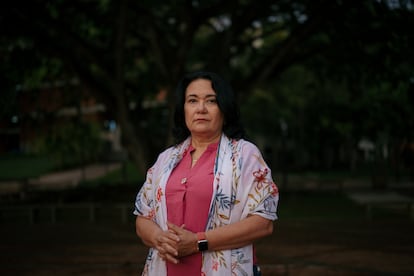
For more than three decades, something more than data has been recorded in Venezuela’s barrios: emotions, connections, and ways of surviving amid precariousness. In that everyday terrain, the Center for Popular Research became a privileged observatory for understanding how people in the country’s poorest areas think and feel.
One of the researchers who has been part of that process is Mirla Pérez. Her work has focused on tracing the emotional evolution of those living in the most impoverished zones of the country — slightly more than half of the population — through long‑term qualitative studies: focus groups, in‑depth interviews, and periodic monitoring that make it possible to capture subtle but decisive shifts.
Over time, the center’s work moved beyond the academic sphere: its readings of social behavior became a reference point for elites, analysts, and media outlets seeking to gauge how the majority was thinking and feeling at different points in the country’s evolution.
Question. How does the poorest segment of the Venezuelan population interpret the current political situation?
Answer. The economic situation of the lower classes in Venezuela is now very difficult. While the middle class is struggling to afford meat, the poor have nothing to eat. This is a recent phenomenon; in recent decades, even under [former president] Hugo Chávez, for better or worse, people in the barrios had enough to eat. People don’t starve because the bonds of solidarity in those environments — family, neighbors, religious networks — remain very strong. Contrary to popular belief, people don’t like to depend on government assistance. They use it because they can’t find work.
Q. What is the current foothold of the communal state in these areas, which were once a source of electoral strength for Chavismo (the political movement and governing project inspired by the late president Hugo Chávez and continued by his successors)?
A. The communal state began entering the reality of Venezuela’s barrios in 2006. It was refined over the years, but that design never fully fit the reality of the barrios, whose social life is community‑based, not communal. The communal model ended up being imposed, and the community life of the barrios initially made use of it, instrumentalizing some of those ideologically driven initiatives. But people always cared that these communal structures did not interfere with their way of living. That, along with the economic crisis, led many to begin distancing themselves from these experiments. Participation slowly started to decline, until 2024 — the year of the presidential elections — when it became clear to everyone how the so‑called Communal Power was fostering denunciation, repression, and political control.
Q. From what point do you think the popular fervor for Chavismo began to fade?
A. By 2018–2019, those spaces of the Communal Power were already empty shells, structures without real roots. Small, isolated groups remained; in some cases, armed.
Q. How would you summarize the thinking and aspirations of the majority of Venezuelans living in poverty?
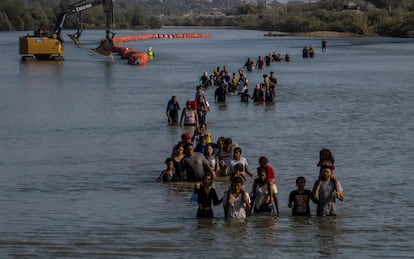
A. The migratory exodus played a major role in breaking the bond that once existed with the regime. The idea of “my children left because of Chavismo” is a very present feeling. That is the first wound, and it shapes all the other perceptions. The years 2014, 2017, and 2019 were marked by intense violence, and the memory of that pain remains. Then came the leadership of María Corina Machado, starting in 2023, as she began traveling around the country and generating enormous expectations. In that year, and again in 2024, there was once more massive public participation in politics.
Q. Does the fact that Machado comes from the upper classes create a barrier between her and the poorer sectors?
A. No, not anymore.
Q. Is there any nostalgia among the population for the oil‑rich Venezuela of the 20th century?
A. In the latest studies we’ve conducted, people are talking about a rebirth. About a new Venezuela, about starting over. It’s a feeling anchored in the outcome of the 2024 presidential elections, the national reconstruction. The past is a point of reference, but people are interested in projecting the future.
Q. Is there a clear awareness of the xenophobia Venezuelans face in South America?
A. Yes, of course. In the outlying neighborhoods of Caracas, there are still many Colombian immigrants. Many have returned, but others remain in the country; many families are intermingled. The same is true for Peruvians and Ecuadorians, although to a lesser extent. All those comments are circulating.
Q. Is there hope among the population for a political change in the near future?
A. It’s a yearning. The transition to democracy in the country actually began in 2024, regardless of what’s said in the corridors of power and what politicians say. It began as a social, everyday, popular phenomenon. That electoral decision is what’s shaping today’s events.
Q. Many Chavista leaders seem to have a palpable hope of reconnecting with the population in terms of popular support, of returning to the good old days. There are even those who fear that increased oil revenues will help acting President Delcy Rodríguez. Do you see that as possible?
A. It’s difficult. The bond is broken. Venezuelan socio‑anthropology is relational, centered on family networks. Personal and emotional ties are very important. When those ties break in communities, they can’t be repaired. The officialist structure exists, but it’s detached from popular sentiment. The communal model developed by the government does not privilege leadership; it speaks of chiefs — community chiefs, street chiefs, commune chiefs. It’s a framework that demands obedience.
Q. How does the population view the leadership of the rest of the opposition?
A. Very poorly as well. There is a very clear, very strong preference for María Corina. Sometimes Primero Justicia appears, but above all Juan Pablo Guanipa.
Q. How do Venezuelans stay informed, given the country’s levels of censorship?
A. Ordinary people are usually interested in keeping up with the news. The first medium they turn to is WhatsApp. For personal relationships, to talk to family members abroad, to find out what’s going on. TikTok and Facebook are also widely used. Radio is used much less now, due to censorship.
Q. Is the return of democracy — even beyond political change itself — seen as a horizon to be reached?
A. Yes, of course, and also finding work, earning wages. People don’t want things for free if they work badly. They prefer to pay for services and have them work. Right now, in many impoverished areas of Venezuela, children are going to school only twice a week because of the collapse of public schools and the migration of teachers. Many families in poor barrios hire private tutors or look for supervised homework programs to improve their children’s education on their own.
Q. Do you have any evidence of how the population viewed the events of January 3, when president Nicolás Maduro was arrested?
A. In our studies, what we capture is relief — the sense of an opening, and the calm of the current moment.
Q. Is there class resentment in poor areas toward wealthier sectors?
A. No, that’s all in the past now; it never really took hold.
Sign up for our weekly newsletter to get more English-language news coverage from EL PAÍS USA Edition









































