
The easing of US bank sanctions against Venezuela gives Delcy Rodríguez a lifeline amid social unrest
The measure will facilitate dollar transactions, but experts believe the obstacles won’t disappear entirely because the government itself remains under sanctions
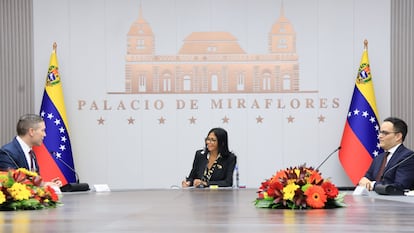

U.S. President Donald Trump on Tuesday threw a valuable lifeline to Delcy Rodríguez, Venezuela’s interim president. Bradley T. Smith, director of the Office of Foreign Assets Control (OFAC), signed two licenses that significantly ease the sanctions imposed on the Venezuelan financial system, providing a boost to the Caracas government’s efforts to revive the country’s ailing economy.
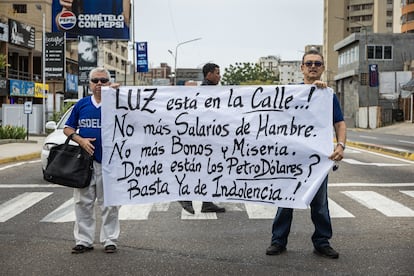
The enormous expectation that was created after the U.S. intervention against Nicolás Maduro in January and its still meager results in the domestic finances of ordinary Venezuelans — and also of companies — is threatening both the plans of Chavismo to remain in power and those of Washington to continue exploring the possibilities that Venezuela has opened up.
The government of Delcy Rodríguez is demanding the lifting of all sanctions, not just those affecting the state-run financial system, but this latest gesture offers a respite from the predicament she has faced for the past 111 days. Following the January 3 raid in Caracas, Rodríguez has been pursuing a whirlwind agenda of change, opening the country to foreign investment, expanding freedoms and enacting legislative reform. All of it is aimed at revitalizing the Venezuelan economy and gaining international credibility. But it is also about maintaining control of the country with the world’s largest known oil reserves.
Beyond the oil investments that Donald Trump is focusing on, ensuring that Venezuelans feel an improvement in their personal finances has become a priority for both Caracas and Washington—each for its own reasons—so that the stabilization, recovery, and transition plan announced by U.S. State Secretary Marco Rubio can move forward. Without economic improvement, public frustration could grow—it already is—and thereby threaten the stability that both capitals are determined to maintain.
For days, economic and financial actors in Caracas had been speculating about the urgent need to lift sanctions on the Venezuela Central Bank so that the hundreds of millions of dollars generated by the growing sale of oil to the United States could reach the pockets of Venezuelans. Even so, the speed of the measure has caused some surprise and a common interpretation: the initiative provides a lifeline to Rodríguez’s administration.
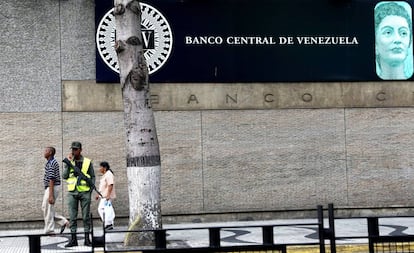
The new licenses open the door to financial transactions with four banking entities controlled by the Venezuelan state, including the central bank. According to financial sector sources consulted by EL PAÍS, this is a gesture of confidence from Washington, which had hoped to condition the measure on a profound change in the leadership of the central bank, co-opted by Chavismo, but ultimately did not.
Replacing that leadership might seem straightforward, but it remains a Herculean task because many of the qualified candidates who could take on the challenge of leading the state-owned bank have declined to risk their reputations on what they consider an uncertain mission, given an equally uncertain future, according to sources familiar with the negotiations. Following the U.S. move, they now agree, it is easier for someone to accept. And, most importantly, the measure is stimulating the flow of funds.
The direct sanctions affected expressly listed Venezuelan banking entities and went even further: any ministry employee, regardless of rank, was automatically barred from any dealings with U.S. individuals or institutions—signing contracts, opening accounts, receiving money or aid. “In everyday life, and not just in the corporate sphere, this always made things extremely cumbersome; countless times accounts have been closed, transactions have been delayed, or costs have increased,” explains Tamara Herrera, chief economist at the Venezuelan consulting firm Síntesis Financiera C.A.
Herrera believes this measure will ease the situation, but the obstacles won’t disappear entirely because the government itself remains under sanctions. “Foreign banks will continue to have the power to assess the risk of doing business with Venezuela.”
“The inability to operate in dollars through local banks led thousands of Venezuelans and companies to open accounts in the U.S., Spain, Panama, the UK, or Turkey, and to establish companies abroad,” explains a Venezuelan source familiar with the country’s financial sector and the sanctions that cripple it. “This increased operating costs and, in turn, raised consumer prices,” the source adds, speaking on condition of anonymity because they are not authorized to speak publicly.
“The Central Bank of Venezuela is the country’s monetary authority,” this expert continues. “With this institution excluded from international payment channels, it was impossible to perform basic operations like converting dollars to euros,” she explains. “This license normalizes those channels, beyond just the energy sector.” The measure should contribute to economic improvement in the short term, according to the economists and experts consulted, although enthusiasm remains subdued.
Despite what most economic actors consider good news, Chavismo maintains its rhetoric that it is not enough. “We insist to President Trump that he lift the sanctions so that all investments can fully develop. Because there are always details, and investors require greater legal certainty,” Rodríguez insisted after the announcement.
Chavismo has blamed much of the country’s economic collapse on the sanctions imposed by the United States during Nicolás Maduro’s successive terms. Depending on when these restrictions are lifted, its political discourse and continuity will hinge on its ability to attract investment and improve the lives of millions of exhausted Venezuelans.
Chavismo’s aspiration to abruptly end the restrictions clashes with the very nature of the sanctions. This is compounded by the network that Delcy Rodríguez herself built over years to circumvent them while in charge of finances for much of Maduro’s presidency. “Sanctions are like an onion,” the Americans tell Venezuelans when they feel under pressure. “You have to peel them back layer by layer.” The history of the sanctions is like that, says Tamara Herrera. “They aren’t lifted; instead, loopholes are created through licenses. That’s the tragedy: it’s a tangled web that has grown over more than 10 years, and it has to be dismantled piece by piece.”
U.S. sanctions have shaped the Venezuelan economy over the past decade. For some, with little success. “The U.S. punishment has achieved the opposite of what it intended,” maintains a key economic player in the country. “The sanctions strengthened Chavismo and divided the opposition. They strengthened geopolitical rivals and weakened the interests of U.S. oil companies and the financial world,” he says. For the opposition, the sanctions have only served to justify the country’s questionable economic management. In any case, Rodríguez begins a new test on April 14 under the watchful eye of the White House.
Sign up for our weekly newsletter to get more English-language news coverage from EL PAÍS USA Edition









































