
Chevron consolidates its position as Venezuela’s largest private oil producer
The signing of two agreements with the Chavista regime allows the oil company to expand its operations in the Orinoco Belt, which holds more than 80% of the country’s reserves
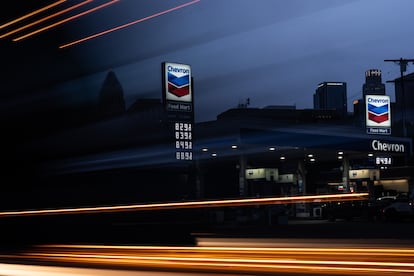
With its leadership still unrivaled, oil giant Chevron on Monday signed two key agreements with the Venezuelan government led by Delcy Rodríguez that will allow it to restructure its assets in Venezuela and focus on expanding its extra‑heavy crude operations in a strategic area of the Orinoco Oil Belt.
Under the agreements signed at the Miraflores Palace in Caracas, Chevron increased its stake in Petroindependencia, one of its joint ventures with state-owned Petróleos de Venezuela (PDVSA) dedicated to extra‑heavy crude production in the Orinoco Belt. This stake has risen from 35.8% to 49%, the company said in a statement.
Chevron also agreed to receive the rights to develop another block, Ayacucho 8, allowing it to expand the geographic footprint of its largest project in Venezuela: Petropiar. The move reinforces the position the company has secured in recent years as the Orinoco Belt’s largest private producer — a region that is critical to the development of heavy and extra‑heavy crude and holds more than 80% of the country’s total reserves.
Agreements like those signed on Monday are part of a surprising opening to foreign investment that has emerged following the military operation in which the United States arrested president Nicolás Maduro and forced the formation of a government under Rodríguez. Since then, U.S. President Donald Trump has sought to push an ambitious $100 billion plan to rebuild Venezuela’s energy sector. In record time, Venezuela’s National Assembly — dominated by followers of the ruling Chavista movement — approved a sweeping reform of the Hydrocarbons Law in January that loosens the conditions for private oil companies to be involved in Venezuela’s oil sector.
The negotiations between Chevron and the Rodríguez government are no coincidence. The company was the only U.S. producer to accept a forced migration to the joint‑venture model imposed by former president Hugo Chávez, while its competitors — most notably ConocoPhillips and Exxon Mobil — left Venezuela after filing lawsuits, still unresolved 20 years later, seeking compensation for their expropriated assets.
By shaking hands with Rodríguez on Monday, Chevron took a firm step toward expanding its operational capacity in the Orinoco Belt, an area of more than 55,000 square kilometers that holds the world’s largest reserves of heavy and extra-heavy oil. This comes at a time when other energy companies are evaluating whether there are enough legal guarantees to invest in a Venezuela led by Maduro’s former vice president.
The agreements allow Chevron, the main partner of state-owned PDVSA, to strengthen its role “in supporting regional energy security,” said Javier La Rosa, president of the corporation’s Base Assets and Emerging Countries unit.
In exchange for expanding Petropiar into the Ayacucho 8 block, Chevron’s Venezuelan subsidiaries returned dormant and residual assets: they relinquished two offshore gas blocks that are part of the still‑inactive Plataforma Deltana Project, as well as their stake in the Petroindependiente joint venture in western Venezuela.
In January, Chevron estimated that, maintaining its current infrastructure, it could increase oil production in Venezuela by about 50% within two years. According to Reuters figures, its joint ventures with PDVSA produce 260,000 barrels of crude oil per day, representing almost a quarter of the South American country’s total production.
The agreement between Chevron and Rodríguez comes weeks after a meeting between energy executives and Venezuelan opposition leader María Corina Machado at CERAWeek, the world’s largest oil conference, held in Houston. At the conference, Machado argued that the Rodríguez administration does not provide the legal or operational certainty required for the immediate return of foreign oil investment to Venezuela.
But from Miraflores, Rodríguez assured La Rosa and U.S. officials that the signed agreement should not be seen as “a passing or momentary investment.”
Sign up for our weekly newsletter to get more English-language news coverage from EL PAÍS USA Edition









































