
‘I’m not going to Cuba until things ease up with Trump’: Florida sees decline in trips and sales at stores that supply the island
In Miami, several establishments selling products that get sent to relatives back home have come under scrutiny from U.S. authorities and the exile community, who accuse them of aiding the regime
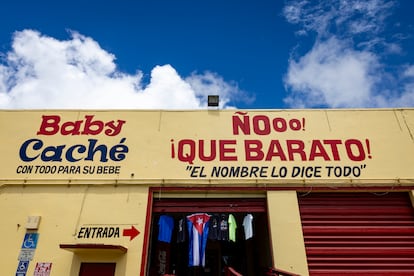

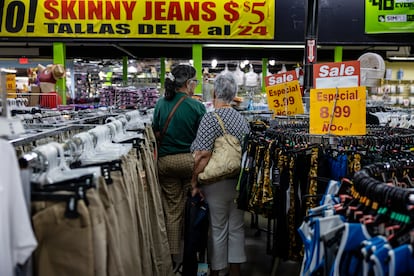
At Ñooo Qué Barato, a store on a street corner in Hialeah where for decades Cubans have bought “everything to send to Cuba”—from school uniforms to baby baskets and rechargeable lamps—customer traffic and sales have declined in recent weeks. “People aren’t traveling to Cuba because they’re afraid of the uncertainty that [President Donald] Trump might do something and they’ll be stranded there,” explains Norelbis Ramírez, a 52-year-old Cuban woman from Bayamo—in the east of the island—who works as a cashier at the store.
Messages from Trump and State Secretary Marco Rubio regarding a possible regime change on the island—whether in the shape of a negotiated solution amid the maximum economic pressure ever exerted by Washington, or as a result of “taking Cuba” as the president has also suggested—have created a climate of uncertainty among Cuban exiles. This lack of clarity has generated a degree of paralysis, but for many, ceasing to support their families in Cuba is not an option.
Ramírez herself traveled to Cuba at the end of last month because her father fell ill and was hospitalized. She hadn’t been there in two years, and although she tried to prepare herself mentally, she says it was still a shock. At the hospital there was no water or medicines, the toilets were clogged, and people were urinating in the sinks. “The streets are garbage dumps, you never know when the electricity will come on or go off,” and there’s no water for days at a time. “In the darkness of night, when I was trying to soothe my father’s pain, I used these lamps we sell here for light,” she says.
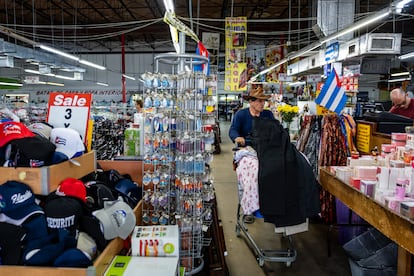
On the plane where she flew to Holguín, which was “almost empty,” several of the passengers were “mules,” people who transport packages and supplies to the island. As direct flights have decreased, shipments have increased, Rodríguez points out. Upon returning to Hialeah this week, she herself sent by plane the things her father needs: a mattress, a wheelchair, a walker, a urinal, and a commode. In total, $800 worth of equipment. Sending them by boat would have been cheaper, but they would have arrived at the port of Mariel in Havana, and “there’s no fuel to take the packages to Bayamo.” Before the trip, she also sent money so her family could buy the gasoline they need and store it.
Besides the fear of being trapped on an island in crisis should a complete collapse occur, others have stopped traveling for fear of being detained upon returning to the United States due to their immigration status. Among them is Marbelis, who arrived two years ago with her husband and daughter through the CBP One program, but has not yet been able to regularize her status under the Cuban Adjustment Act. “Even if I get my residency tomorrow, I’m not going to Cuba until things ease up with Trump. What if they don’t let me back in when I return?” she says.
The Trump administration has already revoked her and her husband’s work permits and, in December, suspended all immigration proceedings. Even so, she considers herself lucky: “At least I’m helping my mom. I hope to gather 20 or 30 pounds of things and ship them,” she adds while choosing some sandals in the store.
Gregorio Álvarez, 76, and his wife, Estervina Morales, 69, both permanent residents of the United States, postponed their trip earlier this year due to uncertainty. They finally decided to go this month. At Ñooo Qué Barato, they bought clothes and other supplies to take to their siblings in Pinar del Río, in western Cuba.
The number of travelers from the United States to Cuba has plummeted by almost 54% this year, amid a widespread collapse in tourism, according to figures from Cuba’s National Office of Statistics and Information. Similarly, an employee of a Miami travel wholesaler told EL PAÍS that sales of charter flight tickets to the island have fallen by more than 20% in the first quarter of the year, which he attributed to fears of sudden flight cancellations. Some small agencies have had to close, he stated.
Under scrutiny from authorities and the exile community
In this context, businesses that sell and ship supplies to the island have become crucial for families to support their loved ones there. But this has also made them targets.
Local authorities in Miami have echoed Trump’s rhetoric that economically strangling the island could bring about a change of government, and they are doing their part. Dariel Fernández, a Cuban immigrant who holds the non-political position of Miami-Dade County tax collector, has revoked business licenses for “businesses linked to the Cuban regime,” including shipping and travel agencies that lacked authorization from the U.S. Office of Foreign Assets Control (OFAC) to operate with Cuba.
Serafín Blanco, owner of Ñooo Qué Barato, maintains that, despite selling and shipping retail goods to the island, the measures don’t affect him because he doesn’t do “anything directly with Cuba.” Even so, he calls them “absurd.” “What they want is for anyone doing business with Cuba to have an OFAC license. If you have a license, nobody says anything to you. Big companies won’t be affected. It’s the ‘mules’ who are affected,” he says.
Blanco opened his store in 1996, after the so-called Balseros Crisis, to sell the new arrivals “what they were looking for back in Cuba: lightweight clothing, mosquito nets, matchsticks and duffel bags.” Over time, he expanded and began producing school uniforms used on the island, from the red and white ones for elementary school to the blue ones for medical school. “In Cuba, they give a five-year-old a size ten uniform. Sometimes they don’t give them any at all, and they have to make do as best they can,” he explains.
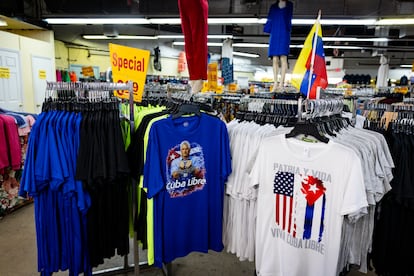
The uniforms have drawn criticism from some who see them as part of the communist regime’s indoctrination. “That little uniform they call the Pioneer uniform, I don’t think it hurts anyone. Otherwise, the children would go to school in ripped pants,” Blanco says. “If they ask me for a militia uniform, I tell them no.”
Blanco was one of the thousands of Cuban children who left for Spain without their parents in the 1960s under a program promoted by Father Antonio Camilla, before reuniting with relatives in the United States. “Everyone knows I’m more anti-communist than many here. Nobody can say anything to me, or to any of those who left like me,” he says.
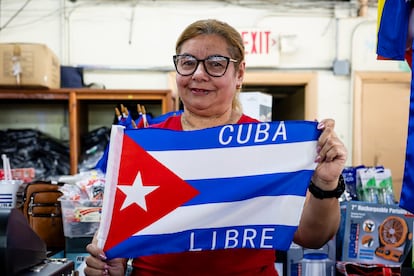
At the end of last month, Blanco was one of the sponsors of a rally for freedom in Cuba in Hialeah. “I gave away a lot of flags at that rally. It was a way of saying that we want Cuba to be free, that we want democracy,” he adds.
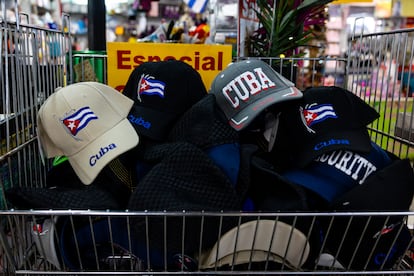
This tension between wanting the regime to fall in Cuba, but having to support family members there, reflects a cruel paradox. Sebastián Arcos, director of the Cuban Research Institute at Florida International University (FIU), says that what the exile community is experiencing “is essentially a situation of extortion” by the Cuban regime.
“The most ironic thing about all this is that the need to help relatives, the family divisions, the misery in Cuba—it’s all caused by the regime; but in the end, we all end up relying on the regime in one way or another, because it’s unavoidable, to help our families,” Arcos points out. “Some say, ‘I have no choice but to send powdered milk to my mother. I know I’m putting money in the regime’s pocket, but I have no other option.’”
Sign up for our weekly newsletter to get more English-language news coverage from EL PAÍS USA Edition









































