
A potential transition in Cuba stirs up leadership disputes among Miami’s exiles
The most prominent figures in the Florida city’s Cuban diaspora are preparing to shape a new reality on the island. But experts note that US State Secretary Marco Rubio seems to be ‘preparing the Cuban-American community for disappointment’ about the scope of change

Expectation has been building in recent weeks in Miami. The capture earlier this year in Venezuela of Nicolás Maduro – Havana’s erstwhile main ally – and Donald Trump’s repeated assertions that the Cuban regime is going to fall soon, have reinforced exiled Cubans’ longing for their country’s freedom. Along with that hope, a well-worn question has resurfaced: who could lead a post-Castro Cuba?
Dissidents, entrepreneurs and influencers who have positioned themselves more or less explicitly as possible architects of a transition are being carefully considered from both sides of the Florida Straits. Hanging over them is the uncertainty of how much of that future leadership will depend on the U.S., seemingly eager to control an island that has not seen free elections in 70 years and which is mired in the worst crisis in its recent history.
Throughout those 70 years, the exiled community has generated its own political references to represent the aspiration of a free Cuba. The spectrum has ranged from historical figures such as Huber Matos, the commander who broke with Castro, and the leader of the Bay of Pigs, Manuel Artime, to politicians such as Lincoln Díaz-Balart and activists like Jorge Mas Canosa, from the Cuban American National Foundation (CANF), who organized the pro-democracy opposition. Today, a new generation of leaders, with different backgrounds and career paths, has positioned itself in the political arena beyond Cuba’s borders.
Meanwhile, President Trump has gone so far as to suggest that he would like to put Secretary of State Marco Rubio, the Miami-born son of Cuban immigrants, at the helm in Cuba. At the same time, Rubio has been negotiating with the Castro regime, which has put names linked to the Castro family, such as Guillermo Rodríguez Castro, Raúl’s grandson, and Minister Oscar Pérez-Oliva Fraga, on the table. But mention of these potential candidates has generated unease among the exiles, who flatly rejected any dialogue with the regime at a rally last week in Hialeah, north of Miami.
A plan designed in exile
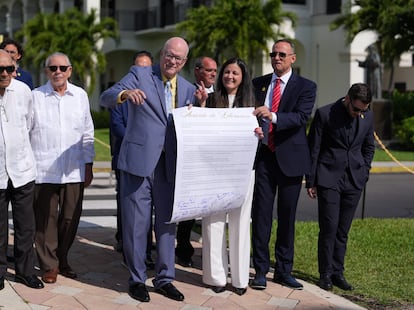
Orlando Gutierrez-Boronat, 61, who leads the Assembly of the Cuban Resistance, a Miami-based coalition of more than 50 opposition groups said to be in contact with the Trump administration, is convinced that they are “close to real change in Cuba.” Opponents have been working out a detailed transition program for Cuba for decades, Gutierrez-Boronat explains. Last month, the Assembly was joined by another coalition, Pasos de Cambio, also comprised of 50 groups, launched in 2019 by Rosa María Payá, daughter of the historic opposition leader Oswaldo Payá, for the signing of a “Liberation Agreement.” Contemplating a change of governance on the island, the document proposes a provisional council of 51 members that functions as a parliament, and an executive composed of a president and two vice presidents.
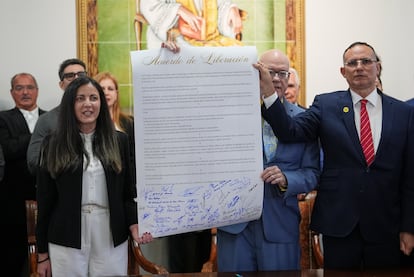
Most of the council’s members would be “people from inside Cuba,” Gutierrez-Boronat says. Even if they are currently engaged in politics under the communist government, as long as “they do not have blood on their hands and have contributed to the liberation of Cuba.” Under this plan, the council would govern for two years and members would not seek re-election in order “to demonstrate democratic commitment.”
Gutiérrez-Boronat avoids naming possible leaders, but highlights the role of exiles in U.S. policy regarding the island. Specifically, there is the 1996 Cuban Liberty and Democratic Solidarity Act, better known as the Helms-Burton Act, which Gutiérrez-Boronat calls “a great achievement by Cuban exiles and the opposition.” The legislation makes the lifting of the economic embargo conditional on a political change on the island.
The main driving force behind the Helms-Burton Act was the CANF, founded in 1981 by Mas Canosa, the most influential Cuban exile in U.S. politics until his death in 1997. His son, the billionaire Jorge Mas Santos, 63, now runs the foundation and has recently expressed interest in contributing to Cuba’s reconstruction. After a visit last month to the White House with his soccer team, Inter Miami FC, he declared that his family’s patrimony was “at the service of a free Cuba” and that Trump had told him that Cubans could return “very soon” to their country, with change imminent.
The protagonism of exiled Cubans has, however, also been subject to criticism. Ricardo Herrero, of the Cuba Study Group, which promotes a transition through dialogue between the island and the diaspora, says you only need to lob a few stones in the direction of Miami to throw up several wannabe presidents of Cuba. He also states that for those in exile “the issue of Cuba is a currency that has been used to advance personal interests.” Therefore, “change and the next leaders have to come from within. We could plant a ruler there, but there would be a massive disconnect with the ordinary Cuban.”
The line between exiles and the opposition within Cuba are not, however, always so clear. At the same time that the Helms-Burton was taking shape in the U.S., the opposition leader Oswaldo Payá founded the Christian Liberation Movement to promote change from within Cuba. Payá died in 2012 in a car crash, a tragedy found to have been engineered by the Cuban government, according to the Inter-American Court of Human Rights (IACHR). His daughter took over and founded Cuba Decide, an initiative that calls for a plebiscite. She later launched Pasos de Cambio. Last year, she was elected a member of the IACHR, after being nominated by the U.S. government.
Payá maintains that Cubans must be the “protagonists of change,” with a leadership that is “Cuban and supported by the international community.” She explicitly blurs the line between the island and exile: “The Cuban people are one, and we are acting as such. Those of us who are currently living in exile have the opportunity and responsibility to participate and contribute when it comes to the transition to democracy.”
“Rosa María Payá and Orlando Gutiérrez-Boronat are both very capable leaders and can carry out a real and definitive transition on the island,” says Alexander Otaola, a 46-year-old influencer who has become one of the most audible voices of the opposition, with large audiences for his online program Hola! Ota-Ola! both on the island and in Florida. The program combines Cuban entertainment and gossip with criticism of the regime.
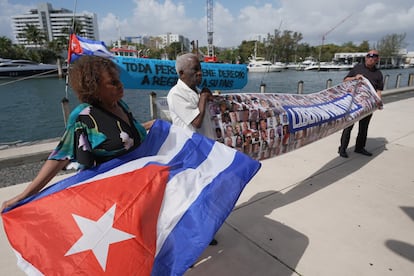
Known for his conservative views, Otaola himself ran for mayor in Miami-Dade in 2023, coming in third. He also created the Cuban Anti-Communist Foundation in Miami last year and organized the recent rally in Hialeah. But he claims not to aspire to hold public office in a future Cuba, although he would like to help “the new free Cuban nation.”
But he does flag up what he considers to be an underlying problem, namely the detachment Cubans have from politics. “The Cuban people do not even know the communists who are in charge. People have no connection with anyone, neither inside nor outside, only with the dollar and with the remittances they receive from their relatives abroad,” he says.
The authority of sacrifice
Not all opponents conceive of leadership in the same way. For José Daniel Ferrer, 55, legitimacy is not built with agreements, but with internal resistance. Ferrer was one of the 75 dissidents imprisoned during the so-called Black Spring of 2003. Upon his release from prison in 2011, he founded the Patriotic Union of Cuba (UNPACU). He was then arrested multiple times, and spent a number of years in prison until he was released last year on condition that he would go into exile.
Ferrer considers himself part of the opposition and in a position to lead a transition process. He maintains that the key factor for leadership is the legitimacy lent by the population, rather than resources or visibility. “In a democracy, the president is elected by the people. No matter how much money you may have, no matter how much propaganda you can make, I am sure that the Cuban people will keep in mind who it was that fought for freedom over a long period of time, whether from prison, from the streets of Cuba or from exile. Our people have a good memory, and they will know to ask ‘where were you when I was beaten, when I went to bed without eating?’” he points out.
According to Ferrer, the outcome will depend on whether the U.S. forces the regime’s exit, as it did in Venezuela, where “Trump decided that Delcy Rodríguez was the right person for that transition from dictatorship to democracy… It is better that it happens in whatever way is possible than that it does not happen at all,” he adds.
Even so, Ferrer maintains that those in exile can do “much more than sign documents.” UNPACU carries out clandestine activism inside Cuba with graffiti, protests with pots and pans and the burning of garbage – activism which in his opinion will be key to influencing a transition scenario. “We must show that our struggle is ongoing despite the repression. The more prominence we have, the more we can demand and prevent what happened to [opposition leader] María Corina Machado in Venezuela, who Trump said they loved very much, but did not respect enough,” he says.
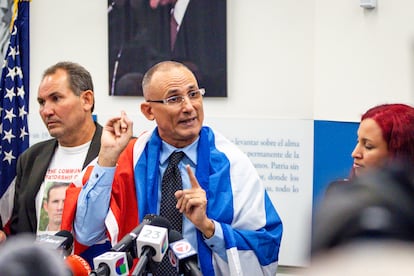
One of the leaders of UNPACU who went into exile in 2020 after threats against his family is Carlos Amel Oliva, 38. Oliva believes that the leadership of the transition will emerge from the conditions that are in place when it happens. If the transition is triggered by a popular uprising such as the mass protests of July 11, 2021, the leadership will be assumed by “whoever is inside Cuba leading that resistance… No plan [from outside] will survive the struggle. Legitimacy will be lent by the weight of the facts,” he says.
Oliva believes that Cuba “is ready for a transition” thanks in part to the fact that “the gap between Cuba and Miami has narrowed… People are no longer informed by the National News; they open Facebook and see their cousin who was here yesterday and there today. That is why we no longer see Cubans protesting about hunger or electricity. They demand freedom, they ask for change, they say ‘down with communism.’”
The opposition, he says, is ready to form a “very successful” government of which he would like to be a part, although he does not know “what position I would occupy”, or if they would call on his services. “But I am willing to drop everything and go to Cuba to rebuild my country,” he says.
The risk of promoting a chimera
But analysts are cautious about developments. Ted Henken, a sociology professor and expert on Cuba at New York’s City University, believes that the crisis on the island together with Washington’s aggressive policy has generated “an exaggerated expectation” that feeds what he calls “the industry of being a Cuban leader in exile.”
“Some have very good intentions, but it is also a kind of industry that does not need to produce results because it does not govern. It is like an electoral campaign where everything is promised without having to assume responsibility, attributing limitations to the current dictatorship. It is, in a way, an irresponsible position,” he concludes.
Rubio, he adds, seems to be “preparing the Cuban-American community for disappointment, so that they understand that the agreement that is reached may not be the one they would prefer,” he says. “It is possible that the Cuban government will resist again, or that even if there is a change, many of the promises will not be fulfilled — or at least not immediately.”
Sign up for our weekly newsletter to get more English-language news coverage from EL PAÍS USA Edition









































