
Pilgrims under the bombs on their way to Iraq
Some 20 million worshippers visit the holy city of Karbala each year, but the US-Israeli offensive is drastically reducing religious tourism, a key economic driver
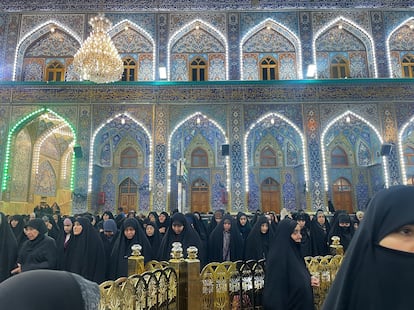

It’s hard to breathe with dozens of bodies pressing in from all sides. The easiest thing to do is to let yourself be carried along by a dense black wave of abayas and chadors. It’s the older women who move forward with the most determination, through the security lines, where the guards conduct thorough pat-downs and searches of bags. The elderly women also set the pace, chanting religious slogans that the rest join in with. They walk barefoot in the mausoleum in the Iraqi city of Karbala toward the tomb of Imam Hussein, son of the fourth caliph Ali — cousin and son-in-law of the Prophet Muhammad — who died in battle in that city in 680, the founding date of the Shia schism of Islam, the branch practiced by between 10% and 15% of the world’s two billion Muslims, according to the Pew Research Center. More than 20 million worshippers visit this pantheon annually, the world’s leading Shia pilgrimage destination. But the war that the United States and Israel launched against Iran in Febrauary has impacted this formidable flow of people.
Despite the inevitable bottleneck that forms in the area restricted to women in order to pray and touch Hussein’s tomb, the vast complex is experiencing its lowest number of visitors, with the conflict in the neighboring country knocking on Iraq’s doorstep and its airspace closed by crossfire from missiles and drones.
“From Iran?” one of the women asks two others who are conversing in Farsi. The pilgrims nod. The youngest, extremely pale, looks ill.
When asked about their journey, the older woman mimes flying planes and falling bombs with her hands. In this line, everyone is showing solidarity with their Iranian sisters.
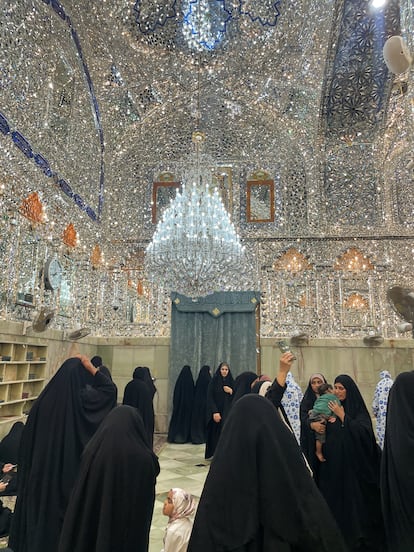
Cameras are prohibited, and although taking photos is also forbidden, cell phones peek out from the sleeves of abayas to capture memories of the imposing architecture, fabulous carpets, and crystal chandeliers hanging from the ceilings. The two Iranian women have come from Tehran for three days, which means two days of travel by road, each journey taking 15 hours, leaving them one day to pray at a shrine that never closes. It is precisely in difficult times, when the distance between life and death seems to narrow with each missile strike, that the faithful yearn most for spiritual peace. But few Iranians dare to defy the bombs to pray in this sacred place, where they are greeted with posters bearing the face of the former Iranian Supreme Leader, Ali Khamenei, assassinated in a U.S.-Israeli airstrike.
From tens of thousands to dozens
“Before, they used to come by the tens of thousands. This square was overflowing. But now you only see dozens,” laments Abu Mohamed, a man in his seventies, who for decades has run a stall outside the mausoleum selling nuts and sweets by weight. The vendor says his customers believe the government won’t be able to pay civil servants’ salaries next month because “with the blockade of the Strait of Hormuz, they haven’t been able to sell the oil.”
Iraq’s state revenues depend 90% on hydrocarbon sales, which totaled $86 billion last year in a country that ranks fifth in the world in terms of oil reserves. Since the start of the war, crude oil exports have plummeted by 70%.
The impact of these pilgrimages transcends the spiritual. Religious tourism generates around $6 billion in revenue annually, making it one of Iraq’s most important economic sectors. Although, unlike the Hajj — the pilgrimage to Mecca in Saudi Arabia — many services here are offered free of charge by volunteers, the arrival of pilgrims generates more than 60% of local employment in Karbala and the neighboring holy city of Najaf — home to the tomb of Ali, the fourth caliph — with tens of thousands of people working in hotels, transportation, restaurants, and souvenir shops.
“People used to come here from all over the world: Indians, Pakistanis, Lebanese… but now only Iraqis and the occasional Iranian come,” explains Abu Mohamed. While only Iran, Iraq, Bahrain, and Azerbaijan have a Shia majority, Pakistan, India, and Lebanon are home to significant Shia communities.
A few meters from the checkpoint, Fatime’s polite smile can’t quite mask her exhaustion as she carries her youngest child in her arms. She has come from Qom, Iran’s holy city south of Tehran, with her husband and two other children. They passed through the Iranian crossing at Mehran, a point in the middle of the shared border that stretches 1,400 kilometers (870 miles) between the two countries. When asked about the situation in his country, Fatime’s husband, a teacher, admits that the war could drag on, but he believes the Islamic Republic will ultimately win because “it’s on the right side.” At that point, he predicts, his country “will emerge stronger.”
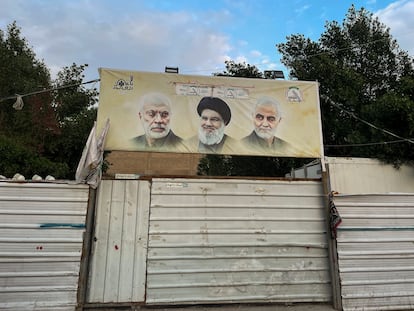
Above the teacher’s head hangs a banner bearing three faces: in the center, Hassan Nasrallah, the deceased leader of Hezbollah; on either side, Qassem Soleimani, former head of an elite unit of the Revolutionary Guard, and Abu Mahdi al-Muhandis, who led pro-Iranian militias in Iraq. All three were killed in attacks by the U.S. or Israel.
The three were adherents of the Iranian school in Qom, which also attracts millions of visitors each year and stands as one of the main Shia religious centers. That city played a key role by becoming a focal point of the 1979 Iranian Revolution, from where Ayatollah Ruhollah Khomeini worked to overthrow the Shah and establish a theocratic system.
“My husband and I disagree,” admits a smiling Mansura, in her thirties. She’s also from Qom, but arrived in Karbala three weeks ago in search of an internet connection. Her husband, Mohamad, is a computer engineer and works for an Irish company. They crossed the border three days after the first attacks and only have one week left on the one-month visa they received at the Mehran border crossing. Mansura disagrees with the Iranian regime, which, she says, has led to many arguments during their 13 years of marriage.
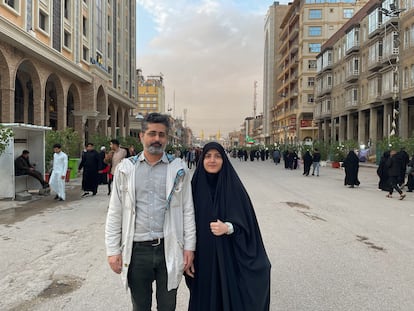
She explains that he is more aligned with the social and religious project inherited from Khomeini. Mohamad smiles and nods. She supports the various waves of popular demonstrations — in 2009, 2022, and in the months leading up to the Israeli-American offensive — as well as women’s rights. “But just because I want change doesn’t mean I want it to come from the U.S. and Israel,” she clarifies, her smile now twisted. “We all know that Trump doesn’t care about the fate of the Iranians and that he only wants our oil. And that Israel only wants to dominate the region.”
Choosing the lesser evil is the same stance that Iraqis outside the Kurdish region usually defend: criticism against their own government, which they accuse of harboring pro-Iranian militias in their territory, is set aside to close ranks with the state, which has openly opposed the attack against Iran.
Sign up for our weekly newsletter to get more English-language news coverage from EL PAÍS USA Edition









































