
Revitalized opposition returns to the streets in Venezuela
After months of repression and clandestinity, the politicians of the Unitary Platform reunite with their members to design a roadmap towards democracy
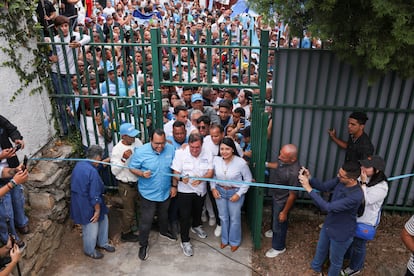
The national headquarters of Vente Venezuela, the party founded by María Corina Machado, was reopened a few days ago in the Altamira neighborhood of Caracas. The event was led by the party’s organizing secretary, Henri Alviarez, who cut the ribbon to formalize the reopening and declared to an enthusiastic crowd: “María Corina will return soon, and we are preparing for elections.” Alviarez is currently on a national tour, rallying the members of his party, which has borne the brunt of the state repression of recent months. According to reports, Vente Venezuela’s machinery is beginning to prepare to face — immediately, if necessary — an electoral contingency.
Delsa Solórzano, leader of Citizens’ Movement, was organizing a national assembly of her party’s leaders that weekend in Miranda state, very close to Caracas. Alfredo Ramos, of Radical Cause, was leading a tour of the city of Barquisimeto, demanding a prompt call for elections. Piero Maroun, organizing secretary of Democratic Action, was participating in an event on Margarita Island welcoming new members. Leaders of Justice First operating in the capital region — Caracas and the states of Miranda and Vargas — met throughout the weekend to agree on a work plan for the coming weeks. Up to 400 members gathered in Petare, a sprawling working-class neighborhood on the far east side of Caracas, where the party has maintained a significant political presence for years.
“People keep asking me if I’m campaigning, if I want to be a candidate,” quipped Freddy Superlano, secretary general of the Popular Will party, who had just been released from prison, at an event in the city of Barinas. “Well, I am campaigning: my candidate is María Corina Machado,” he concluded emphatically, amid cheers from the crowd. After that speech, Superlano toured the outskirts of Barinas accompanied by hundreds of motorcyclists.
Tentatively, gauging the situation, and gradually, the political leaders of the Venezuelan opposition, grouped under the umbrella of the Unitary Platform, are beginning to travel the country to reconnect with their supporters and address the population. Almost all of them had been imprisoned or in hiding for the past 18 months. They are all seeking to reclaim their place in the country’s new political landscape following the U.S. military attack on January 3, in which Nicolás Maduro and his wife, Cilia Flores, were arrested. Efforts are underway to create the conditions that will make the next step possible: the return of Machado to Venezuela to reunite with her followers.
In addition to social issues and economic stagnation, the fundamental demand of these political leaders is the calling of early presidential elections. The rallies being organized prioritize — rather than large mass gatherings — reconnecting with party members, assessing the current situation, and taking stock of morale and resources within each of these political groups. After a period of severe repression, the Chavista regime is ceding space to them and, at least for now, has allowed them to demonstrate.
“Popular Will is fully operational right now,” affirms Adriana Pichardo, the party’s political coordinator, and, along with Superlano, one of the few members of the party leadership not in exile. “We are working intensively, from the parish structures to the regional leadership in each federal entity,” she assures. “We have already visited the states of Carabobo, Lara, Falcón, Zulia, Mérida, Guárico, Aragua, and Barinas. I feel that people are very hopeful, always understanding that everything is a process. More than fear, what persists among the people is institutional distrust due to the lack of guarantees.”
“We have a very well-organized structure that withstood the regime’s siege these past months from underground,” says Delsa Solórzano, speaking about her party, Citizens’ Movement, which had as many as 50 members imprisoned during this time. “Personally, I’m very involved in the agenda of the Unitary Platform, which has had many conversations these past few days with the diplomatic corps, the Catholic Church, academia, and the student movement,” she affirms. “The transition process that everyone is talking about isn’t ready; it has to be built,” she says. “People’s support remains intact. There’s still fear, which is understandable.”
The members of the eight parties in the Unitary Platform typically work together in all these demonstrations, which, although growing in number, still have a relatively limited reach. Organizing mass demonstrations remains a challenge. The government of Delcy Rodríguez has no interest in discussing elections. Neither do the moderate sectors of the tolerated opposition in the country. There is still considerable apprehension among the public regarding the excesses committed by state security forces in recent months. However, most of the leaders consulted are optimistic about what the country may hold in the medium term.
“This is an awakening, a rebirth of the opposition’s party structures,” says Juan Carlos Caldera, a member of the Justice First national leadership. “This makes the everyday seem extraordinary. What I gather from my colleagues in Justice First is a very firm commitment to the cause of democracy. In the Unitary Platform, our ultimate goal — and I believe we will specify it in the coming days — is to bring together all our regional coordinators to present a proposal to the country: to outline a concrete roadmap, a plan with steps and deadlines, to finalize the transition to democracy.”
Sign up for our weekly newsletter to get more English-language news coverage from EL PAÍS USA Edition









































