
The slow death of Jesús, the Mexican man who refused to go to a hospital for fear of ICE
The migrant’s health deteriorated until he became bedridden, but he still refused to see a doctor for fear of being arrested and deported
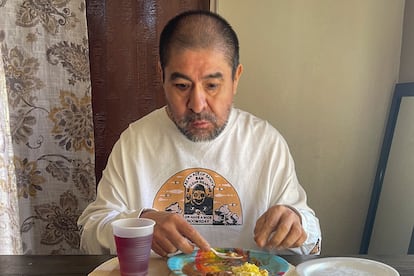
Guadalupe’s strength waned as she sadly watched videos and photos of her husband, Jesús Juárez Cruz. Her cell phone grew heavier in her hand as memories flashed by: a joyful, strong, active Jesús playing with his granddaughter. All of that has vanished. “So many memories came flooding back, and I felt terrible. I felt like I was going to faint,” says this undocumented Mexican migrant, who agreed to tell her story on the condition of anonymity for fear of reprisals from the Trump administration.
Jesús’s body is now in a cold morgue in California, and he will be buried in a few days. Guadalupe maintains that her husband’s death is linked to the harsh immigration policies in the United States. Jesús’s health declined, and he became bedridden at home. He needed his family for even the most basic necessities. Despite these circumstances, he never went to a hospital for fear of being detained and deported by Immigration and Customs Enforcement (ICE). It was too late when his wife and children finally decided they had to take him to a doctor. He died at the end of February. He was 50 years old and left behind four orphans, one of them a minor.
“I told my son, ‘Please take your dad to the doctor.’ Because I could see he wasn’t eating anymore,” Guadalupe recounts, her voice trembling with emotion. “We were afraid that ICE agents would come and take him away.”
Since Trump returned to power last year, reports have surfaced of masked agents entering hospitals and other medical facilities to make arrests, a practice that had been banned for years in these spaces because they were considered sensitive locations, as were schools and courthouses. When the Republican returned to the White House, repealing that policy was one of his first actions. According to migrant advocacy organizations, the change has provoked fear in the community, much like the fear Jesús felt. Organizations representing healthcare workers warn that these operations jeopardize the medical care of undocumented immigrants.
The deterioration of Jesús’ health
Guadalupe speaks with composure throughout most of the interview, despite now being a widow with no job or savings, and having accumulated a $34,000 funeral debt in a matter of hours. The Mexican Consulate in San Bernardino has provided financial assistance to Jesús’ family and arranged for a low-cost funeral home. Even so, dying in California is very expensive, and the Juárez family has turned to the public for help through the GoFundMe platform.
Jesús was young when he left his impoverished hometown of Tungareo, in the Mexican state of Michoacán, to support his family with remittances. In the U.S., he learned every skill in the construction trade. At a regional Mexican music event, he met the love of his life, Guadalupe, also from Michoacán. The couple had four children who are now 16, 21, 26 and 27 years old. She worked cleaning houses and offices.
Everything changed when Jesús began drinking uncontrollably. One morning in 2009, while taking his son to school, a Los Angeles police officer noticed him driving as if he were drunk. Jesús failed the breathalyzer test. His deportation was inevitable. Back in his homeland, depressed about being away from his family, he sank into addiction. He was never the same again, not even when, years later, he crossed the border once more. “He didn’t want to eat, he would lock himself away, and all he wanted to do was drink. He drank nonstop,” Guadalupe laments.
At the height of his alcohol intoxication, Jesús would bang his head against the walls, oblivious to the consequences. Shortly before the Covid pandemic hit, he had already ceased to be a responsible employee. He would get lost on his way to construction sites and wouldn’t understand his boss’ instructions. One day, he simply stayed home. To this day, his family has no diagnosis of what happened to him. They hope the death certificate will shed some light on his condition.
Jesús spent his last days staring at the ceiling. His wife fed him “like he was a baby.” Their 21-year-old son, Joe, took over as his caregiver after graduating from high school. “I helped him bathe, get ready for the day, feed him, and we’d also go outside so he could feel the fresh air and the warmth of the sun… Now it’s something I’ll have to get used to, learn to live without him,” the young man wrote in a text message.
Jesús finally passed away in the early hours of February 21st. There had been plans to take him to a private clinic the day before, but his son arrived late from his second job. Around 5:00 a.m., they discovered that Jesús no longer had vital signs. It was a heartbreaking scene. “I didn’t want to call the police, but my son told me I had to,” recounts Guadalupe, who doesn’t even know who eventually contacted the authorities. At 10:00 a.m., employees from the medical examiner’s office removed the body.
“ICE agents are not welcome in medical centers”
As her husband’s wake and funeral approach, Guadalupe reflects on the questionable actions of ICE, which is following Trump’s plans to deport all undocumented immigrants living in the country. Her husband was on the agency’s blacklist, despite earning an honest living, because he returned after being deported. “If he had received proper medical attention, this wouldn’t have happened,” she says firmly.
ICE did not respond to a series of questions sent by this newspaper regarding Jesús’ case and the presence of its officers in hospitals. Meanwhile, an official at the Mexican Consulate in San Bernardino said he would request authorization from the Ministry of Foreign Affairs to discuss the matter, but did not issue a comment by the time of publication.
Jesús’ concern is not isolated. It is shared by immigrant advocacy organizations and unions representing thousands of healthcare workers. “ICE agents are not welcome in Los Angeles County public medical facilities,” says Mike Long, spokesperson for Local 721 of the Service Employees International Union (SEIU), which represents more than 100,000 employees of hospitals, clinics, and mental health facilities in Southern California. “Immigration status should not prevent anyone from receiving the medical care they need.”
When Trump’s deportation machine had its sights set on Los Angeles in the summer of 2025, immigration officers raided medical facilities. The California Nurses Association denounced the fact that ICE agents had arrived at Glendale Memorial Hospital, northeast of Los Angeles, to arrest a patient and remove him “apparently against the recommendation” of a doctor. The organization warned that this action set an “extremely dangerous” precedent and stated that it was “absolutely unacceptable and violates ethical and medical care standards not only for this patient, but for public health.”
The situation escalated into legal proceedings in July 2025, when masked ICE agents wearing bulletproof vests stormed the Ontario Advanced Surgical Center, east of L.A. They were after one of three gardeners who were outside the facility. Two hospital workers tried to stop the operation by demanding the officers show their identification, as seen in a video that went viral. “Take your hands off him. You don’t even have a warrant,” an enraged Danielle Avila, a member of the hospital staff, said as she stepped between her colleague Jose Ortega and one of the officers. Avila and Ortega now face charges of assaulting a federal agent and conspiring to interfere with a law enforcement operation, crimes that carry sentences of up to 14 years in prison, the Central District of California Department of Justice reported.
Los Angeles U.S. Attorney Bill Essayli clarified that the incident involved not a patient, but an undocumented Honduran man who ran toward the hospital fleeing ICE. “This story is yet another example of the media’s false narrative pushing an agenda that delegitimizes federal agents,” the official said in a statement.
The extent of the problem is currently unknown. Medical personnel continue to document these types of incidents, which are not limited to California. In January, immigration agents entered a Minneapolis hospital, handcuffed a patient “at high medical risk” to his bed, and remained with him for more than 24 hours, according to Democratic Congresswoman Aisha Gomez and the group Unidos MN, as reported by CBS News.
Guadalupe, the wife of the deceased Jesús Juárez Cruz, identifies with the pain of the families of the more than 40 people, including 14 Mexicans, who have died in ICE custody since Trump arrived at the White House, a cold figure that portrays the consequences of his anti-immigrant policies.
The widow faces an uncertain future. She cannot return to the Michoacán village where she was born 45 years ago because her family left after her father disappeared 15 years ago. Armed men took him, and they never heard from him again. Guadalupe says that this pain prepared her for the one she faces now. “There’s no going back. Now I say, ‘I should have taken my husband to the hospital.’ But I can’t turn back time.”
Sign up for our weekly newsletter to get more English-language news coverage from EL PAÍS USA Edition









































