
The ‘victims’ left in Kristi Noem’s wake: ‘The damage is done. To me, to the Americans who have been murdered, to the migrants’
People who were injured, arrested, or deported by the former US Secretary of Homeland Security are celebrating her departure

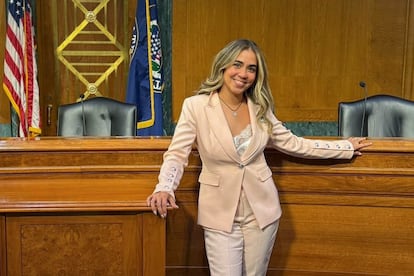
In a few hours, Arianne Betancourt will face one of the people responsible for her father being locked up in Florida’s Alligator Alcatraz migrant detention center. It’s the afternoon of March 2, and she is boarding an American Airlines flight in Miami. Later, she touches down in Washington, leaves the airport and heads to the mall in Pentagon City, where she locates the Macy’s. She looks for clothes that “stand out.” She doesn’t want to go “dressed in mourning clothes.” “If they drag me out, I want people to know that it was me that they removed, because I couldn’t stay silent.” She chooses a pink jacket and pair of pants, pays for the set and goes to her hotel. She is almost ready to look into the eyes of Kristi Noem, who is still the U.S. Secretary of Homeland Security. Noem is set to appear the following day at a hearing before the Senate Judiciary Committee. It will ultimately lead to Noem’s dismissal.
Around 8 a.m. on March 3, 33-year-old Betancourt lines up to enter the Dirksen Senate Office Building, located next to the U.S. Capitol. Noem still has not gotten to the room where the hearing will take place, but it is already full of people, among them, members of the group Angel Families, formed by family members of people who have died from crimes committed by undocumented immigrants. Some hold up photos of their grandchildren, nieces, and nephews. Others wear hats that read “MAGA moms.” They are in the front row, where Betancourt and other family members of migrants have also been directed to sit. Betancourt is joined by a young woman whose sick boyfriend has been held at the Krome detention center in Miami for months; the son of another man in the hands of immigration agents; a young person who was the victim of a beating by immigration authorities; and Marimar Martínez, the Chicago woman who survived being shot five times by Border Patrol agents last year.
The members of Angel Families are beginning to get impatient. They don’t want any migrants to sit by them. They say they are victims of people like them. The migrants retort that they are also victims. Suddenly, it becomes clear that there are two opposing factions in the room, the same ones who have been facing off for the last year around the country. Officials decide to relocate the family members of immigrants further back, to the third row. Betancourt asks one why they are the only ones being moved. “Don’t talk to me,” responds the man.
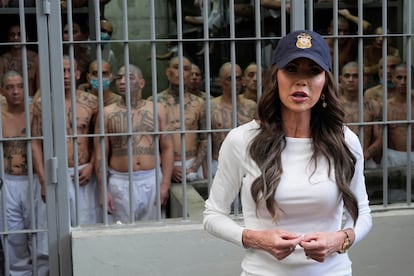
Noem, who is 54 years old, enters the room at 9 a.m. “She looked stretched-out, made-up, with an enormous emerald ring on one hand and one made of diamonds on the other,” remembers Betancourt. Throughout the year that Noem led the Department of Homeland Security, tasked with carrying out Donald Trump’s harsh immigration agenda, she was known for her attention-getting and symbolic looks: the bulletproof vest she wore on occasions, the luxurious $50,000 Rolex she sported on her left wrist during a visit to the Terrorism Confinement Center (Cecot) in El Salvador, the mega-prison to which the U.S. government deported over 250 migrants last year, despite a judge’s orders.
Ángel Blanco Marín, a 23-year-old Venezuelan musician, was locked up in cell No. 32 on March 26 when he witnessed the DHS secretary’s entry into the maximum-security prison. She was “a little arrogant, with a condescending look,” he says by telephone from his town, located 20 minutes from Caracas, where he arrived as a deportee after his time in El Salvador.
Before the official could visit the penitentiary center, inmates were given deodorant and clean sheets, and ordered to tidy their cells. “They told us to make everything pretty, no one could go to the bathroom,” Blanco Marín says. “She came in, went on a mini-tour through half of the prison and stopped at cell No. 31 to pose for a photo.” That was for the image in which Noem appears in a navy blue baseball hat, white shirt, and tight pants, in front of a background of shirtless and tattooed men.
Blanco Marín says that the inmates began to shout all kinds of “swear words” at her, and demand that they be set free. “They removed her in a hurry,” he says. The Venezuelan, who now makes his living as a food delivery worker in his birth country, has not forgotten Noem’s face. “The damage is done. To me, to the Americans who have been brutally murdered, to the migrants. And nothing happened, everything is the same.”
Noem has worn other controversial outfits during her time at the DHS, among them a Coast Guard uniform, as well as the one she had on to record a message while on horseback, part of a $200 million publicity campaign that, among other things, wound up costing her Cabinet position. In one of its multi-million-dollar ads — which, according to Noem, had been approved by the president, contrary to the White House’s account — the official warned: “You cross the border illegally, we will find you.” She delivered the words wearing chaps, with a cowboy hat and boots.
Noem has always had an affinity for Western footwear, ever since her childhood on her family’s ranch in Watertown, South Dakota. She wore them when she was governor of that state, a period during which she won Trump’s affection for her fervent MAGA militancy.
But on that Tuesday at the beginning of March inside the Dirksen Building, Noem came dressed in an impeccably tailored brown suit. A man shouts at her that she’s committing crimes against humanity, and the members of Angel Families jump to her defense. Then the voice of a woman in a pink suit rings out: “I stand with immigrants,” she says, her assertion rising above the collective din. It is Betancourt.
“I shouted it with all the power of my soul,” she recalls of that day. “I felt disgusted to see her, I felt shame.”
Five months ago, everything changed in Betancourt’s life. U.S. Immigration and Customs Enforcement (ICE) detained her 54-year-old Cuban father Justo Betancourt. Amid the anguish, she suffered the miscarriage of her son. She cries almost every day. The day she began to protest at public demonstrations and vigils to demand her father’s freedom, her boyfriend left her, her aunt kicked her out of the house, and several friends and a cousin cut off contact. “They say I lost my head, that I’m crazy,” she says. “But I’m not only doing this for my father, but for many people.”
“What is happening is shameful”
At that March 3 hearing, Noem came to settle a score. The official leading a department that was created just over two decades ago, which now controls 22 federal agencies and has a budget of more than $100 billion, had to respond to questions from senators of both parties as to the many controversies that had followed Noem over recent months. These included the alleged extramarital affair she had with one of Trump’s former advisors, in addition to her implementation of the government’s immigration policy.
In the hearing room, very close to Betancourt, sat Marimar Martínez, the 30-year-old U.S. teacher who was shot by a Border Patrol agent on October 4, 2025 in Chicago. The incident left her with nerve damage in her right hand. At one point, Senator Richard Blumenthal asked Noem to recognize the error that had been committed by the agents connected to the shooting of Martínez. “Sir, I don’t know the situation or the case,” Noem responded. During his turn, Senator Dick Durbin asked about the deaths of Renee Good and Alex Pretti, two U.S. citizens who died after being shot by immigration agents deployed in Minneapolis, and who Noem called “domestic terrorists.”

“Do you retract these statements identifying these individuals as domestic terrorists?” Durbin asked. “We were working in those situations where there is a tragic loss of life and there is something that our agents were involved in,” responded the official before Durbin interrupted: “Is it so hard to say you were wrong?”
Noem evaded the question. She preferred to ignore the incident that marked the beginning of her collapse as DHS head.
Betancourt left the hearing “disappointed.” “What is happening, and the fact that woman can continue lying, is shameful. The proof is there, the families are there, the dead are there.”
“I am a victim of the DHS”
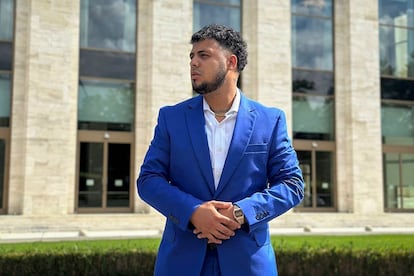
From the cheaply made, one-room home of metal sheets where he now lives in southeastern Mexico’s Villahermosa, Cuban Rafael Crespo, who was deported on January 26, 2026 after living in the United States for more than 30 years, says bluntly: “I am a victim of the DHS. I was abused by the American government.”
It is still painful to walk, due to the spinal fractures he suffered while in federal custody. He was detained on October 29 of last year in Florida. By around 9 p.m., none of the more than 80 detained migrants in the center where Crespo found himself had eaten. They were agitated: they called to the guards, but none paid attention. Some of them began to kick the door to the prison. The first thing that officials at the North Florida Detention Center did was cut off their water. Then they began to spray gas from the ceiling. At a certain point, people began to cough. They could barely breathe. The desperate men’s situation became a hornet’s nest. “It was gas to suffocate us, people were running back and forth, the door was locked,” says 55-year-old Crespo. “I couldn’t breathe through my nose or mouth. They were suffocating us. I felt like I was going to die.”
People began to vomit. Others fainted. Crespo, trying to breathe through a window above a bunk bed, fell to the floor, landing on his back. Later, they were taken out of their cell, doused with water and punished by not being allowed to bathe or make phone calls for a week. Three days later, Crespo fainted, and he was found to have a hernia on his stomach from so much coughing. He still has the report from the hospital that testifies to the fact that he suffered a fracture to the spine in his fall, and that he had blood in his liver. The same documents show that prison officials denied him medical care.
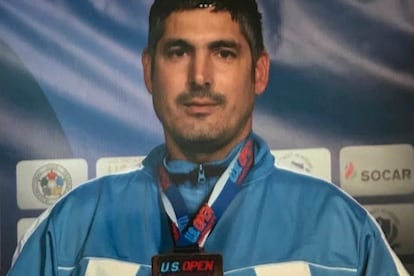
“They’re going to pay for everything they did to me. Someone has to do something,” says Crespo. “They violated my civil rights and detainee rights. I came there OK and left in bad shape. Injured, deported — I lost everything.”
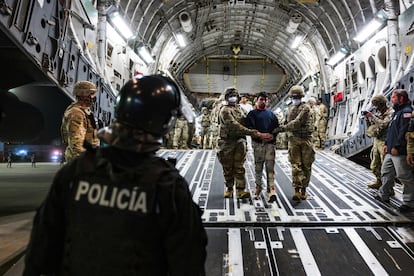
The tally Noem leaves behind after a year at the head of the DHS is far from insignificant: more than 20 people dead in ICE custody and more than 70,000 imprisoned in detention centers throughout the country, where many have denounced a lack of medical care, discrimination against people from the LGBTQ+ community, and scarce access to lawyers. There are at least 4,000 children who have been detained and some 700,000 individuals who have been deported, the majority of them lacking any criminal record. Many who legally entered the country now live in a migratory limbo, their visas revoked and processes suspended.
For Ernesto Castañeda, American University professor and director of the school’s Center for Latin American and Latino Studies and Immigration Lab, this footprint is significant. “Much of the Latino community in the United States is terrified, depressed and imprisoned, in either detention centers or their apartments and houses. Some have preferred to leave the country; many have decided they don’t want to come here, even with papers. The psychological, moral, and economic damage will take decades to repair.”
The firing
On March 5, two days after Noem’s Senate hearing, Donald Trump announced the official would be replaced as Secretary of Homeland Security on March 31, and that she would become Special Envoy for the Shield of the Americas. The night after that announcement, a group of mothers, spouses and children, who get together every day to pray for their family members in detention centers, enthusiastically received word of Noem’s demotion. “I had a beer and a shot of Bacardi and celebrated in style,” said one of the women. “She was corrupt. It doesn’t matter if she had a lover or not, she was corrupt,” said another.
Then on March 31, news broke that Noem’s husband had been posting photos of himself cross-dressing online. The leak took place on International Transgender Day of Visibility, a date the White House marked with a press statement celebrating its “swift and unrelenting dismantling of subversive, woke policies that endangered children,” including the ending of federal funds for gender-affirming health care for trans youth. Noem stated she was “devastated” by the bombshell.
Some have seen Noem’s fall from grace as a sign of hope, with others regarding it as yet another political maneuver. “In my opinion, what they did is a publicity trick: they changed her position because they were losing the vote. I myself voted for Trump and have been extremely disappointed,” said one of the members of the group of migrant families.

José Andrés Bordones Molina was at his parents’ home in Maracaibo, Venezuela when he heard about Noem’s firing. First, he thought it wasn’t true. Then, he didn’t assign it much importance. The damage is in his body, like a souvenir. His left arm still has the scars from the two bullet wounds he received from a U.S. citizen when he was detained on September 24, 2025, by ICE.
“Every time I see my arm, I remember that day. When I look in the mirror, or when I see the news, even though it’s not about me, I remember what I experienced, what I lived through,” says Bordones.
It wasn’t yet 7 a.m., and immigration authorities had him and nine other migrants detained and handcuffed, in a truck outside an immigration office in Dallas. Joshua Jan, a 29-year-old U.S. citizen, began to shoot at them, before fatally turning his gun on himself. “When he stopped shooting, we were able to get out of the truck and go into the building,” remembers Bordones.
He had been shot twice in the arm, and another bullet grazed his head. Two of his peers did not survive the attack. Norlan Guzmán Fuentes, a 37-year-old Salvadoran, died at the scene. “It was intense, I saw how he wasn’t reacting, he was in agony; the agents didn’t know what to do,” says Bordones. Miguel Ángel García Hernández, a 32-year-old Mexican, died two days later in hospital.
“He said to me, ‘Why did this happen to me? I’ve never done anything to anyone,” says Bordones. “I’m a victim, because ICE should have been protecting us.”
After two days in the hospital, Bordones was taken to a detention center and deported to his birth country on January 28, 2026. Currently, his attorney is trying to apply for his U visa, which was created to protect victims of certain crimes who have suffered physical or mental abuse. He wants to return to the United States to fulfill, he says, “the goal” with which he arrived two years ago. “I would like to go back, to work, to buy myself a little house,” he says. “I want to leave something to my children.”
Translated by Caitlin Donohue
Sign up for our weekly newsletter to get more English-language news coverage from EL PAÍS USA Edition









































