
From charming toys to unsettling creatures on a catwalk: When did robots start to scare us?
The presence of androids in a show organized by ‘Vogue’ in Milan has once again revived the eternal debate: what is our real relationship with cyborgs that resemble us?
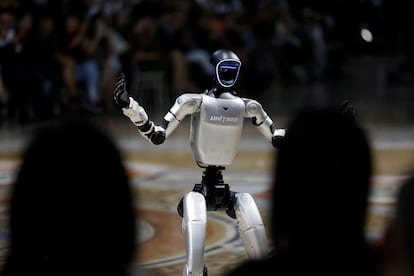

Yumi Nu is one of the world’s most sought-after models. An American citizen of Dutch and Japanese descent, and the niece of DJ Steve Aoki, she has appeared on the cover of Sports Illustrated and walked for L’Oréal and Victoria’s Secret. On September 22, at Vogue World in Milan, Nu shared the runway with a group of inexperienced intruders: four humanoid robots built by the Chinese company Unitree Robotics.
The mechanical brutes were the highlight of a special segment called The Age of Intelligence, with which Vogue set out to celebrate the embrace of technology by an industry accustomed to preserving its traditions. Yumi Nu and the other two elite human models who took part in the show, Ruth Deng and Alex Consani, watched their new competitors with resigned curiosity. After all, if artificial intelligence is going to replace three out of four flesh-and-blood workers in the next decade, why would fashion models be an exception?
Juan Costa Paz, Vogue’s creative director, wrote in a later piece for the magazine that parading a quartet of androids down the catwalk of the historic Galleria Vittorio Emanuele II was not merely a disruptive prank. “Robots are here to stay,” Costa said. If they still seem clumsy, ugly and unsuited to a runway, it’s because we are at the dawn of the robotic revolution. “They’re still very clunky, like how the first cellphones were suitcase-sized, but the robots are meant to be an inflection point in human history,” Costa added: “It’s fun to watch them. Although, at the same time, it’s like confronting something terrifying: AI is here to stay, robots are here to stay.”
Do androids dream of mechanical runways?
Not everyone shares the enthusiasm of Anna Wintour’s current right-hand man. In his Washington Post column, Shane O’Neill lambasted the “stupid, ugly robots” that barged into a high-level celebration and turned it into a sad charade. He was particularly horrified by the clapping and absurd dances the androids performed to liven up the audience and by the “odd cameo” of a robot dog that thus became not only one of the first professional robotic models but perhaps the first four-legged one.
The magazine TechCrunch highlights the very adverse reaction of Alessandro Michele, Valentino’s creative director, who seemed to take the stunt as a personal affront, and questioned why the androids walked “naked” (albeit without genitalia they don’t need) if the aim was to demonstrate their capacity to showcase clothing.
D’Scene adds to the debate that we already knew modern robots can “walk, gesture and move their hands.” The only novelty is that we now know they can also move their feet to the rhythm of Gigi D’Agostino’s L’amour toujours. It notes that Boston Dynamics’ robots already showed, a couple of years ago in a Coperni show, that they have basic skills that can be very useful on a catwalk, such as “putting on and taking off a jacket,” skills that Unitree Robotics’ models apparently lack. More than an evolutionary leap promising a splendid future for the cyber-mannequins, what happened in Milan was a step back into the caves.
Aiyana Ishmael, in Cosmopolitan, adopted an ironic tone. In her view, Milan’s show of “the children of ChatGPT” did not go entirely well. Although presented as heralds of the age of intelligence, the nude robots proved to be rather “silly.” Finally, CyberNews highlights how the world’s top designers reacted to Vogue’s stunt. Pierpaolo Piccioli gave a polite but awkward smile. Donatella Versace hesitated for a moment but eventually applauded. Miuccia Prada put on her best aristocratic look of indifference.
What have the androids done for us?
It’s clear that robots are no longer amusing to everyone. As we grow accustomed to encountering them and as they infiltrate more and more spheres once reserved for humans, the rejection they provoke increases — and yet they have never been so useful.
If we are willing to allow it, this new generation of androids is capable of running our factories like a quantum clock, guarding our homes, performing surgery, feeding us, driving our vehicles with astonishing precision, caring for (and educating) our children, painting a picture, or writing us a poem.
Perhaps, step by step, together with other machines endowed with some kind of intelligence, they are approaching the theoretical threshold of the singularity — the moment they begin to develop a firm consciousness and their own agenda, realize we are in their way, and decide to destroy us. But that possibility has been present for decades; science fiction warned us of impending disaster as early as the late 19th century, and yet real androids (hypothetical ones are another matter) didn’t necessarily make us dislike them.
On the contrary, our ancestors found the first automatons charming, even when they were frauds like The Mechanical Turk, a supposed mechanical chess player with an elegant turban that in reality concealed a human chess player inside. The myth of the good robot, as cultural anthropologist Giles Crouch explains, has accompanied us for centuries and survived tests such as the emergence, in the 20th century, of evil robots in literature and film. For every HAL 9000, the most polite and intelligent serial killer in history, there was a WALL-E, a GORT (from The Day the Earth Stood Still) or a robotic butler like the one in Woody Allen’s Sleeper — so clumsy, so inefficient, so delightfully human.
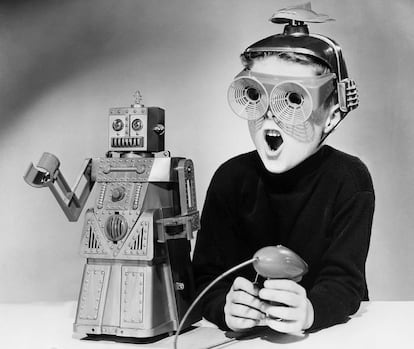
But the trend seems to be shifting. Gone are the years when we named our Roombas and dressed them in knitted sweaters as if they were clever poodles rather than gadgets that merely move dust around. As early as 2017, the journalist Sherry Turkle reported that a new line of “sensitive and empathetic” toy robots (Jibo and Cozmo were the most famous) was failing spectacularly with American children despite offering intelligent conversation and showing an interest in their problems.

Children found it distressing to talk to a creature that moved back and forth and looked at them with lamb-like eyes. For conversation, they already had Alexa or Siri. You expect a robot with arms and legs to be able to play games that involve destroying things, not to have it psychoanalyze you or pretend your feelings matter. Turkle ended her article with advice to parents in that pre-pandemic, carefree society of nine years ago: “Don’t accustom your children to the idea that robots are their friends.” They already have dogs and stuffed animals for that. Or other children.
Another example: in 2022 the Mutua Madrid Open became the first Spanish tennis tournament to use robots as security guards. Yellow, an elegant AI device with a vaguely canine appearance, patrolled the courts throughout the tournament, helping its human supervisors detect incidents and potential threats.
Some attendees said its presence intimidated them — they thought it might harm them. It’s curious, because almost no one distrusts the Argentine mastiffs or German shepherds used as security aides at other tournaments. They wear muzzles, we assume they are well-trained, and a human holds their leash. But an Argentine mastiff does have willpower, can get nervous, responds to stimuli, and can react unpredictably. Robots do not. True to their name (derived from the Czech word robota, meaning slave), they lack true will and do strictly what we order. Yet it is they who frighten us.
Perhaps the watershed moment came when we realized that, rather than destroying us in the medium term, what androids are likely to do tomorrow or the day after is ally with their cousins, the computers, and leave us unemployed. Transhumanism (any evolutionary horizon that leads to some form of human-machine synthesis) seems a poor consolation. We want to remain carbon creatures, as the robots in Alien called us. And it irritates us that the only reasonable alternatives emerging from technological forecasts seem to be that robots will transform us or replace us.
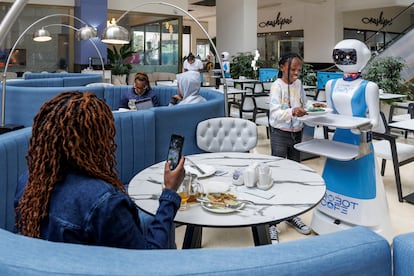
Although another explanation is possible. As the D’Scene article cited above suggests, the modern antipathy toward androids may be aesthetic, technological and practical. In an era that talks so much about AI’s transformative potential, how can humanoid robotics still be so precarious, so unaesthetic, so shabby, despite the undeniable progress of some pioneering firms? Why, in automated Japanese restaurants in Madrid or Barcelona, are the tray robots that bring you sushi still metal drawer-like contraptions that stumble over tables and bump into customers? “Are those dreadful clanking robots that clap and dance the future of our industry?” Miuccia Prada and Alessandro Michele must have wondered. “Are those tin monstrosities going to put me out of work?” Yumi Nu must have thought. Maybe the androids of 2026 (at least Anna Wintour’s) are not what they were or what they have long promised to be. That’s why they freeze our smiles and why, for now, we don’t want to see them walk our runways.
Sign up for our weekly newsletter to get more English-language news coverage from EL PAÍS USA Edition









































